Oil opened near $73.36, jumped almost 9% on Monday, and kept climbing toward a weekly high around $81.85. By Friday’s close, WTI sat roughly 11% higher, outperforming stocks, gold, bitcoin, and the U.S. dollar.
Geopolitical tension alone didn’t drive that move.
Military threats, diplomatic warnings, sanctions, and political posturing hit oil markets all the time. The headlines can spike prices for a session or two, then the risk premium fades once traders decide oil is still flowing normally.
This week, traders started pricing a direct threat to how oil actually gets shipped.
Why Did WTI Crude Oil Rally This Week?
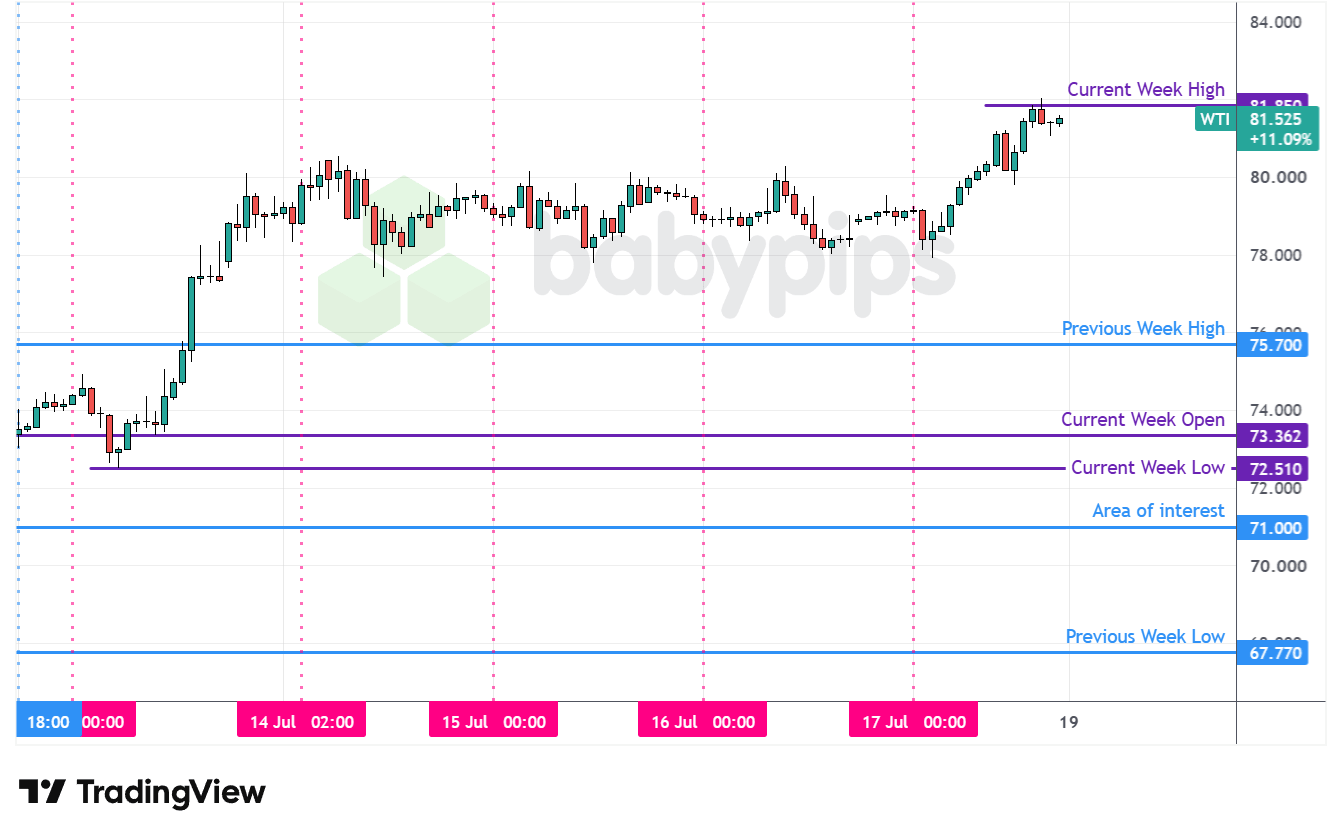
WTI Crude Oil – Chart Faster With TradingView
The rally began after Iran launched drone strikes on Oman and U.S. forces struck Iranian military targets. The conflict spread through the week, and each new threat to the Strait of Hormuz, one of the world’s most important energy routes, raised fresh concerns about oil shipments.
Those concerns intensified Monday after U.S. President Donald Trump announced a proposed 20% “guardian” fee on Strait of Hormuz shipping and reinstated a blockade on Iranian vessels.
WTI crude oil finished the session up close to 9% as traders added a supply-risk premium.
Trump later shelved the proposed fee, but oil didn’t give back the rally. Buyers kept supporting prices as military strikes continued and shipping concerns stayed unresolved.
Holding that gain sent its own signal: traders expected the disruption to last.
Why the Strait of Hormuz Matters to Oil Prices
The Strait of Hormuz is a narrow waterway connecting the Persian Gulf with the Gulf of Oman and the Arabian Sea. It’s a critical route for oil and liquefied natural gas shipments from major Middle Eastern producers.
If traders think tanker traffic through the strait could face delays, restrictions, or interruptions, they start pricing in less energy reaching global buyers, even without a full shutdown.
Higher insurance costs, shipping delays, vessel diversions, military inspections, or reduced tanker traffic all raise the cost and difficulty of moving energy through the region.
That’s why oil can rise before official data show an actual shortage. Futures markets price the risk of what might happen next.
What It Takes to Sustain an Oil Rally
Not every geopolitical headline deserves the same market reaction.
A threatening statement from a government official can spike oil for a session. But traders need real evidence before they’ll hold a geopolitical premium for days.
Ask whether the event could change:
- Oil production
- Export capacity
- Pipeline operations
- Port activity
- Tanker traffic
- Shipping and insurance costs
Traders saw more than aggressive language this week.
The strike-and-counterstrike sequence continued, the conflict widened, and tanker traffic through the region stayed a concern. Together, that made the threat to oil transport harder for traders to dismiss.
The rally held because traders priced in a real threat to physical oil supply, not a scary headline.
Promoted: Is Your Small Account Holding Your Strategy Back?
Trading $100 isn’t the same as trading $100k. Emotional discipline & trading flexibility is easier when you have the right backing. FTMO is a global prop firm with a 4.8★ rating on 40K+ reviews, serving traders since 2015! No time limits. Free trials. Up to $200K in Demo Capital.
Start a free trial with FTMO!
Disclosure: To help support our content, we may earn a commission from our partners if you sign up through our links, at no extra cost to you.
Why Oil Held Steady After the Shipping Fee Was Shelved
Traders could have used the shelved fee as an excuse for a much bigger selloff.
But the fee was only one factor among several.
Traders were also watching the ongoing military campaign, the blockade on Iranian vessels, thin tanker traffic, and the chance the conflict could widen or drag on longer than expected.
Traders shrugged off several developments that would normally spark profit-taking:
- The withdrawal of the proposed Hormuz shipping fee
- Iran’s release of a detained American
- Periods of U.S. dollar strength
- A sharp technology-led equity selloff
- Broader concerns about global risk appetite
Even with those headwinds, traders kept buying, and WTI climbed to about $81.85 by Friday.
U.S. Oil Inventories Provided Additional Support
Geopolitics dominated the week, but U.S. inventory data helped stabilize oil prices too.
WTI weakened Wednesday as some traders took profits, then rebounded after the U.S. Energy Information Administration reported an unexpected drop in crude inventories.
An inventory draw means the amount of crude in storage fell during the reporting period.
Inventory figures can be noisy week to week, but an unexpected draw can convince traders that available supply is tighter than they expected.
The inventory report didn’t start the rally. It gave an already-nervous market more reason to stay bid.
Why Oil Rose Even as Stocks Fell
Oil and equities tend to move together when traders are focused on economic growth.
In a typical growth scare, stocks fall on expectations of weaker corporate earnings, while oil falls because traders expect businesses and consumers to use less fuel.
This week broke that pattern.
Renewed worries about AI competition and spending pressured U.S. equities. Oil kept responding to the risk of interrupted Middle East supply.
Because the catalysts differed, WTI rose even as the broader stock market fell. The move signaled rising risk to oil supply, not improving growth expectations.
How the Oil Rally Affected Other Markets
A sustained oil rally can ripple far beyond energy prices.
Inflation expectations
Higher oil prices can raise transportation, manufacturing, and distribution costs. If the rally lasts, investors may worry that energy inflation slows progress toward central-bank targets.
Oil-sensitive currencies
Currencies tied to major energy exporters can benefit when oil rises, though the relationship isn’t automatic. The oil rally lifted the Canadian dollar this week, even as traders weighed a cautious Bank of Canada outlook.
Consumer spending
Higher fuel prices can leave households with less to spend elsewhere, a drag on consumer activity if the rally holds.
Corporate profit margins
Airlines, shippers, manufacturers, and other energy-intensive businesses can face higher costs when crude and fuel prices climb.
Safe-haven demand
A worsening conflict can support defensive assets like the U.S. dollar or gold. But that relationship depends on interest rates, positioning, and each asset’s own competing drivers.
Promoted: Scale Your Strategies
As persistent inflation and shifting central bank policies whipsaw traders, navigating the current macro landscape requires more than just a good entry. It requires a partner that has seen it all before.While new firms come and go with the volatility, The5ers (4.7★ rating on 32K+ reviews) has spent the last 10 years perfecting a funding model that works for the trader. It’s why over 1.6 million traders worldwide trust them to provide the capital and scaling needed to turn market analysis into meaningful professional growth.
Learn more about The5ers & available discounts
Disclosure: We may earn a commission from our partners if you sign up through our links, at no extra cost to you.
What Oil Traders Can Learn From This Week
Measure geopolitical risk by whether it threatens oil’s actual production, transportation, or availability, not by how dramatic the headline sounds.
Announcements, threats, and diplomatic warnings can shake markets. But a rally that holds usually means traders believe physical supply is actually at risk.
The premium lasted this week because traders saw a concrete threat to regional shipping and energy flows.
That doesn’t mean oil keeps rising.
Geopolitical premiums can disappear fast when:
- Shipping activity normalizes
- Military operations slow
- Diplomatic negotiations improve
- Export volumes remain stable
- Producers compensate for disrupted supply
- Weak demand starts to outweigh supply fears
A scary headline can spark a spike. Only evidence of real physical disruption sustains one.
What Could Move WTI Crude Oil Next?
Traders will likely keep watching the balance between physical disruption and diplomatic de-escalation.
Key factors:
- Whether tanker traffic through the Strait of Hormuz stays restricted
- Whether the strike-and-counterstrike sequence continues
- Whether more countries get pulled in
- Whether producers change output or export plans
- Whether shipping and insurance costs keep rising
- Whether U.S. crude inventories keep falling
- Whether higher prices start weakening demand
- Whether diplomatic progress lowers the regional risk premium
As long as the physical supply threat stays credible, geopolitical developments may matter more to crude oil than routine economic data.
If shipping conditions improve and exports continue without real disruption, some of this week’s risk premium could unwind fast.
What BabyPips Premium Members Received
Before the week began, BabyPips Premium members got a structured oil outlook covering two possible paths:
- A scenario where the conflict stayed mostly verbal and the oil premium faded
- A scenario where physical shipping disruption intensified and the premium kept building
The full Premium recap reviews:
- The original oil scenario published before Monday’s open
- The price level that confirmed the supply-disruption branch
- The invalidation point that would have weakened the bullish case
- The projected upside path reached during the week
- What the framework got right
- What could have been handled better
- How this week changed the framework for evaluating future geopolitical headlines
Oil didn’t climb 11% just because the headlines were scary. It climbed because traders believed the conflict could disrupt the physical flow of global energy supplies.
Read the complete Premium scenario scorecard, original WTI levels, and framework review.
This content is for educational purposes only and does not constitute financial or trading advice. Market conditions can change quickly, and all market analysis represents probabilities rather than certainties. Past performance is not indicative of future results. Always conduct your own research and consider your financial circumstances before making investment or trading decisions.