

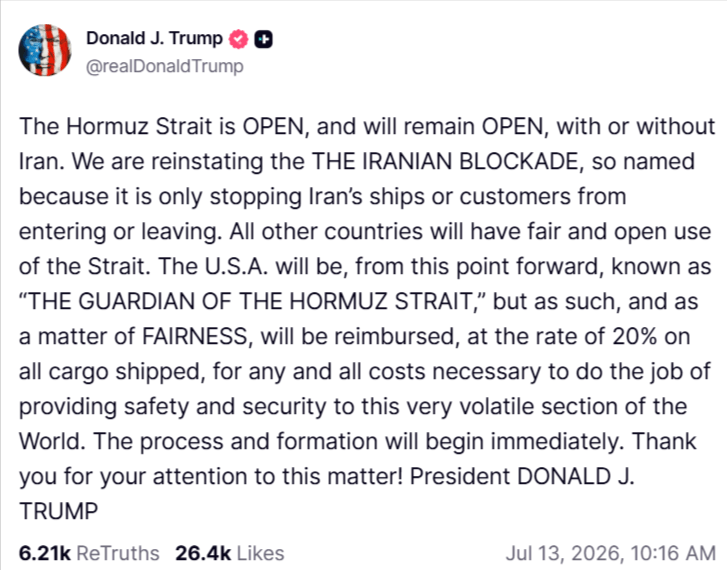
Trump just declared the U.S. the Strait of Hormuz’s “guardian,” for which there will be a 20% fee for the privilege. Oil jumped 5-6% on the news. Stock markets tumbled. But here’s the catch: the whole thing looks more like theater than policy. The June ceasefire is officially dead. Shipping traffic through the world’s most critical oil chokepoint is down significantly. And will anybody actually agreed to pay Trump’s toll?
Hormuz Gets a Makeover: Key Takeaways
- 20% “guardian” fee: Trump posted on Truth Social that the U.S. will charge all non-Iranian cargo a reimbursement fee of 20%. Starting now.
- Iranian blockade is back: U.S. Navy will block Iranian ships and entities from Hormuz entirely. Everyone else gets “fair and open access” (theoretically).
- Oil traders woke up to $80 Brent: Crude rose 4.7% to $80/barrel within hours. WTI crossed $75.
- Stocks got hit: S&P 500 down 0.6%, Nasdaq down 1.3%. Risk-off mode activated.
- Ships are ghosting the strait: Vessel traffic down 52% week-on-week. Captains aren’t taking chances.
- June’s ceasefire is officially kaput: Trump said it last week. Today’s announcement proves it. The deal is done.
So What’s This “Guardian” Thing All About?
Monday morning, Trump went on Fox News and said the U.S. should “get paid” for keeping Hormuz open. By midday, he’d posted the official announcement: America is now the strait’s “GUARDIAN,” and everyone shipping cargo through will cough up 20% of the value as reimbursement. The process starts immediately. Meanwhile, Iran’s ships? Blocked. Everything else flows through freely. Assuming the U.S. doesn’t change its mind tomorrow.
This isn’t the first time America offered security to vessels in the Persian Gulf. In the 1980s, the U.S. Navy escorted Kuwaiti tankers during Iran’s attacks. But back then, nobody charged a fee. Today, Trump’s making it explicit: protection costs money.
Why Oil Traders Got Jumpy
The Strait of Hormuz channels about 20% of the world’s oil. That’s not a number traders ignore. When you announce you’re blockading half of it and charging a mystery fee on the other half, energy markets react instantly. Oil jumped because traders know two things: (1) supply just got riskier, and (2) the June ceasefire is officially dead. The blockade is back. Shipping companies that thought Hormuz was stabilizing just found out they were wrong.
The real kicker? Nobody actually knows how Trump plans to collect this fee. Twenty percent of what exactly: cargo value? Weight? And shipping firms already told Iran “no thanks” when Tehran floated similar ideas. International law says straits should stay toll-free.
The Ceasefire That Never Really Was
Less than four weeks ago, the U.S. and Iran signed a 60-day interim deal on June 17. It was supposed to let oil flow again. Instead, both sides immediately disagreed on which shipping route was legal. Iran wanted northbound traffic through its territorial waters. The U.S. pushed ships south, through Omani waters. When captains used the southern route, Iran attacked them. When ships got hit, the U.S. launched airstrikes. Repeat. By July 7, Trump called it quits. Monday’s announcement just makes it official: the deal is dead, and the blockade is back.
What This Means for the Markets
Energy traders see immediate volatility spikes. Oil is a buy-and-hold risk trade right now. Every day brings new headlines. Currency traders need to think bigger. Higher oil prices historically strengthen commodity exporters (the loonie, Aussie dollar, Norwegian krone) while hitting importers hard (Japan, UK, many emerging markets). But geopolitical fear also triggers safe-haven flows: dollar, Swiss franc, yen all tend to rise when conflict escalates. Watch those crosses closely. USD/JPY and USD/CHF are your early warning systems for “risk-off” moves.
The real tail risk is stagflation: inflation stays high, growth slows, and central banks get trapped between two bad options. That’s the scenario that theoretically kills risk assets and tends to reward defensive positioning.
The 20% Question: Can Trump Actually Pull This Off?
Short answer: unlikely. Long answer: watch what happens when the first major shipping company refuses to pay and sails through anyway. International law is pretty clear on freedom of navigation. Major carriers have already said no to Iran’s toll ideas. Enforcing collection without triggering a full diplomatic crisis would be nearly impossible. And if the fee actually sticks? It gets priced into every import and export that flows through the strait, which means higher costs for consumers everywhere. That feeds inflation. Central banks hate that. So do voters.
This announcement looks more like a show of force than a workable policy. But markets don’t wait for policy details. They react to headlines. And this headline says: the Strait of Hormuz is less safe, oil stays expensive, and geopolitical risk is back on the table.
Promoted: Geopolitical shocks move faster than most traders can react.
When Trump announced the Hormuz blockade and 20% fee, oil jumped 5% and stocks fell 1%+ in minutes. The traders who stayed calm weren’t guessing. They had a tested plan. FTMO is a global prop firm (4.8★ rating on 40K+ reviews) with no time limits on challenges, so you can hold positions through volatile geopolitical events without artificial time pressure. Free trials. Demo capital up to $200K.
Start a free trial with FTMO!
Disclosure: We may earn a commission from our partners if you sign up through our links, at no extra cost to you.
FAQs: The Trump Hormuz Plan Explained
What is the Strait of Hormuz, and why do traders care?
It’s the waterway between Iran and Oman. About 20% of global oil passes through it. Roughly 20 million barrels a day. When access gets blocked or chaotic, oil prices spike. Energy trades domino into FX moves, stock corrections, and inflation fears. It matters to every trader.
Does the U.S. have a legal right to charge a toll?
No. International law protects freedom of navigation through straits. That’s why oil markets and shipping firms are skeptical Trump can actually collect. He can blockade Iran. He can stage Navy assets. But demanding 20% from civilian ships violates the UN Convention on the Law of the Sea. Watch for legal challenges and pushback from shipping companies.
What happens if shipping companies refuse to pay?
That’s the million-dollar question. If major carriers just sail through and ignore the fee, Trump loses credibility. If the U.S. Navy tries to stop every ship, it becomes a shooting situation. If Trump backs down, markets realize the threat was empty. Any of those outcomes creates more volatility and uncertainty. And that’s exactly what traders hate.
How does this affect inflation and interest rates?
If oil stays elevated (and it probably will), consumer energy prices rise. That puts pressure on central banks to stay hawkish (keep rates higher) even if growth slows. Stagflation scenario = nightmare for Fed and BoE. Bad for stocks, good for defensive positioning and high-yield currencies.
Promoted: The Strategy Is Half the Battle; Your Mindset Is the Rest.
Geopolitical shocks test your discipline in seconds, not hours. In “Unknown Market Wizards” (⭐ 4.6★ | 1,400+ reviews on Amazon), Jack Schwager interviews successful traders to reveal their edge: not special knowledge, but psychological resilience and rigid risk control. Whether you’re holding through Hormuz drama or any other shock, learn how pros stay clinical when everyone else panics.
Master Your Trading Mindset with Unknown Market Wizards
Disclosure: We may earn a commission from our partners if you sign up through our links, at no extra cost to you.
Read More About Geopolitical Risk at BabyPips
The Hormuz situation is classic geopolitical risk overriding fundamentals. But most traders don’t understand how these shocks actually move currency pairs.
📖 Our lesson on Geopolitical Risk, Trade Policy, and Safe Haven Flows covers exactly this scenario. It explains why energy shocks matter to central banks, how they reshape currency flows, and which pairs move first when conflict escalates.
Become a BabyPips Premium subscriber today and get the comprehensive context you need to trade with confidence when geopolitical headlines hit.