


This article has been translated from English to Gen Z Slang.
Yo, if you wanna peep the trend using moving averages, here's a dope method.
The basic way is to just smack a single moving average on that chart, no cap.
When the price vibes above the moving average, it’s signaling a LIT UPTREND.
If the price is chilling below, we’re talkin' a BIG DOWNTREND.
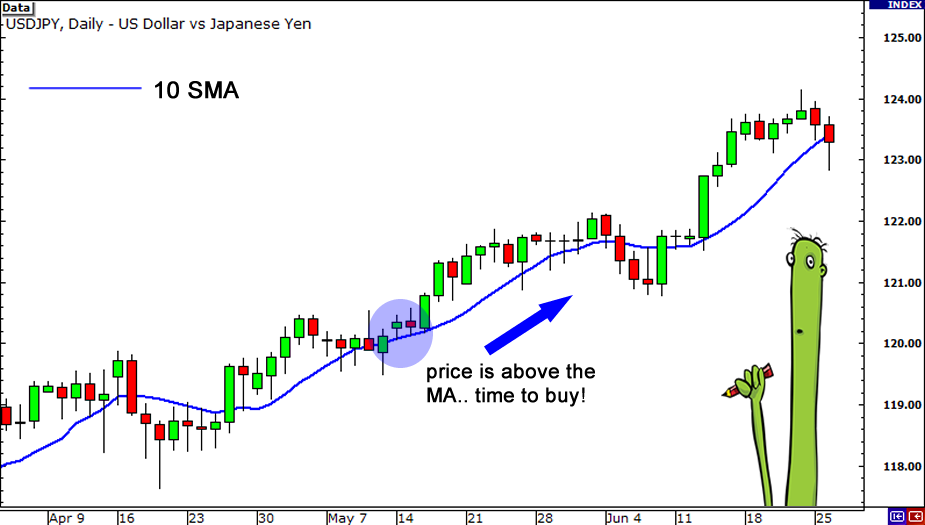
But hold up, that’s kinda basic, fam.
Imagine USD/JPY is in a slump, then BOOM, a news drop makes it pop off.

Now the price pops above the moving average and you're like:
“Yas! This pair’s totally turning. Let’s cop this gem!”
So you go all in, snagging a billion units 'cause you're sure USD/JPY is finna break up.

And then, bamboozled! You got totally juked, for real!
Turns out the squad just hyped up the news, and the trend was like, “nah fam,” and kept tanking!
What the savvy traders do, and you totally should too, is flash more than one moving average on deck, instead of flying solo.
That’s their boo for real signals on whether it’s heading north or south, depending on the MA lineup order.
Let us break it down for ya.
In the upland, the “speedy” moving average chills above the “turtle” moving average, and in the down-low, it’s a flip.
Peep this: Suppose we got two MAs—10-period MA and 20-period MA. Your chart’s gonna look fire like this:
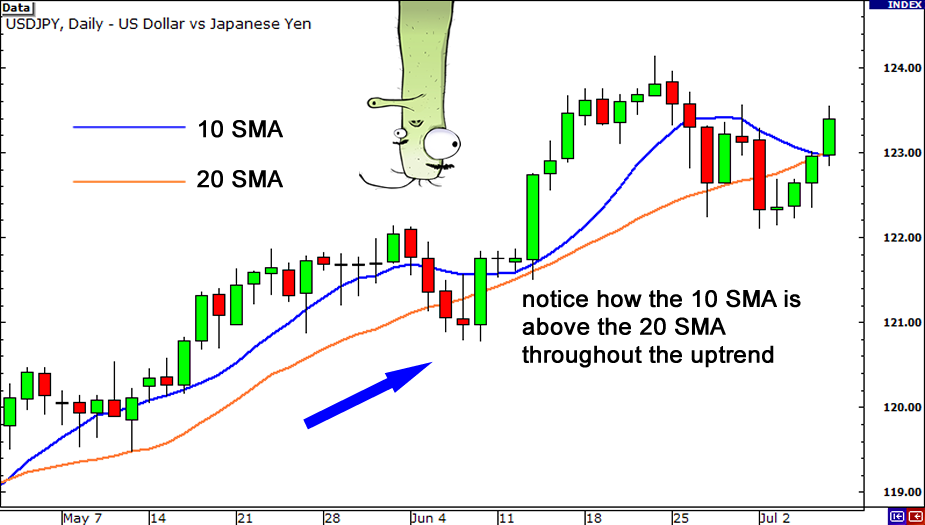
Boom! That’s USD/JPY’s daily chart flexin’.
Throughout the rise, that slick 10 SMA cruises above the 20 SMA.
Peep how moving averages can suss out if a pair's on the climb or switchin’ lanes down.
Pair it up with trend lines knowledge, and you'll be gucci deciding whether to go long or short on a currency pair.
You could even sprinkle more than two moving averages on your chart.
As long as you got that hierarchy locked (speedy MA on top in a rise, slow poke on top in a slide), you’ll know if the pair is climbing up or heading down, good to go.