


This article has been translated from English to Gen Z Slang.
We finna use Fibonacci ratios a ton in our trading, so you better vibe with it like you do with your mom's best TikTok recipes.
Fibonacci is like this next-level topic with a bunch of funky-sounding names, but we’re just gonna keep it chill with two: retracement and extension.
Let's kick it off with the OG Fib man himself…Leonardo Fibonacci.
Yeah, no, Leonardo Fibonacci ain't no celebrity chef. This dude was a legendary Italian math whiz, basically the ultimate mega geek.
His big brain moment was discovering this sick numeric combo that formed ratios showing the natural vibes of the universe.
The juicy ratios pop out from this number gang: 0, 1, 1, 2, 3, 5, 8, 13, 21, 34, 55, 89, 144…
This ain’t rocket science; start with 0, then 1, add 0 + 1 and boom, you got the third number 1.
Add the second and third numbers (1 + 1) and you get 2, which is our fourth homie, and you keep it up.
After you go through the numbers, if you peep the ratio of any number to the one after it, bingo, you hit .618.For instance, 34 divided by 55 equals .618.
And if you're feelin' fancy and check every other number's ratio, you get a chill .382.
For example, 34 divided by 89 = 0.382 .
BAM! You just dropped into the Fibonacci Sequence!

Fibonacci Sequence
A Fibonacci sequence is just some math magic where you take 2 numbers, any 2 at all, vibe them together and get a third number.
Then throw the second and third ones together to get Number Four.
Keep doing that ‘til ya bored.
The last number’s ratio over the second-to-last is like close to 1.618.
This go-to ratio shows up in nature all the time, hence why it’s dubbed the golden ratio.
You can spot the golden ratio all over the place in geometry, art, architecture, and even chillin’ with Sonic the Hedgehog.
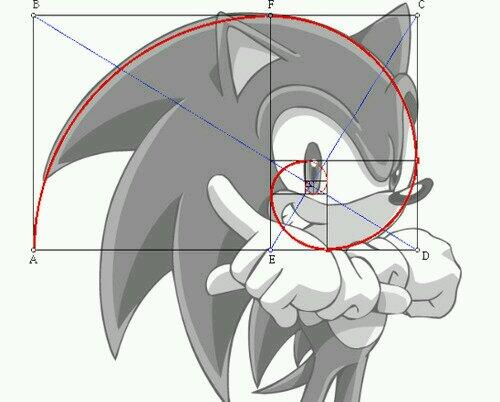
The golden ratio is a real baddie, totally irrational like pi, often just chilling with the Greek phi (φ).
Alright, enough with the number talk.
We don’t want you catching z’s like an elephant. Here’s the lowdown: THESE are the ratios that gotta be on your radar:
Fibonacci Retracement Levels
0.236, 0.382, 0.618, 0.764
Fibonacci Extension Levels
0, 0.382, 0.618, 1.000, 1.382, 1.618
No need to break a sweat working out these digits. Your charting software has your back.
But knowing the basics means you can spit-math knowledge and maybe even impress that hottie.
The Fibonacci retracement levels go off the idea that after a major price move in one direction, the price might retrace and bounce back to a previous price level before hitting the original track again.
Traders, they peep Fibonacci retracement levels for possible support and resistance spots.
With so many traders vibing with these levels and dropping buy and sell orders on them, it sometimes ends up like a whole prophecy come to life.
Traders keep their eyes on Fibonacci extension levels as their spots for cashing out.Again, because everybody's checking these levels to make a move, it usually works out, yeet, more often than not due to people just catching the vibe.
Most chart software already has those Fibonacci retracement and extension level tools.
To work those Fibonacci levels onto your charts, you gotta ID the Swing High and Swing Low moves.
A Swing High is a candle flexing with at least two lower highs chillin’ on both its sides.
A Swing Low is just kicking it with at least two higher lows on both sides.
Got all that? Chill, we got you covered. We’ll break down retracements, extensions, and most importantly, how to snatch those pips using the Fibonacci tool in the next bits.