


The BOJ spent August sounding like a central bank itching to raise rates, yet USD/JPY kept knocking on 160.
That disconnect isn’t as strange as it looks once you dig into the forces still favoring the dollar.
Here’s why increasingly hawkish signals haven’t been enough to turn the yen around.
What Has the BOJ Been Saying?
August was an unusually loud month for hawkish talk from the BOJ. The June meeting minutes, released in early August, showed two board members pushing for faster rate hikes. Most members also warned that inflation could spread further into consumer prices.
At its July meeting, the BOJ voted 8 to 1 to keep rates unchanged. Board member Hajime Takata dissented and formally proposed raising the policy rate to 1.25%. The BOJ’s own outlook also warned that core inflation will likely accelerate clearly above 2% in the second half of fiscal 2026, driven by rising wages, higher oil prices, and a weaker yen.
Japan’s July CPI report, released August 21, added more fuel to the hawkish fire. The BOJ closely watches inflation excluding both fresh food and energy for a clearer read on underlying price pressures. That measure rose 1.9% from a year earlier, and economists began pointing to September as a live meeting for another rate hike.
Then came the BOJ’s July Summary of Opinions on August 27. Policymakers still saw room to keep raising rates and pointed to growing upside inflation risks. Deputy Governor Himino added Thursday that hikes need to come in a timely manner and that the weak yen is adding to inflation. The BOJ then sent hawkish Tamura to Wyoming in Governor Ueda’s place.
No matter how you slice it, August delivered one of the BOJ’s most sustained hawkish stretches in years. And yet, USD/JPY is still hovering near 159, with the yen shaping up to be the month’s weakest major currency.
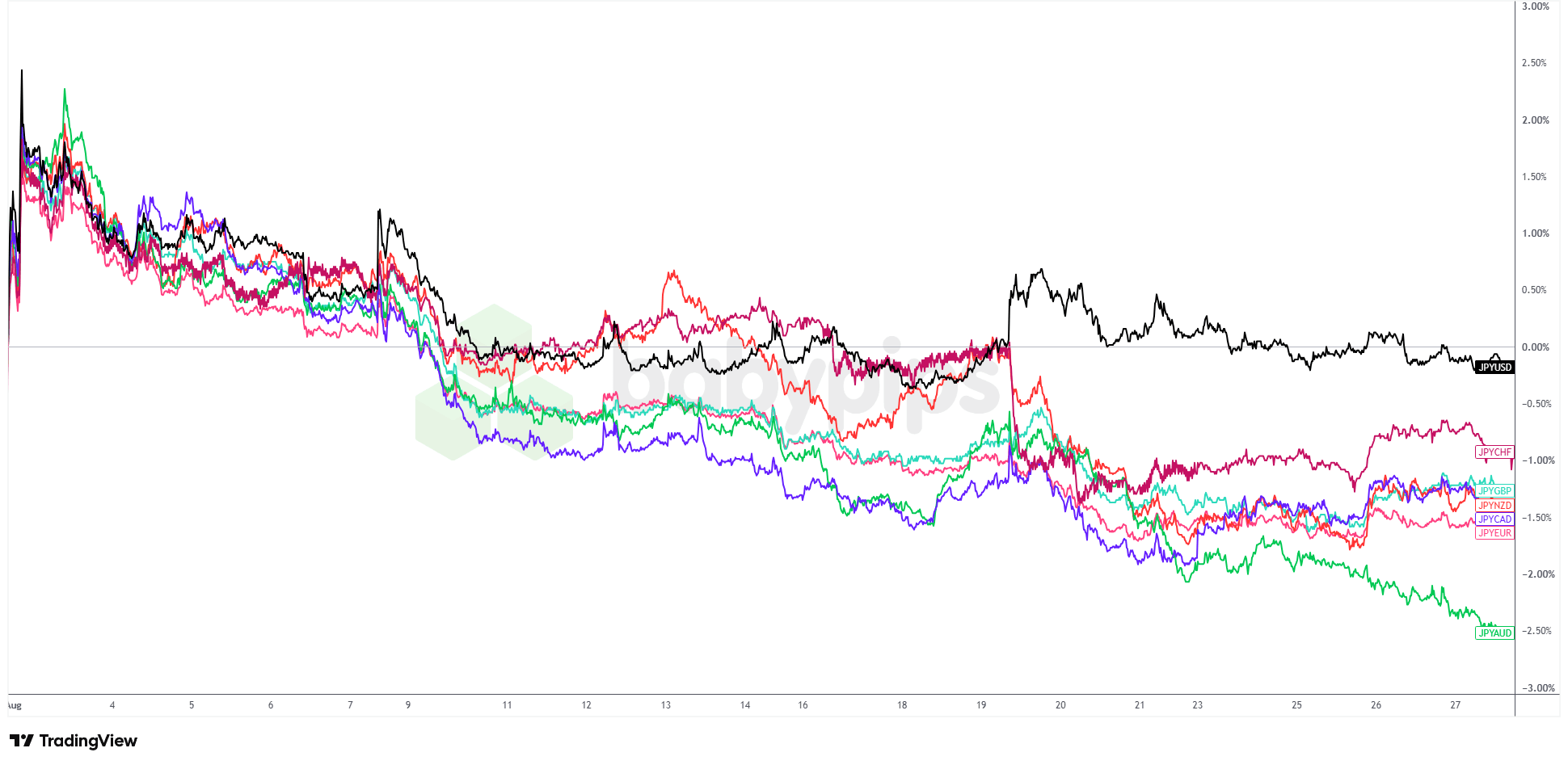
JPY 15-minute August Forex Performance- Chart Faster with TradingView
So Why Isn’t the Yen Moving?
The short answer is that currency markets care about the gap between interest rates, not just the direction one central bank is heading.
The interest rate differential is the gap between two countries’ benchmark policy rates, and it can drive capital flows between their currencies. When that gap is wide, money tends to flow toward the currency offering the higher yield because investors can earn more simply by holding it. When the gap narrows, that incentive starts to fade.
Here’s an easy way to think about it. Your bank raises its savings rate from 0.5% to 0.75%, but your neighbor’s bank is still paying 5.25%. You’re probably not moving your money because that enormous gap still matters more than the modest increase.
That’s where the yen finds itself right now. Even if the BOJ raises rates to 1.25% at its September meeting, the federal funds rate would still be several percentage points higher. The gap would continue to heavily favor the dollar, and carry traders are crunching the numbers and concluding that one BOJ hike wouldn’t change the equation very much.
The market isn’t ignoring the BOJ’s hawkish signals. In fact, traders increasingly expect a September hike. The real issue is magnitude. Closing a gap of several percentage points takes more than one or two moves from the BOJ.
This gap sustains the carry trade, the practice of borrowing cheaply in yen to fund positions in higher-yielding currencies. Traders keep those positions open as long as the math holds, and unwind fast when risk sentiment shifts, which can send USD/JPY sharply lower.
Promoted: Be Ready When the Yen Finally Moves
Understanding why BOJ hawkishness hasn’t lifted the yen is one thing. Having the capital to act when rate differentials and carry trades finally shift is another.
The5ers (4.7★ rating on 32K+ reviews) has spent 10 years helping traders scale their strategies, with more than 1.6 million traders worldwide using its funding programs.
Learn more about The5ers and available discounts
Disclosure: We may earn a commission from our partners if you sign up through our links, at no extra cost to you.
What Would Actually Move the Yen on a Sustained Basis?
Three developments could meaningfully change the math. The Fed could cut rates aggressively enough to shrink the dollar’s yield advantage. The BOJ could raise rates faster than markets currently expect. Or a global risk shock could trigger a broad carry trade unwind, lifting the yen regardless of where interest rates stand.For now, none of those scenarios looks imminent. U.S. Treasury Secretary Scott Bessent said that the BOJ is “behind the curve” and needs to raise rates. He also indicated that he planned to raise the issue directly with Governor Ueda. That outside pressure adds a political wrinkle to the yen’s outlook, but actual rate decisions are what ultimately move interest rate differentials.
Friday’s Jackson Hole speech from Fed Chair Kevin Warsh could still reshape expectations for U.S. rates. A hawkish message would likely reinforce the dollar’s yield advantage and give traders another reason to keep their yen-funded positions open. A more measured tone could pull those expectations back slightly, though one speech probably wouldn’t change the math enough to reverse such deeply entrenched positioning.
The Bottom Line
Rate differentials, not rate direction, drive long-term currency flows. The BOJ spent August turning up the hawkish volume with a dissenting vote for a rate hike, hot CPI data, hawkish meeting minutes, and Tamura heading to Wyoming in Ueda’s place. The yen still weakened.
The carry trade remains attractive because the gap between BOJ and Fed rates is still wide enough to make borrowing yen profitable. Markets are increasingly pricing in a September hike to 1.25%. Even so, one hike wouldn’t erase a rate gap that still favors the dollar by several percentage points.
Watch for meaningful movement on both sides of the differential. Fed rate cuts combined with BOJ hikes could start changing the equation. So could a global risk shock that forces traders to unwind their carry positions. But a hawkish central bank that remains the cheapest place to borrow won’t be enough on its own.
What’s Worth Watching Next
Fed Chair Kevin Warsh speaks at Jackson Hole on Friday at 2:00 p.m. GMT. His comments on the Fed’s rate path could directly affect the other side of the gap between BOJ and Fed rates.
The next BOJ meeting will show whether August’s hawkish signals actually translate into action.
If USD/JPY approaches 160, keep an eye out for verbal intervention from Japanese officials. That works through a different mechanism, which we covered in a previous update.
This article explains why a string of hawkish BOJ signals still hasn’t been enough to lift the yen, and the answer comes down to a concept some readers may not be fully familiar with: interest rate differentials between two countries. Premium members can read our lesson:
📖 Interest Rates: The Force That Moves Currencies
Reading this helps you understand how rate differentials between two countries create currency trends, why the size of the gap matters more than the direction one central bank is heading, and how yield advantages drive capital flows between currencies.
And if you’re not a Premium subscriber yet, now’s a good time to sign up.
With Babypips Premium, you get full access to School of Pipsology lessons that help you understand not just what central banks are signaling, but how the gap between two countries’ interest rates actually determines where currencies go.