


Nvidia’s blockbuster revenue outlook powered technology stocks and steadied the AI trade, lifting the S&P 500 even as most of its members fell. Oil led the broad market with a roughly 2% gain on renewed Strait of Hormuz supply worries, while the dollar drifted to a mixed, arguably net weaker finish against the majors ahead of Friday’s Jackson Hole keynote.
Check out the forex news and economic updates you may have missed in the latest trading session!
News Headlines & Data:
-
- Australia Household Spending for July 2026: 7.0% y/y (4.4% y/y forecast; 6.0% y/y previous)
- China Industrial Profits (YTD) for July 2026: 17.6% y/y (16.0% y/y forecast; 18.7% y/y previous)
- Germany GfK Consumer Confidence for September 2026: -26.6 (-29.5 forecast; -29.6 previous)
- Swiss Non Farm Payrolls for Q2 2026: 5.7M (5.55M forecast; 5.54M previous)
- France Unemployment Benefit Claims for July 2026: 21.5k (10.0k forecast; 5.9k previous)
- Canada Current Account for Q2 2026: 8.8B (-3.0B forecast; -7.2B previous)
- Canada Average Weekly Earnings for June 2026: 3.4% y/y (3.3% y/y forecast; 3.4% y/y previous)
- U.S. Initial Jobless Claims for August 22, 2026: 203.0k (210.0k forecast; 206.0k previous)
- U.S. Goods Trade Balance Adv for July 2026: -118.8B (-100.0B forecast; -101.5B previous)
- U.S. Kansas Fed Manufacturing Index for August 2026: 17.0 (14.0 forecast; 17.0 previous)
- Euro area M3 Money Supply for July 2026: 3.4% (3.3% forecast; 3.3% previous)
Broad Market Price Action:
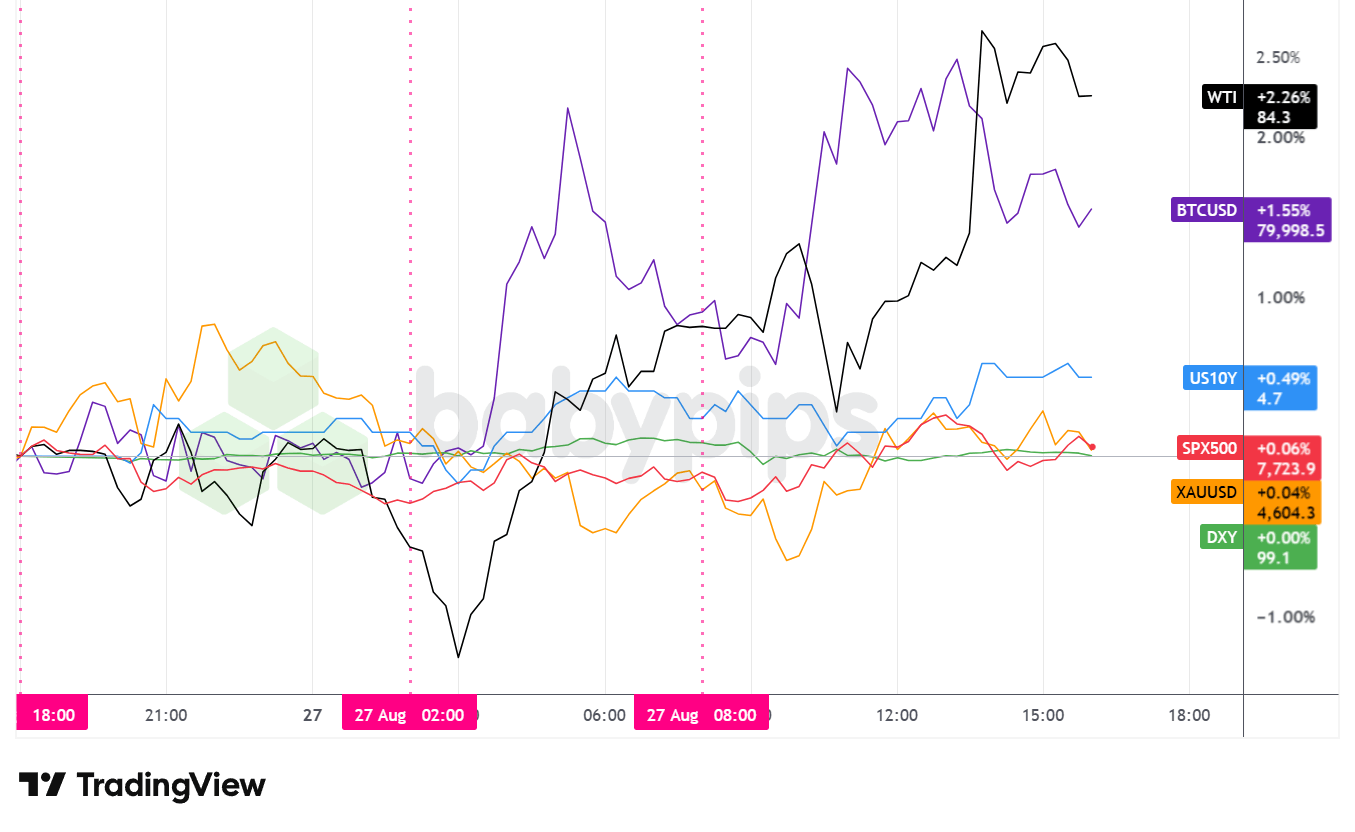
Dollar Index, Gold, Oil, S&P 500, U.S. 10-yr Yield, Bitcoin Overlay – Chart Faster With TradingView
Assets held narrow ranges through the Asian hours before oil and bitcoin broke higher from the London morning onward. By the close, oil topped the broad market overlay with a gain near 2%, bitcoin followed with a rise above 1.5%, and the 10-year Treasury yield ticked up. The S&P 500 and gold finished close to flat, while the dollar index landed almost unchanged on the day.
The S&P 500 spent the session drifting inside a tight band and closed near 7,724, up around 0.06%. Nvidia jumped about 8.7% after guiding to roughly 70% revenue growth in the next fiscal year, and the advance in technology shares carried the index higher even as most of its members declined. The gain reflected confidence in the artificial-intelligence trade rather than broad participation. Traders also stayed cautious ahead of Fed Chair Kevin Warsh’s Jackson Hole speech on Friday, which likely capped the index’s upside through the afternoon.
Gold traded choppily and finished near 4,605, up around 0.04% on the overlay. The metal ran up toward 4,643 during the Asian session before stalling, then slid to a session low near 4,565 through the London morning. Prices recovered from midday and settled back near the opening level. Dollar-depreciation concerns and worries over rising U.S. debt likely kept a floor under the metal, though its inability to hold the highs may reflect caution ahead of Jackson Hole.
WTI crude oil was the day’s standout, closing near 84.27 and up roughly 2%. Oil based out near 82.50 through the Asian hours, dipped to a session low around 81.30 into the early London morning, then climbed steadily to a high near 84.92 during the U.S. afternoon. The rally tracked renewed Strait of Hormuz supply worries after it was reported the Trump administration told mediators it has no interest in returning to the terms of the June memorandum of understanding reached with Iran.
The U.S. 10-year Treasury yield edged higher, closing near 4.69% and up around 0.49% on the day. Yields drifted in a narrow range through Asia and London before pushing to the session high in the U.S. afternoon, a move consistent with inflation and fiscal-deficit concerns keeping upward pressure on the long end ahead of Warsh’s remarks.
Bitcoin closed near 79,999, up roughly 1.55% on the day. Prices held near 78,700 through the Asian hours before a sharp push from the London morning cleared 80,500, with a session high near 80,848 in the early U.S. afternoon before a fade into the close. No single crypto-specific catalyst stood out, so the advance likely tracked the firmer risk tone that the Nvidia-led tech rally set for the broader session.
FX Market Behavior: U.S. Dollar vs. Majors
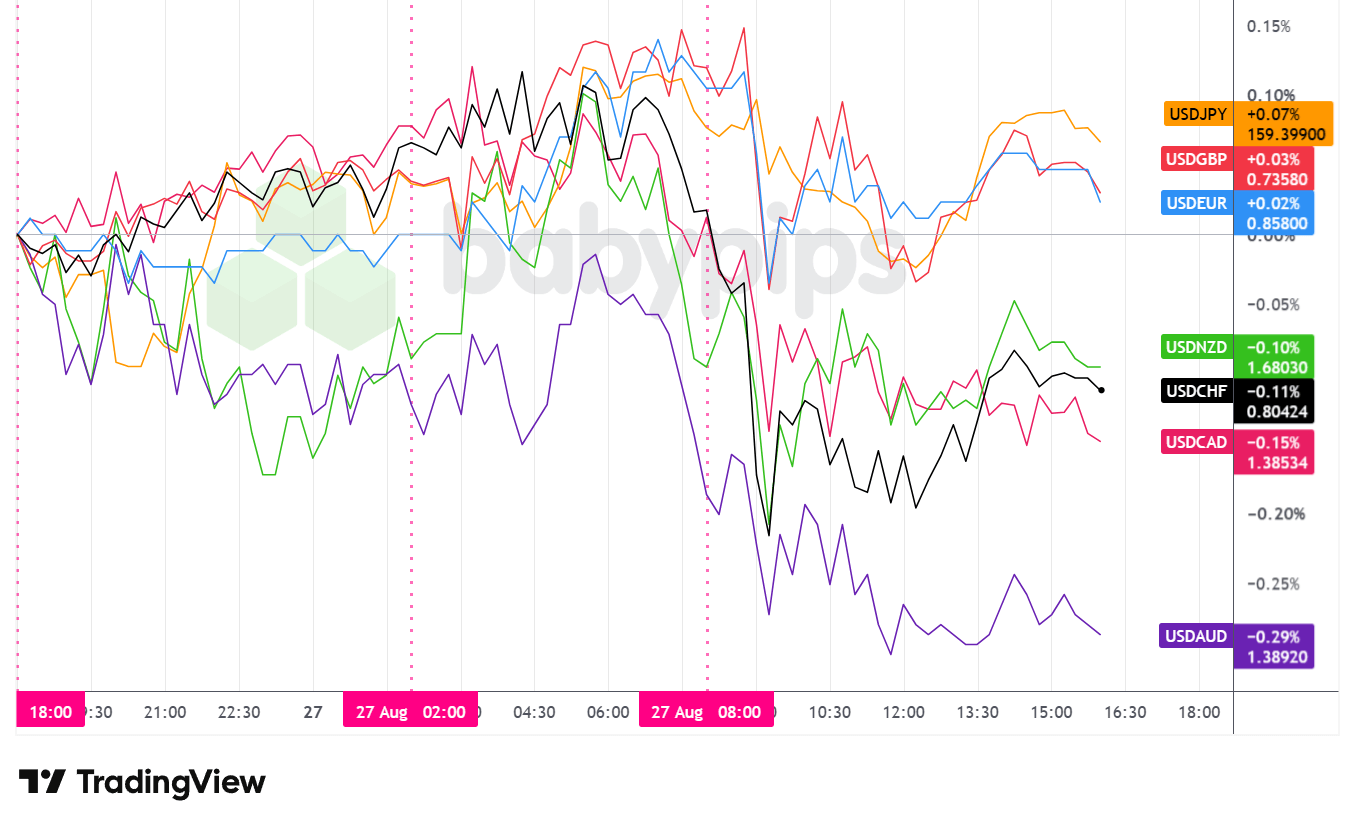
Overlay of USD vs. Major Currencies – Chart Faster With TradingView
The U.S. dollar traded mixed against the major currencies on Thursday, finishing arguably net bearish overall on a quiet pre-Jackson Hole session.
During the Asian session, the dollar traded mixed against the majors heading into the London handoff, with no single regional catalyst setting direction. Australian data leaned hawkish, as household spending rose 1.1% month over month in July, nearly triple the forecast, building on the case for a Reserve Bank of Australia hike established by Wednesday’s firm inflation print. The Aussie stayed underpinned by rate-hike expectations, and USD/AUD spent the day as the dollar’s weakest pairing. Bank of Japan Deputy Governor Ryozo Himino called for timely rate hikes and flagged a weak yen as an inflation risk, yet the yen softened regardless, leaving USD/JPY near 159.40.
After the London session opened, the dollar leaned net bullish until just ahead of the U.S. open, when it started to turn lower. News flow stayed light, with traders holding back ahead of the Jackson Hole symposium. Germany’s GfK consumer confidence reading improved to -26.6 from -29.6, and the euro area monetary aggregates came in slightly firmer than forecast, though neither release shifted the dollar’s broader path.
Once the U.S. session opened, the dollar dipped against the majors and continued to trade net weaker into the afternoon. Initial jobless claims fell to 203.0k, below the 210.0k forecast, and the Kansas City Fed manufacturing index held at 17.0, but the data did little to arrest the slide. The dollar then stabilized and traded mixed for the rest of the day, closing arguably net bearish on the session.
Upcoming Potential Catalysts on the Economic Calendar
- Japan Core CPI & Tokyo CPI for August 2026 at 11:30 pm GMT
- Japan Unemployment Rate for July 2026 at 11:30 pm GMT
- Japan Consumer Confidence for August 2026 at 5:00 am GMT
- France Inflation Rate Prel for August 2026 at 6:45 am GMT
- Swiss KOF Leading Indicators for August 2026 at 7:00 am GMT
- Germany Employment Updates for August 2026 at 7:55 am GMT
- Euro area Economic Sentiment for August 2026 at 9:00 am GMT
- Canada GDP for June & July 2026 at 12:30 pm GMT
- U.S. Chicago PMI for August 2026 at 1:45 pm GMT
- UoM U.S. Consumer Sentiment Index for August 2026 at 2:00 pm GMT
- U.S. Non Farm Payrolls Annual Revision Prel at 2:00 pm GMT
- U.S. Fed Chair Warsh Speech at 2:00 pm GMT
- Euro area ECB Schnabel Speech at 3:55 pm GMT
Friday hinges on Fed Chair Warsh’s first Jackson Hole keynote, and a hawkish tone could extend support for the dollar and long-end yields while pressuring gold, whereas a measured delivery could unwind some of that positioning.
A dense European calendar of inflation and sentiment readings may add cross-currents before the Wyoming podium takes over, and the unresolved Hormuz situation with oil back above 84 remains a live risk under all of it.
Stay frosty out there, forex friends!
Thursday’s market recap shows how Nvidia’s strong earnings, oil’s 2% rally on Strait of Hormuz supply worries, and Treasury yields all moved in concert to shift the dollar. But if you’re not reading stocks, bonds, and commodities alongside your currency charts, you’re missing half the story. Premium members can read our lesson:
📖 What Is Intermarket Analysis?
Reading this helps you understand how currency prices connect to equities, commodities, and bonds, why the risk-on tone from a tech rally can flow directly into currency pairs like USD/AUD, and how oil supply concerns immediately feed into forex moves.
And if you’re not a Premium subscriber yet, now’s a good time to join.
With Babypips Premium, you get full access to School of Pipsology lessons that help you understand not just which asset class is moving, but how those moves translate into currency flows and where your next trade opportunity lives.