


The Japanese yen jumped as much as 2% against the U.S. dollar on Thursday, spiking to 160.11 with no clear news trigger behind it. The sudden move revived trader suspicions that Japan’s Ministry of Finance had stepped back into the currency market to defend the yen. Tokyo has not confirmed anything, and the bigger test may come Friday, when the Bank of Japan delivers its own policy decision.
Yen Intervention Watch: Key Takeaways
- Sharp yen jump: USD/JPY fell as much as 2% intraday on Thursday, touching 160.11, according to Bloomberg, its biggest jump since Japan’s confirmed intervention in April.
- No confirmation yet: Japan’s Ministry of Finance has not confirmed or denied buying yen on Thursday.
- 40-year low backdrop: The yen had touched 163.99 per dollar just a week earlier, its weakest level since November 1986.
- Repeated warnings: Finance Minister Satsuki Katayama has spent weeks warning that “decisive action” remains possible.
- BOJ decision Friday: The Bank of Japan wraps a two-day policy meeting on July 31, with markets expecting it to hold its benchmark rate at 1%.
- Fed held rates: The Federal Reserve kept its rate at 3.50%-3.75% on Wednesday, with three officials dissenting in favor of a hike.
- Soft U.S. growth: Second-quarter GDP grew just 1.5%, missing forecasts of 2.1% and adding to dollar weakness Thursday.
What Happened to the Yen on Thursday?
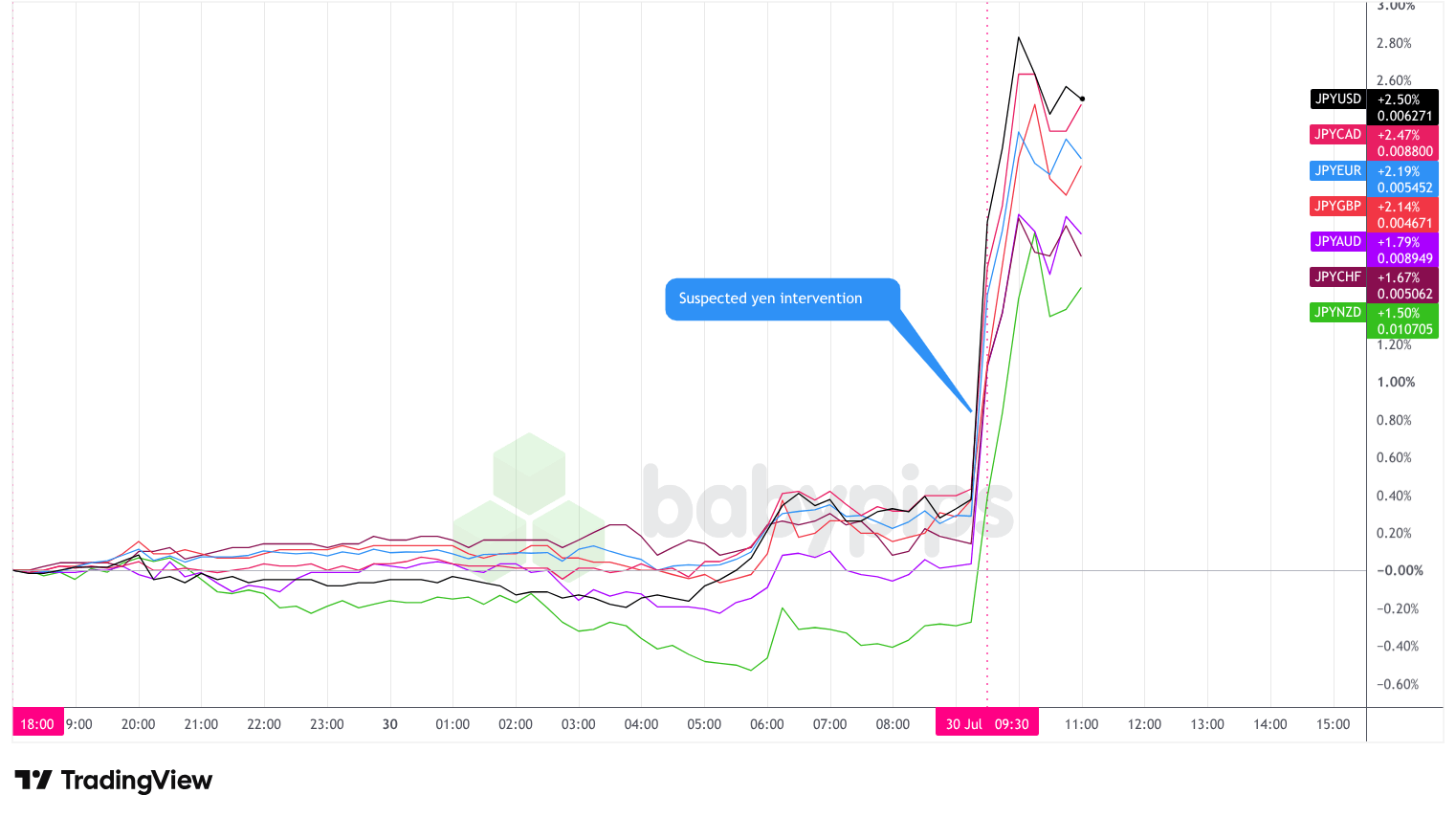
Overlay of JPY vs. Major Currencies – Chart Faster with TradingView
The dollar had been trading calmly near 163 yen through Wednesday and early Thursday. Then, around 9:55 a.m. in New York, the yen suddenly took off. It gained as much as 2% in minutes, dragging USD/JPY down to 160.11, according to Bloomberg. Other major yen pairs moved just as fast. EUR/JPY and GBP/JPY both dropped more than 1% within the same stretch.
Nobody could point to a headline that explained it. There was no data release, no central bank speech, no breaking news from Tokyo. That absence of an obvious catalyst is exactly what makes traders suspect official buying rather than ordinary market flow.
Was This an Actual Bank of Japan Intervention?
Nobody knows for certain yet. Japan’s Ministry of Finance sets currency policy and decides when to intervene. The Bank of Japan acts as its agent, executing any yen-buying trades on the ministry’s orders. So far, the ministry has neither confirmed nor denied stepping in on Thursday.
The pattern looks familiar. On April 30, the yen jumped nearly 3% after the dollar topped 160.72. Sources later confirmed that Japan had intervened for the first time in roughly two years. Officials spent close to ¥5.4 trillion, or about $34.5 billion, that day alone. Confirmation this time will have to wait. The ministry’s next release of intervention data, covering activity through July 29, lands the same day as the Bank of Japan’s decision.
Why Has the Yen Been So Weak This Year?
Promoted: Trade the Headlines, Not Just the Chart.
Suspected central bank intervention. A Federal Reserve on hold. A Bank of Japan decision landing within hours. Weeks like this reward traders who have the capital and the risk framework to handle sudden, headline-driven volatility.
The5ers (4.7★ rating on 32K+ reviews) has spent the last 10 years building a funding model designed for exactly this kind of market. Over 1.6 million traders worldwide trust The5ers to provide the capital and scaling needed to turn a well-timed call into real, funded growth.
Learn more about The5ers & available discounts
Disclosure: We may earn a commission from our partners if you sign up through our links, at no extra cost to you.
Three forces are pulling in the same direction. First, U.S. interest rates still sit well above Japan’s, even after the Bank of Japan’s rate hikes this year. That gap rewards a trading strategy called the carry trade, where investors borrow cheap yen and invest the money in higher-yielding dollar assets. The trade keeps steady pressure on the currency.
Second, the ongoing Middle East conflict has pushed oil prices higher for months, and Japan imports nearly all of its energy. Costlier oil widens Japan’s trade deficit and adds to the case for yen weakness. Third, a weak yen used to draw safe-haven buying whenever tensions flared. This time the currency has stayed pressured even as the conflict escalates. Traders are watching the rate gap more closely than they’re watching safety.
For a deeper fundies look at Japan and the yen, check out our Premium Fundies Snapshot here!
What Will the Bank of Japan Decide on Friday?
The Bank of Japan’s two-day meeting concludes on July 31, alongside its quarterly Outlook Report on growth and prices. Markets expect the bank to hold its policy rate at 1%, the level it reached after a hike earlier this summer. The real focus will be Governor Kazuo Ueda’s tone and whether the bank signals another hike as soon as October.
Traders should keep this separate from any currency intervention. Interest rate policy addresses inflation and growth. Intervention is a Ministry of Finance tool aimed directly at the exchange rate. A more hawkish Bank of Japan can still support the yen indirectly. It narrows the rate gap with the U.S. without spending a dollar on intervention.
What Does This Mean for Forex Traders?
Promoted: A Bank of Japan Decision Is Not the Time for a Dropped Connection.
When the yen can move 2% in minutes without warning, execution speed and uptime matter as much as your analysis. ForexVPS provides ultra-low latency, dedicated trading servers that keep your platform and any automated strategies running around the clock, through Friday’s Bank of Japan decision and beyond. Stop letting a home Wi-Fi outage erode your edge on a day like this.
Explore VPS plans at ForexVPS!
Disclosure: To help support our free daily content, we may earn a commission from our partners if you sign up through our links, at no extra cost to you.
Friday stacks two separate yen catalysts on top of each other: the Bank of Japan’s policy decision and the Ministry of Finance’s monthly intervention data. Either one could move USD/JPY sharply on its own, and together they raise the odds of a volatile session. Sudden, unexplained yen spikes like Thursday’s can also keep repeating without warning until officials either confirm their hand or the market decides they are bluffing.
Tight stops and smaller position sizes make sense heading into these events. Watch Finance Minister Katayama’s press briefings too. Her past warnings have often lined up with real intervention days.
Frequently Asked Questions About Yen Intervention
What is currency intervention?
Currency intervention happens when a government buys or sells its own currency to influence its exchange rate. Japan’s Ministry of Finance orders these trades, and the Bank of Japan carries them out. Japan typically intervenes to support the yen, buying it with foreign currency reserves.
Did Japan confirm it intervened this week?
No. As of Thursday, Japan’s Ministry of Finance had not confirmed or denied buying yen. Confirmation, if it comes, would likely show up in the ministry’s intervention data due for release on July 31.
What’s the difference between the Bank of Japan and the Ministry of Finance on currency policy?
The Ministry of Finance decides if and when to intervene in currency markets, while the Bank of Japan executes those trades on the ministry’s instructions. The Bank of Japan sets interest rate policy on its own, which is what Friday’s meeting is about.
Why is the yen near a 40-year low?
Three forces have weighed on the yen through 2026. A wide U.S.-Japan rate gap keeps the carry trade active, and rising oil prices tied to the Middle East conflict add pressure.
What should USD/JPY traders watch next?
Friday brings the Bank of Japan’s rate decision and Outlook Report, plus updated Ministry of Finance intervention data. Comments from Governor Ueda and Finance Minister Katayama are likely to matter as much as the numbers themselves.