Three Federal Reserve officials voted to raise interest rates on July 29, while Chair Kevin Warsh made it clear that inflation remained the committee’s biggest concern. Long term Treasury yields even climbed to their highest levels since 2007.
By the textbook, the U.S. dollar should’ve rallied.
Instead, it ended the day lower against six of the seven major currencies.
What’s up with that?!
What Did the Fed Decide, and What Did It Leave Unsaid?
The Federal Open Market Committee (FOMC) kept its benchmark rate at 3.50% to 3.75%, marking its fifth straight pause.
The vote came in at 9 to 3, with Cleveland Fed President Beth Hammack, Minneapolis Fed President Neel Kashkari, and Dallas Fed President Lorie Logan all backing a 25 basis point hike.
This marks the first time since September 2016 that three voting members had joined together in a hawkish dissent, meaning they formally opposed the majority’s decision because they preferred tighter policy.
The Fed’s statement gave the dissenters plenty to work with, noting that inflation was still running above the 2% target, partly because of higher global energy prices tied to the ongoing conflict between the U.S. and Iran.
What the statement didn’t offer was any clue about timing. Warsh has chosen to operate without forward guidance, which is the Fed’s usual practice of preparing markets for where policy may be heading.
The June dot plot, the Fed’s quarterly chart showing where officials expect rates to go, had already pointed to one hike by the end of 2026. Wednesday’s decision didn’t change that outlook. It simply left traders guessing about when the move might come.
Why Didn’t the Dollar Rally on a Hawkish Fed?
Currencies move on the gap between expectations and reality, not the headline alone. Some estimates had the odds of a rate hike in the mid 40% range before the decision, which meant a big chunk of the market was already positioned for a hawkish outcome.
Against that backdrop, a hold looked softer than traders had expected, even with three officials voting for a hike.
The real surprise wasn’t that the Fed sounded hawkish. It was that the Fed didn’t raise rates.
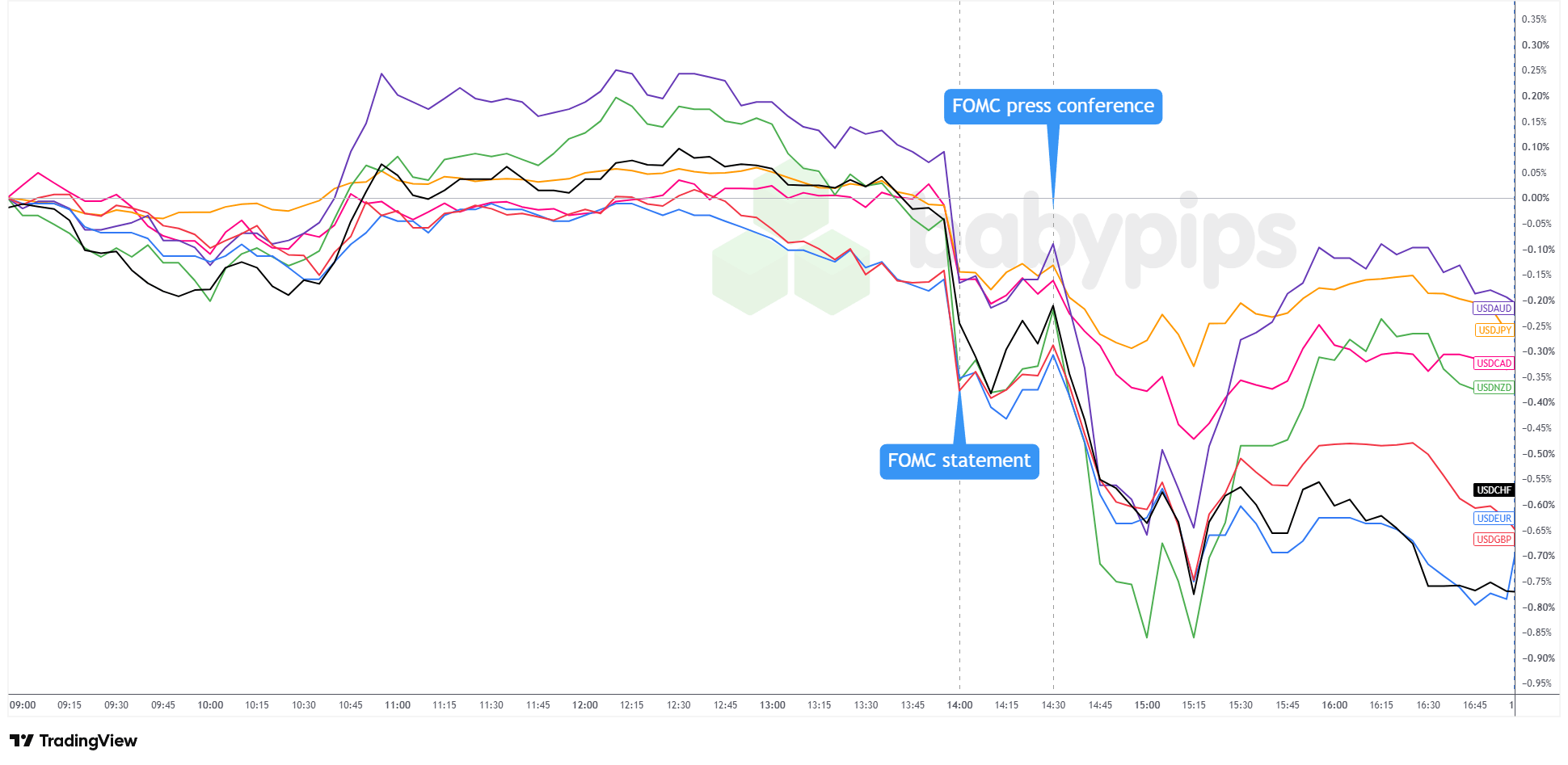
USD 5-Minute Forex – Chart Faster with TradingView
The dollar reflected that disappointment almost immediately. It traded near flat through the early U.S. session, dropped after the statement release, briefly bounced, then fell again once Warsh’s press conference began at 2:30 p.m. It never fully recovered.
By day’s end, the U.S. Dollar Index ended the day about 0.4% lower, while the dollar lost roughly 0.3% to 0.8% against most major currencies.
Note that the bigger decline came during the press conference, not after the statement. And that’s where the next part of the story begins.
Promoted: Markets move on surprises, not just headlines.
When central bank decisions hit, FinancialJuice helps traders track the data, commentary, and market expectations shaping price action in real time.
Join FinancialJuice for Free to learn more!
Disclosure: We may earn a commission from our partners if you sign up through our links, at no extra cost to you.
What Do Three Hawkish Votes Tell Us About September?
Twelve officials vote at each FOMC meeting: seven members of the Board of Governors and five rotating regional Fed presidents.
Dissents are uncommon, and three votes in the same direction send a clear signal.
Hammack, Kashkari, and Logan are now formally on record favoring higher rates. If the next two CPI reports come in hot, or oil prices keep rising as Middle East tensions escalate, those votes could help build the case for a September hike.
This matters for USD traders heading into the fall. The June dot plot already pointed to one quarter point hike by the end of 2026, but sticky inflation and three officials openly pushing for higher rates could bring that move forward.
The dollar may not have rallied Wednesday because the market wasn’t surprised by hawkish tone. It would likely rally if the data forces a hawkish action.
Why Did Warsh Pull the Roadmap?
Forward guidance has shaped Fed communication for more than a decade. Think of it as the central bank’s weather forecast. It isn’t always right, but it helps traders prepare.
Phrases like “rates will remain elevated” or “a cut is on the table” give markets time to adjust instead of scrambling on decision day.
Warsh is moving away from that approach. He’s made it clear that the lack of guidance is intentional, with the Fed’s next move depending on the data rather than advance signals.
That makes every major release between now and September more important for USD traders. Core PCE, the Fed’s preferred inflation gauge, lands today at 12:30 GMT, less than 24 hours after Warsh called inflation the committee’s main concern. The August and September CPI reports come next, while any Middle East escalation that pushes oil higher could keep energy driven inflation in focus.
Those releases now carry the market moving weight that used to be spread across months of Fed commentary.
The 2:00 p.m. statement took an immediate hike off the table. The 2:30 p.m. press conference took away the roadmap.
Quick Takeaways
- The Fed held at 3.50%–3.75% on a 9-3 vote on July 29, 2026, with three members preferring a 25bp hike — the most unified hawkish dissent since September 2016
- Currencies move on the surprise relative to expectations; the dollar fell because a hold landed softer than what the market had leaned toward going in
- Three formal dissents create a documented record that keeps September hike pressure live if inflation data stays elevated
- Warsh removing forward guidance makes Core PCE, CPI, and oil prices the primary USD drivers into autumn — every print now carries more weight than usual
- Markets don’t move on what the Fed does alone. They move on whether it delivers more or less than traders expected.
What to Watch
U.S. core PCE for June lands today at 12:30 GMT. Markets expect inflation to rise 0.1% from May and ease to 3.3% annually, down from 3.4%, its highest level since October 2023.
A hotter reading could keep a September hike firmly in play. A softer print may widen the gap between three hawkish votes and an actual rate increase. The Fed’s next full meeting comes in September.
This article breaks down why the dollar fell on a hawkish FOMC meeting, a move tied to how markets price in central bank decisions before they happen. Premium members can read our lesson:
📖 Market Expectations: Why Good News Can Tank a Currency
Reading this helps you understand why currencies move on the deviation from expectations, how to read what the market had already priced in before a central bank decision, and why a hawkish hold can still send the dollar lower when the outcome lands softer than expected.
And if you’re not a Premium subscriber yet, now’s a good time to sign up.
With Babypips Premium, you get full access to School of Pipsology lessons that help you understand not just what the Fed decided, but why the dollar moved the way it did.