The Reserve Bank of Australia (RBA) raised its cash rate – Australia’s benchmark overnight rate – to 4.60% on Tuesday for its fourth hike of 2026.
The Australian dollar initially climbed on the decision, but the gains quickly evaporated during Governor Michele Bullock’s press conference. Heck, AUD/USD slid to a nine-week low!
A rate hike weakening a currency might sound contradictory, but it isn’t always that straightforward.
What Did the RBA’s Statement Actually Say?
Tuesday’s move marked the RBA’s fourth hike of 2026, bringing the total tightening since February to 100 basis points. At 4.60%, the cash rate is now at its highest level since November 2011.
The RBA pointed to three pressures behind the decision:
- The Middle East conflict has pushed global energy prices above the central bank’s August forecasts.
- AI-related demand is also driving up global prices for technology-related goods.
- Meanwhile, Australian businesses are facing genuine cost pressures, with many already raising prices or preparing to do so.
The Board made it clear that demand still needs to cool to bring inflation under control. It also pledged to do whatever is necessary to return inflation to target, including raising rates again if the data calls for it.
Taken alone, that hawkish message gave the Australian dollar a brief lift in the minutes after the decision.
Promoted: Central bank signals can move more than currencies.
The RBA raised rates, but softer guidance sent AUD lower. When policy shifts ripple through global risk markets, Crypto.com offers a simple platform for following and trading crypto as sentiment changes.
Learn more here at Crypto.com!
Disclosure: We may earn a commission from our partners if you sign up through our links, at no extra cost to you.
Why Did Bullock’s Press Conference Reverse the Rally?
Bullock struck a much more cautious tone than the written statement suggested, and traders adjusted quickly. She revealed that the Board had seriously considered leaving rates unchanged before ultimately voting for a hike, a detail missing from the official statement.
So, although the vote was unanimous, the Board’s consideration of a hold showed that the decision was less clear-cut than the result suggested.
Bullock also suggested the rate hike cycle could be nearing its end. She said current financial conditions were restrictive and already working, while leaving the door open to a pause if inflation cooperates. Her message remained conditional, with future decisions tied to incoming data rather than a firm commitment to keep raising rates.
In central banking, promising another hike and merely keeping one on the table send very different signals. Traders heard the softer message and repriced the Australian dollar accordingly.
The rate hike itself was already largely priced in, meaning it had been factored into AUD exchange rates before Tuesday’s announcement. This helps explain why the initial bounce was so modest.
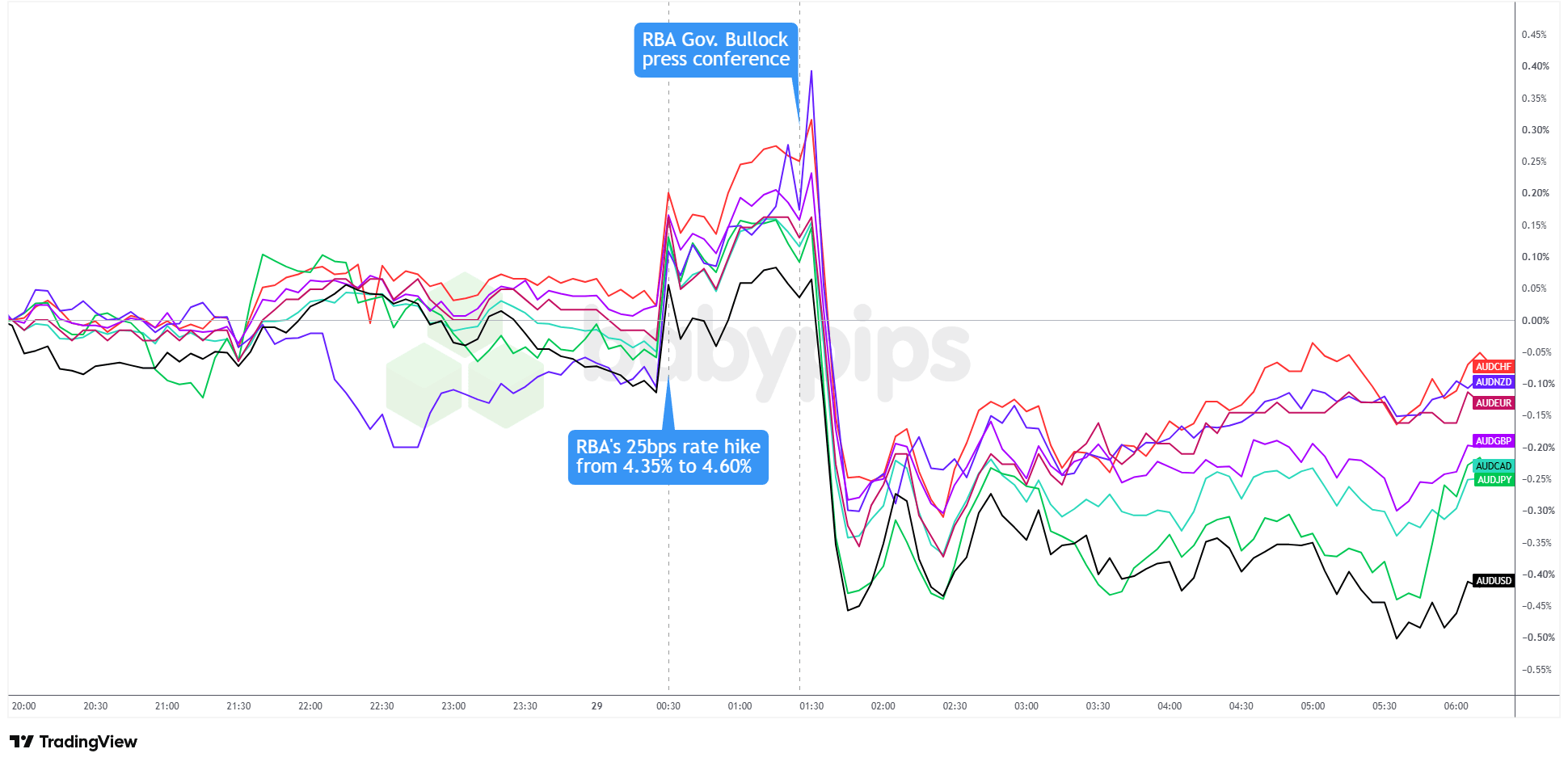
AUD 5-Minute Forex – Chart Faster with TradingView
The chart shows that major Australian dollar pairs gained just 0.15% to 0.40% after the decision, a relatively small move for a rate hike. What traders weren’t prepared for was forward guidance that cast real doubt on a fifth hike.
Every AUD pair reversed at roughly the same time once Bullock began speaking. That broad reversal across the Australian dollar supports that her remarks drove the move, rather than a wider shift in market sentiment.
The Aussie didn’t catch a break on Tuesday, finishing as the weakest major currency. It took its biggest hits against the dollar and yen, while losing less ground to the Kiwi.
What Comes Next for AUD?
Whether AUD recovers will likely depend on two things: what Australia’s inflation data says and what the U.S. Federal Reserve does.
Australia’s August CPI report, which landed a day after the RBA hike, handed both sides of the rate debate something to hold.Headline inflation jumped to 4.0% year over year from 3.5% in July, according to the Australian Bureau of Statistics (ABS). Energy did most of the damage: fuel prices surged 14.8% in the month after federal fuel excise relief expired, and electricity costs climbed 13.2% from a year earlier.
The RBA cares more about trimmed mean inflation, which removes the biggest price swings at both ends to show the underlying trend. That gauge held at 3.6% for a third straight month, still above the RBA’s 2% to 3% target, but it slowed to 0.2% month-on-month from 0.5% in July, a touch below the 0.3% economists expected.
After the CPI release, odds of a fifth hike at the November 2 to 3 meeting fell to about 20% from about 35% to 40% a day ago, and AUD/USD slipped about 0.3% to a two-month low.
Whether Tuesday marked the final hike of the cycle or simply the latest one remains an open question. The RBA has tied future decisions to incoming data, while Bullock gave the Board enough room to pause without contradicting its hawkish statement. That uncertainty will likely keep AUD sensitive to every inflation-related report until the outlook becomes clearer.
The U.S. side adds another wrinkle. The 10-year Treasury yield is hovering near 5.24%, its highest level since 2007, while markets are pricing a more than 70% chance of another Fed hike in October.
The rate differential is the gap between the yields investors can earn in two countries. If U.S. rates rise faster than Australian rates, that gap widens in favor of the U.S. dollar. That could limit AUD/USD gains even if Australia’s inflation data supports another RBA hike.
Key Takeaways
- The RBA raised Australia’s cash rate to 4.60% on Tuesday, its fourth hike of 2026 and a cumulative 100 basis points since February.
- The written statement cited three inflation drivers: Middle East energy prices, AI-driven tech goods demand, and domestic cost pressures, and it left the door open to further tightening.
- Governor Bullock’s press conference softened that message by indicating the Board had considered holding rates, with language built around conditions rather than commitments.
- AUD/USD fell despite the hike because forward guidance reduced expectations for a fifth move, not because anything changed about the current rate level.
- When a central bank decision is fully priced in, the words around it may move currencies more than the decision itself does.
If the RBA’s rate hike sending AUD lower left you puzzled, understanding how hawkish and dovish central bank signals work is what makes it click. Premium members can read our lesson:
📖 Hawkish vs. Dovish: How to Read Central Bank Language
Reading this helps you understand how tone and forward guidance shape currency moves, why a cautious press conference can outweigh a rate hike, and how to decode the signals central banks send beyond the rate decision itself.
And if you’re not a Premium subscriber yet, now’s a good time to sign up.
With Babypips Premium, you get full access to School of Pipsology lessons that help you understand not just what a central bank decided, but why the language around that decision often moves currencies more than the rate change itself.