


Australia’s consumer price index rose 4.0% in the year through August, the highest in four months but just shy of economists’ 4.1% forecast.
The report came one day after the Reserve Bank of Australia (RBA) raised its cash rate to the highest level in 15 years. Core inflation held at 3.6% for the third straight month, still above the RBA’s 2% to 3% target.
The softer headline reading took some steam out of November rate hike bets, but with oil pulling back from its September high near $109 and housing costs still climbing, the RBA’s work isn’t done yet.
Australia CPI August 2026: Key Takeaways
- Headline CPI: +4.0% year-on-year in August 2026, up from 3.5% in July; below the 4.1% consensus forecast
- Monthly CPI: +0.4%, below the 0.5% estimate; trimmed mean rose 0.2% for the month
- Trimmed mean (core) inflation: +3.6% year-on-year, unchanged since June 2026; above the RBA’s 2–3% target
- Automotive fuel: +14.8% month-on-month, compared to 7.5% in July; driven by higher global oil prices and the end of the federal government’s fuel excise relief program
- Housing: +5.7% year-on-year, the largest contributor to annual CPI; electricity costs jumped 13.2%
- RBA cash rate raised to 4.60% in September, the fourth hike in 2026 and the highest rate since 2011
- Odds of a November RBA hike fell to ~20% after the data, down from ~35–40% before; markets moved the next expected hike to early 2027
Promoted: Keep Your AUD Strategy Running Through CPI Volatility.
Australian CPI releases can quickly reprice RBA rate bets and send AUD pairs moving. ForexVPS provides ultra low latency trading servers that keep your automated strategies running around the clock, even when market volatility and trading volume spike.
Explore VPS plans at ForexVPS!
Disclosure: To help support our free daily content, we may earn a commission from our partners if you sign up through our links, at no extra cost to you.
What Were Australia’s CPI Results for August 2026?
The Australian Bureau of Statistics reported that its monthly CPI indicator climbed 4.0% in the year to August, up from 3.5% in July and matching May’s four-month high. Monthly CPI rose 0.4%, also coming in below the 0.5% estimate.
Headline inflation picked up for two big reasons: global oil prices surged, and the federal government’s energy relief programs expired. Automotive fuel prices jumped 14.8% m/m in August after rising 7.5% in July. The ABS pointed to higher global oil prices and the expiration of the federal fuel excise relief program, which ran from April through August 2026.
The softer-than-expected numbers gave financial markets a little breathing room. The Australian dollar (AUD) fell about 0.3% against the U.S. dollar, while three-year government bond yields dropped about 10 basis points to 4.87%. Traders also dialed back their bets on another rate hike in November.
What Drove Australian Inflation Higher in August 2026?
Housing and energy did most of the heavy lifting. Housing costs rose 5.7% from a year earlier, led by higher prices for new dwellings, electricity, and rents. Electricity jumped 13.2% after government rebates expired.
Transport costs climbed 5.6% as the conflict involving the U.S., Israel, and Iran kept Brent crude above $100 per barrel and disrupted the Strait of Hormuz. With Australia relying heavily on imported refined fuel, prolonged oil price pressure could raise the odds of another RBA rate hike before year-end.
Is Australian Core Inflation Coming Down?
Not yet. The trimmed mean, Australia’s preferred measure of underlying inflation, held at 3.6% in the year to August for the third straight month. The ABS calculates it by trimming the weighted 15% of price movements at each end of the distribution. The RBA tends to watch this measure more closely than headline inflation when setting rates.The monthly trimmed mean eased to 0.2% from 0.5% in July, which helped calm immediate market concerns. Still, the annual rate hasn’t budged in three months, suggesting broad price pressures remain sticky.
Inflation has spent much of the past five years above the RBA’s 2% to 3% target. Three rate cuts in 2025 contributed to stronger domestic price pressures before the Iran conflict added another round of energy costs.
What Does This Mean for the Reserve Bank of Australia?
The Reserve Bank of Australia raised its cash rate by 25 basis points to 4.60% on Tuesday. It was the fourth hike of the year and pushed rates to their highest level since 2011. Governor Michele Bullock said the bank could tighten further if needed, and the August CPI report landed the following morning.
The softer-than-expected reading took some pressure off a November follow-up. Market odds of a hike at the November 2 to 3 meeting fell from roughly 35% to 40% before the report to around 20% afterward, giving the RBA more room to pause.
Still, another hike isn’t off the table. If the conflict in the Middle East keeps oil and energy costs elevated, the inflation outlook could worsen again. That means the RBA’s next move may depend more on oil prices and the Strait of Hormuz than Australia’s domestic data calendar.
What Does the August CPI Mean for AUD Traders?
The Aussie fell about 0.3% against the U.S. dollar after the report, touching a two-month low as traders scaled back expectations of another RBA hike.
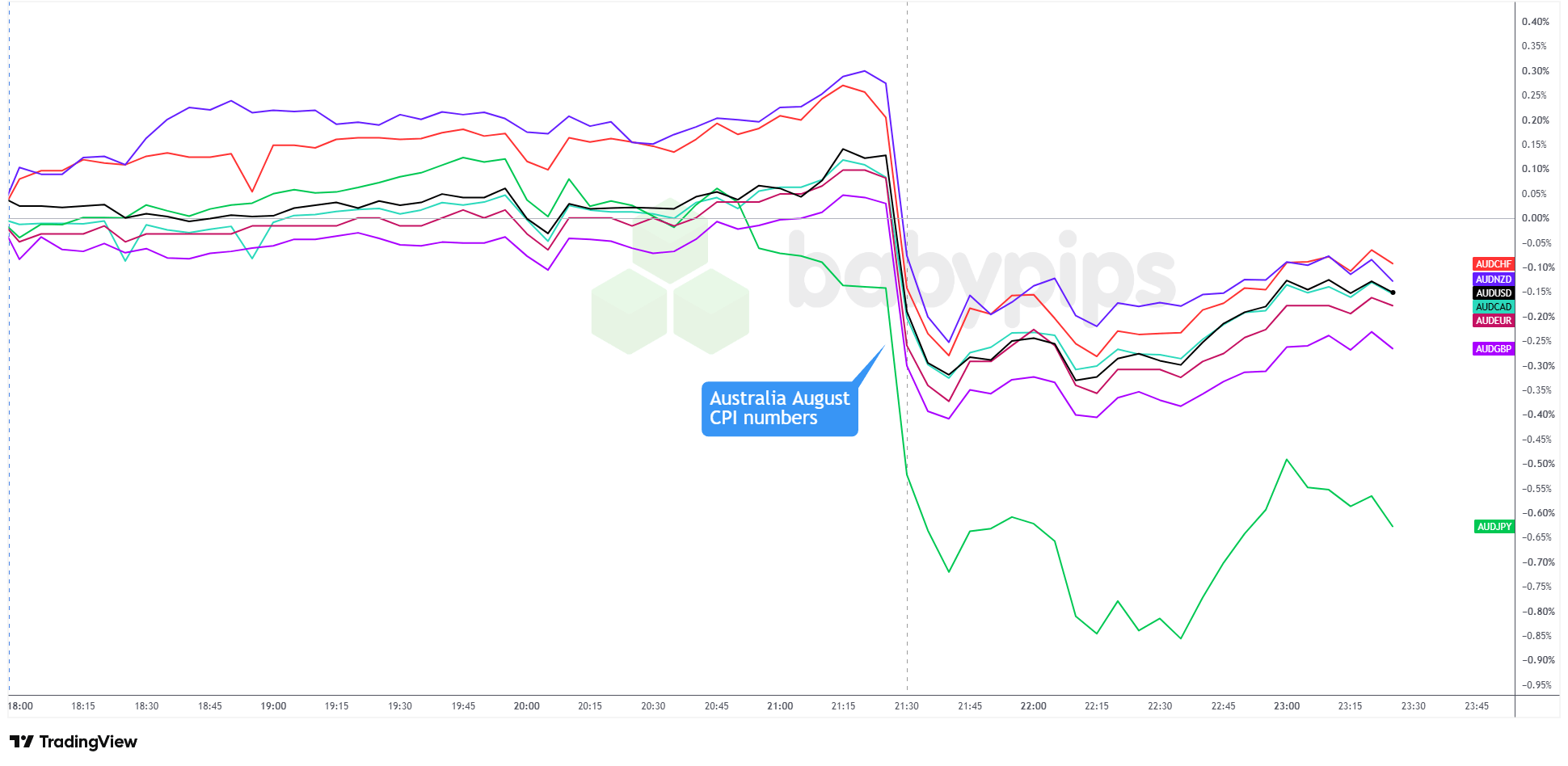
AUD 5-Minute Forex Chart Faster With TradingView
Oil is the big variable from here. Brent priced at around $100 per barrel could keep inflation elevated, push the RBA toward further tightening, and support AUD through wider interest rate differentials. But if the Iran conflict drags on and growth slows while inflation stays high, stagflation risks could muddy the currency outlook.
Brent reached $109 per barrel in September, a surge that isn’t reflected in the August CPI report. September’s inflation data, due in late October, should offer a clearer picture and could trigger another sharp repricing of RBA rate expectations.
Frequently Asked Questions About Australian CPI
What does Australia’s consumer price index measure?
Australia’s CPI tracks changes in the prices households pay for a basket of goods and services. The Australian Bureau of Statistics releases the data each month. The RBA targets annual inflation of 2% to 3% and may raise interest rates when price pressures remain too strong.
Why does Australian CPI matter for forex traders?
CPI helps shape expectations for RBA interest rate decisions. Stronger than expected inflation can lift rate hike bets and support the Australian dollar, while a softer reading can have the opposite effect. That’s why CPI can quickly move Australian bond yields and AUD pairs such as AUD/USD.
What happened with Australian inflation in August 2026?
Headline CPI rose 4.0% from a year earlier in August, up from 3.5% in July but below the 4.1% forecast. Monthly CPI increased 0.4%, missing the 0.5% estimate. Core inflation held at 3.6%, while fuel prices surged 14.8% during the month as global oil prices climbed and federal fuel relief expired.
What is trimmed mean inflation and why does the RBA watch it?
Trimmed mean inflation removes the largest and smallest 15% of price changes, filtering out temporary spikes and dips. This gives the RBA a clearer view of broad price pressures. Australia’s trimmed mean held at 3.6% in August, remaining above the RBA’s 2% to 3% target.
Is the RBA expected to raise interest rates again in 2026?
Another hike is possible, but markets aren’t convinced. The estimated chance of a November increase fell from around 35% to 40% before the August CPI report to roughly 20% afterward. September’s CPI report, due in late October, could help determine whether the RBA hikes again or waits until 2027.
This report covers trimmed mean inflation, the RBA’s 2-3% target, and stagflation risk — concepts that are easier to interpret when you understand how inflation data actually drives central bank thinking. Premium members can read our lesson:
📖 Inflation: The Force That Moves Central Banks
Reading this helps you understand how central banks weigh different inflation measures, why the trimmed mean carries more weight than the headline CPI reading for the RBA, and how inflation regimes like stagflation complicate a central bank’s options and cloud the currency outlook.
And if you’re not a Premium subscriber yet, now’s a good time to sign up.
With Babypips Premium, you get full access to School of Pipsology lessons that help you understand not just what CPI measures, but how different inflation regimes shape central bank decisions and what that means for the currency pairs you’re trading.