


Markets swung on suspected Bank of Japan intervention Thursday, with the dollar tumbling against the yen and the broader majors after the U.S. session opened.
A rebound in chipmakers and Microsoft’s cloud growth lifted U.S. equities out of Wednesday’s technology rout, even as a weaker than expected GDP print underscored a softer growth backdrop for the Federal Reserve to weigh.
Check out the forex news and economic updates you may have missed in the latest trading session!
News Headlines & Data:
- New Zealand ANZ Business Confidence for July 2026: 56.1 (36.0 forecast; 36.6 previous)
- Australia Import Prices for Q2 2026: 5.7% q/q (0.2% q/q forecast; 0.1% q/q previous)
- Australia Export Prices for Q2 2026: 1.1% q/q (0.5% q/q forecast; 0.5% q/q previous)
- Australia Building Permits Prel for June 2026: 8.9% y/y (-0.1% y/y forecast; 5.3% y/y previous)
- Japan Consumer Confidence for July 2026: 34.9 (34.0 forecast; 33.8 previous)
- Swiss KOF Leading Indicators for July 2026: 103.5 (101.1 forecast; 101.2 previous)
- Euro area GDP Growth Rate Flash for Q2 2026: 1.0% y/y (0.4% y/y forecast; 0.3% y/y previous)
- Euro area Unemployment Rate for June 2026: 6.3% (6.2% forecast; 6.2% previous)
- Euro area Economic Sentiment for July 2026: 96.9 (95.9 forecast; 95.0 previous)
- The Bank of England kept its Bank Rate unchanged at 3.75% on July 30, 2026, with the Monetary Policy Committee voting 6–3 to hold after a larger-than-expected fall in June inflation to 2.6% gave policymakers room to pause amid renewed Middle East tensions and volatile oil prices. Governor Andrew Bailey’s press conference emphasized that while inflation remains above the 2% target, the central bank is monitoring energy-price pass-through and wage pressures closely, with markets still pricing in at least one 25bp hike later in 2026 as the MPC flagged a higher likelihood of two rate increases by Q3 2027.
- The Japanese Yen surged on Thursday, suspected to be driven by BOJ Intervention
- Canada Average Weekly Earnings for May 2026: 3.4% y/y (3.7% y/y forecast; 3.8% y/y previous)
- U.S. GDP Growth Rate Adv for Q2 2026: 1.5% q/q (2.1% q/q forecast; 2.1% q/q previous)
- U.S. Initial Jobless Claims for July 25, 2026: 197.0k (200.0k forecast; 187.0k previous)
- U.S. Personal Spending for June 2026: 0.3% m/m (0.2% m/m forecast; 0.7% m/m previous)
- U.S. Core PCE Price Index for June 2026: 3.3% y/y (3.2% y/y forecast; 3.4% y/y previous)
Broad Market Price Action:
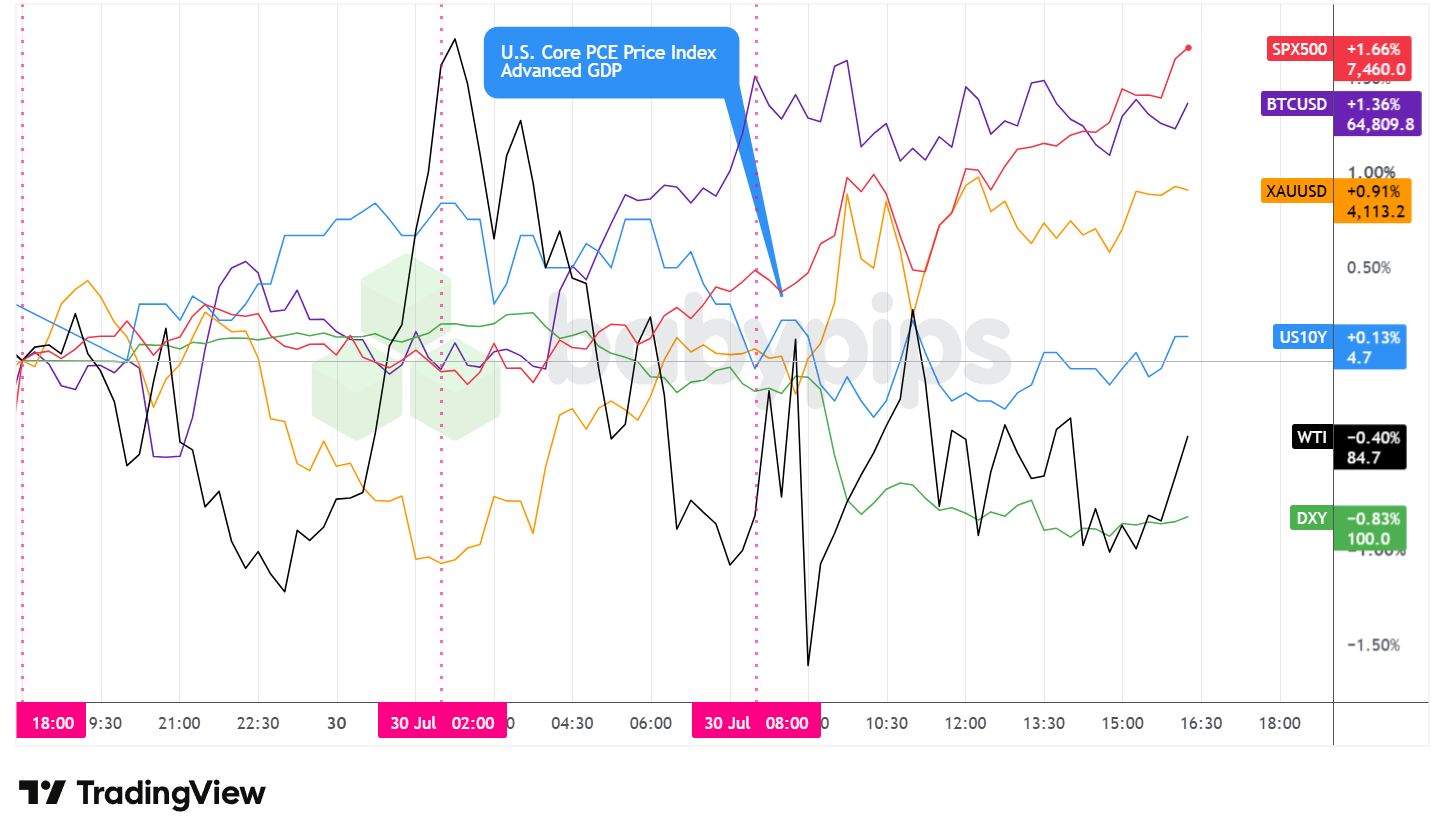
Dollar Index, Gold, Oil, S&P 500, U.S. 10-yr Yield, Bitcoin Overlay – Chart Faster With TradingView
U.S. equities extended Thursday’s rebound after Wednesday’s selloff in some of the market’s most crowded technology trades. Bloomberg reported that a gauge of major semiconductor stocks jumped roughly 8%, and the Nasdaq 100 added several percent a day after closing in a technical correction. Microsoft shares surged on the fastest cloud growth the company had posted in years, and Oracle advanced after expanding its partnership with Google’s Gemini AI platform. Those gains outweighed a soft forecast from Meta Platforms.
The S&P 500 drifted lower through the tail end of the Asian session, found a floor, and climbed through the London morning. The advance picked up once the U.S. cash session opened, and after a brief stumble near midday the index pushed to fresh highs into the afternoon. It closed the day higher by roughly 1.6%, one of its strongest sessions in weeks.
The rally shrugged off a government report showing softer than expected growth last quarter. Gross domestic product expanded at an annualized 1.5% in the second quarter, below the roughly 2.1% economists had expected, even as consumer spending and business investment held up.
Gold pushed higher alongside the broader risk-on tone and the softer dollar. The metal dipped to a session low early in the Asian session, then spent the London morning grinding back through the middle of its range. A sharp break higher followed the U.S. open, lifting the metal to a fresh session high before it settled into a tighter range through the afternoon. Gold finished the day up roughly 1%. With no gold-specific headline to point to, the advance likely reflected the dollar’s broad slide, with some added support from safe-haven demand tied to the Middle East conflict and the session’s yen intervention scare.
Bitcoin tracked the day’s risk-on mood. The cryptocurrency slipped to a session low during the Asian evening, recovered into the London session, and consolidated through the morning. It broke higher after the U.S. open, touched a session high, then pulled back into a tighter band through the afternoon. Bitcoin ended the day up roughly 1.4%. There was no direct catalyst behind the move, and the gain likely tracked the same tech-led risk appetite that lifted equities.
Oil gave back an earlier advance. WTI climbed toward a session peak in the transition from the Asian to the London session, then reversed hard through the remainder of the London morning to a fresh low. A brief bounce followed the U.S. open before the retreat resumed into the afternoon, leaving crude down roughly 0.9% on the day. Bloomberg reported that shipping through the Strait of Hormuz has picked up in recent days despite continued hostilities in the Middle East, with the U.S. saying its navy had escorted tankers through the waterway. That easing in supply anxiety likely weighed on the barrel even as the broader conflict showed no sign of resolution.
The 10-year Treasury yield ground higher through the Asian session to a fresh high, then eased back through the London morning. It chopped in a tight range through the U.S. session, slipped to a session trough, and stabilized into the close, finishing the day little changed.
Promoted: Is Your Small Account Holding Your Strategy Back?
Trading $100 isn’t the same as trading $100k. Emotional discipline & trading flexibility is easier when you have the right backing. FTMO is a global prop firm with a 4.8★ rating on 40K+ reviews, serving traders since 2015! No time limits. Free trials. Up to $200K in Demo Capital.
Start a free trial with FTMO!
Disclosure: To help support our content, we may earn a commission from our partners if you sign up through our links, at no extra cost to you.
FX Market Behavior: U.S. Dollar vs. Majors
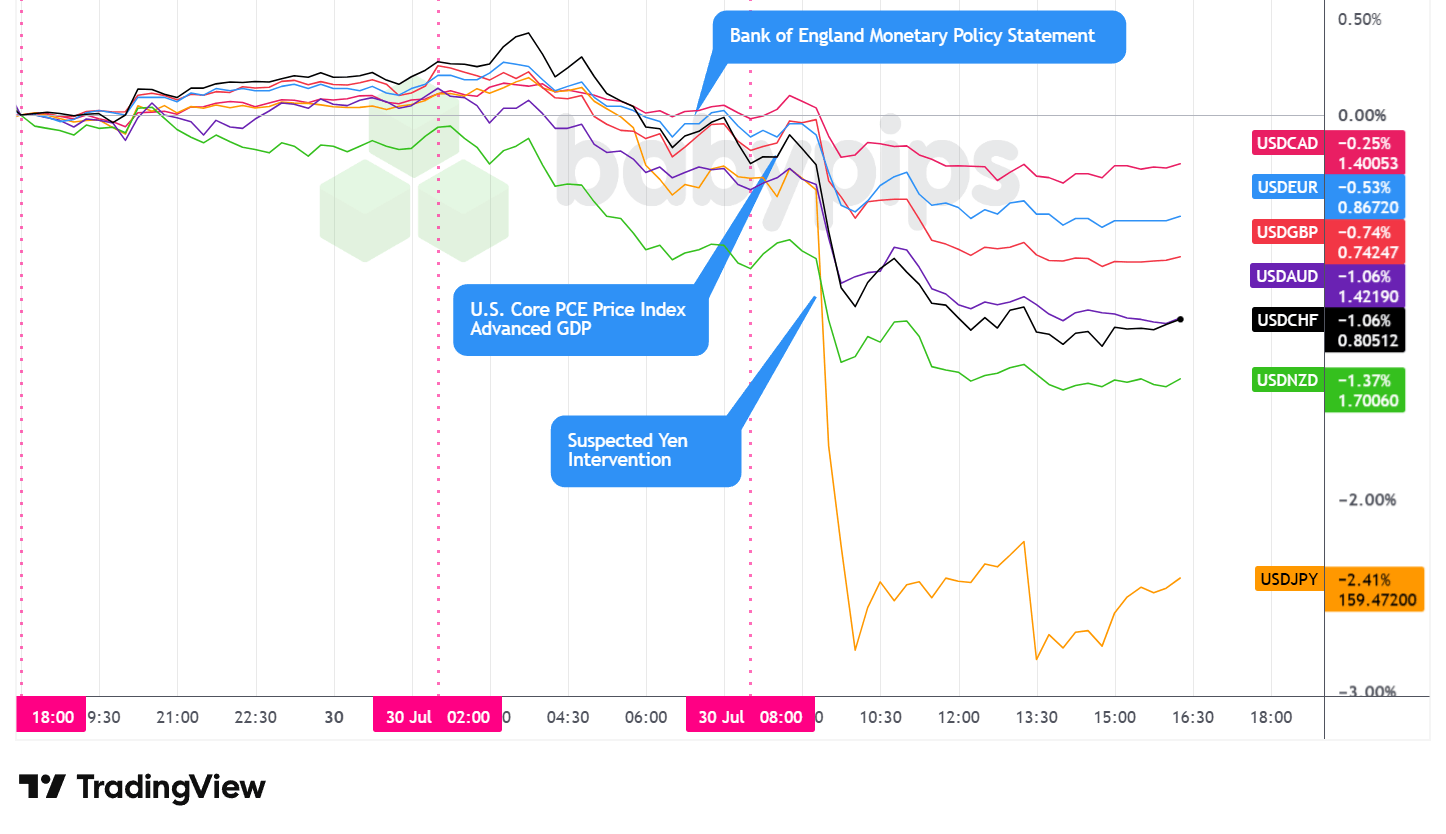
Overlay of USD vs. Majors – Chart Faster With TradingView
The dollar carried Wednesday’s uncertainty into Thursday. Markets were still digesting the Federal Reserve’s decision to hold its benchmark rate at 3.50% to 3.75% in a 9-3 vote, with all three dissents favoring a hike. Chair Kevin Warsh’s press conference struck several outlets as difficult to parse, and the dollar spent Thursday’s Asian session grinding higher against the major currencies on net, with no clear headline behind the move.
That drift reversed after the London open. The dollar stabilized briefly, then turned lower against the majors through the morning, giving back the Asian session’s gains before stabilizing again just ahead of the U.S. open. Away from the dollar, euro area data reaffirmed resilience in second quarter growth even as July inflation firmed, and the Bank of England held its rate steady, judging that a bigger than expected drop in June inflation gave policymakers room to wait.
The larger move came shortly after the U.S. session opened. The dollar fell on net against the majors, and the decline looked driven in large part by USD/JPY. The yen jumped as much as 2% against the dollar within minutes, around 9:55 a.m. New York time, with no data release or scheduled headline behind it. The move revived suspicion that Japan’s Ministry of Finance had stepped back into the market to defend the currency, though the ministry had not confirmed or denied it as of Thursday afternoon.
At Thursday’s close the dollar stood as the session’s worst performing major currency. The declines were broad but uneven: down only a few tenths of a percent against the Canadian dollar and the euro, a bit more against sterling and the Swiss franc, and sharpest against the yen and the New Zealand dollar. It’s possible that month-end positioning and Thursday’s softer GDP print added to the broader pressure on the dollar, though the yen-driven leg of the selloff after the U.S. open likely accounted for most of the day’s damage.
Upcoming Potential Catalysts on the Economic Calendar
- New Zealand ANZ Roy Morgan Consumer Confidence for July 2026 at 10:00 pm GMT
- Japan Core CPI for July 2026 at 11:30 pm GMT
- Japan Unemployment Rate for June 2026 at 11:30 pm GMT
- Japan Tokyo CPI for July 2026 at 11:30 pm GMT
- Japan Retail Sales for June 2026 at 11:50 pm GMT
- Japan Industrial Production Prel for June 2026 at 11:50 pm GMT
- Bank of Japan Governor Ueda Speech
- Australia PPI for June 30, 2026 at 1:30 am GMT
- Australia Private & Housing Credit MoM for June 2026 at 1:30 am GMT
- China NBS Manufacturing PMI for July 2026 at 1:30 am GMT
-
Bank of Japan Interest Rate Decision for July 31, 2026 at 3:00 am GMT
- BoJ Quarterly Outlook Report at 3:00 am GMT
- Japan Housing Starts for June 2026 at 5:00 am GMT
- U.K. Nationwide Housing Prices for July 2026 at 6:00 am GMT
- Swiss Retail Sales for June 2026 at 6:30 am GMT
- Germany Unemployment Rate for July 2026 at 7:55 am GMT
- Euro area CPI Growth Rate Flash for July 2026 at 9:00 am GMT
- Canada GDP Prel for June 2026 at 12:30 pm GMT
- U.S. Employment Cost Index QoQ for June 30, 2026 at 12:30 pm GMT
- U.S. Chicago PMI for July 2026 at 1:45 pm GMT
- UoM Consumer Sentiment Index for July 2026 at 2:00 pm GMT
- Canada Budget Balance for May 2026 at 3:00 pm GMT
Friday stacks two separate yen catalysts within hours of each other. The Bank of Japan wraps its policy meeting with markets broadly expecting a hold, but Thursday’s suspected intervention raises the stakes for whatever guidance Governor Ueda offers on the pace of future hikes.
Japan’s Ministry of Finance is also due to publish intervention data covering the period through July 29, a release that could confirm or complicate the speculation building around Thursday’s yen spike.
Away from Japan, a dense European slate (German unemployment, the flash euro area inflation print, and Swiss retail sales) lands ahead of the London open, while the U.S. session brings the employment cost index, Chicago PMI, and the University of Michigan’s final consumer sentiment read.
Given the dollar’s broad retreat Thursday, it’s possible that further signs of policy divergence, whether a firmer BOJ tone or additional confirmation of intervention, could extend the greenback’s slide into Friday’s close.
Stay frosty out there, forex friends!
Thursday’s suspected yen intervention marked a textbook example of how central banks defend their currency when the market pushes too far in one direction. Premium members can read our lesson:
📖 Currency Intervention: When Central Banks Enter the Market
Reading this helps you understand how to spot central bank intervention coming, what it looks like when it actually happens, and how to manage your risk when an official actor steps into the market.
And if you’re not a Premium subscriber yet, this is a perfect moment to join. Understanding official intervention separates traders who get caught off guard from those who stay ahead.
With Babypips Premium, you get full access to School of Pipsology lessons that help you understand not just when central banks act, but how to anticipate their moves and position accordingly before the market reacts