


Markets turned risk-off on Monday as a fresh escalation in the U.S.-Iran conflict and President Trump’s surprise Strait of Hormuz fee announcement sent oil surging, pressured equities and gold, and firmed the dollar as Fed rate-hike expectations revived. Higher energy costs collided with hawkish Fed commentary just as second-quarter earnings season opened.
Check out the forex news and economic updates you may have missed in the latest trading session!
Forex News Headlines & Data:
- Over the weekend, Iran also launched drone strikes on Oman, while US Central Command hit Iranian military targets
- New Zealand Composite NZ PCI for June 2026: 53.6 (48.9 forecast; 48.4 previous)
- New Zealand Services NZ PSI for June 2026: 50.6 (48.3 forecast; 47.5 previous)
- On Monday, Fed Governor Waller warned that hot core inflation readings this week could prompt the FOMC to consider tightening monetary policy in the near term. He noted broad-based recent increases in core inflation (not primarily due to tariffs) and stressed the need for several months of consistent lower readings to confirm progress toward the 2% target.
- US President Trump made a controversial announcement on Monday to impose a 20% “guardian” fee on Strait of Hormuz shipping and reinstate a blockade on Iranian vessels.
Promoted: Is Your Small Account Holding Your Strategy Back?
Trading $100 isn’t the same as trading $100k. Emotional discipline & trading flexibility is easier when you have the right backing. FTMO is a global prop firm with a 4.8★ rating on 40K+ reviews, serving traders since 2015! No time limits. Free trials. Up to $200K in Demo Capital.
Start a free trial with FTMO!
Disclosure: To help support our content, we may earn a commission from our partners if you sign up through our links, at no extra cost to you.
Broad Market Price Action:
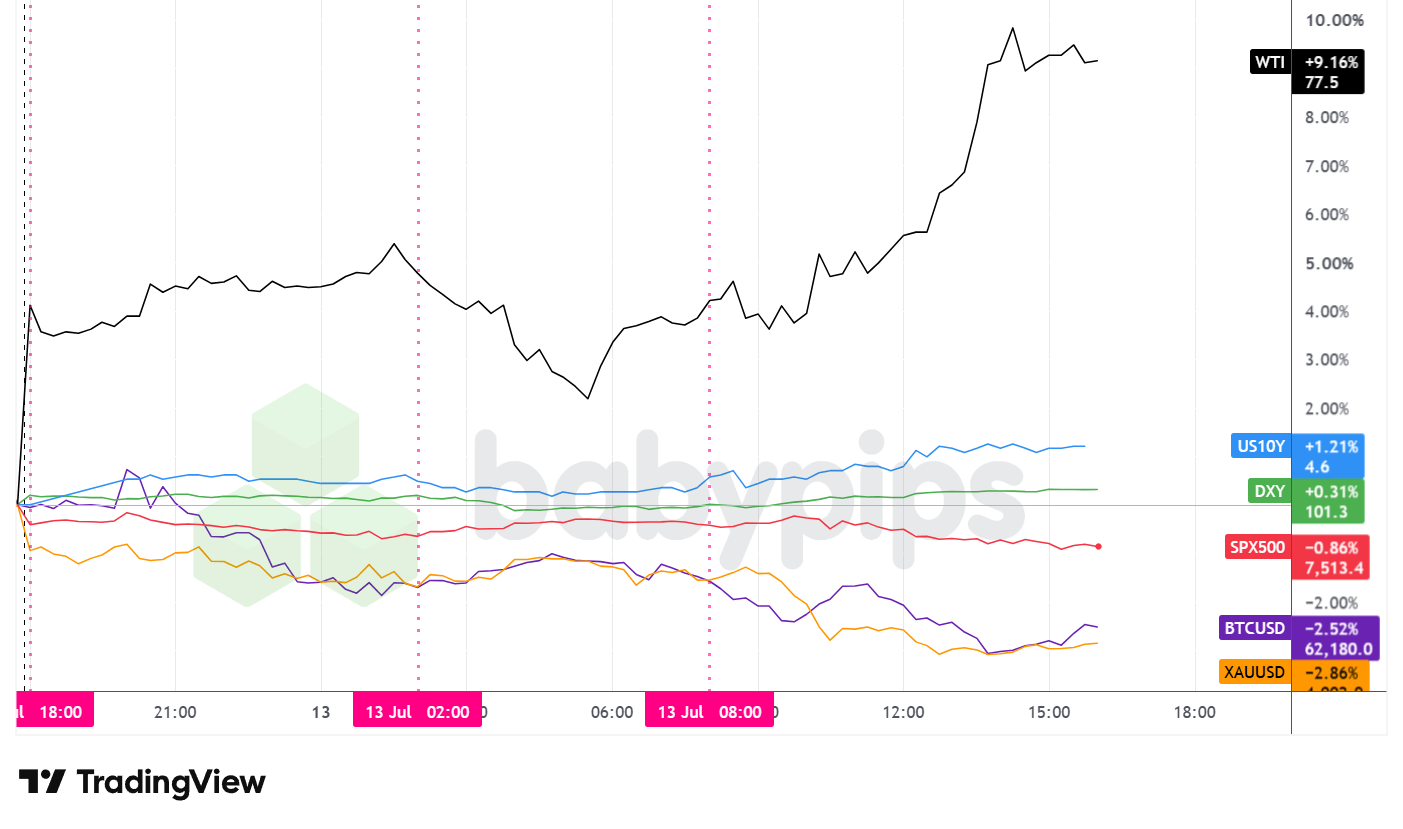
Dollar Index, Gold, Oil, S&P 500, U.S. 10-yr Yield, Bitcoin Overlay – Chart Faster With TradingView
WTI crude oil was the session’s standout, surging roughly 9% to around $77.50 a barrel. The rally tracked the intensifying U.S.-Iran conflict and Trump’s Monday announcement of a 20% fee on Hormuz cargo alongside a renewed blockade of Iranian vessels. Prices built gains through the London and U.S. sessions, with the sharpest leg higher arriving in the early afternoon as traders priced in a tangible threat to a chokepoint that carries roughly a fifth of the world’s seaborne oil.
The S&P 500 fell about 0.86% to close near 7,513. The index chopped through the Asian and London hours before selling off through the U.S. afternoon, pressured by the risk-off tone out of the Middle East and a renewed slide in semiconductor shares. Rising oil prices layered a fresh inflation worry onto the tape just as second-quarter earnings season got underway, and it’s worth noting that markets remain uneasy over whether the heavy spending on artificial intelligence will pay off.
Gold dropped roughly 2.86% to around $4,003 an ounce, an unusual move for a safe haven during a geopolitical flare-up. The decline likely reflected a firmer dollar and revived Fed rate-hike expectations following Waller’s comments, both of which raise the opportunity cost of holding a non-yielding asset. The metal slid steadily from the U.S. morning before stabilizing into the close.
Bitcoin fell about 2.52% to near $62,180. It traded lower for most of the session with no crypto-specific catalyst to point to, a move that possibly reflected the broad risk-off sentiment driving the day’s action across speculative assets.
The 10-year Treasury yield climbed to around 4.6%, grinding higher through the U.S. session. The move fit the day’s theme of rising inflation expectations, with oil pushing higher and Waller flagging the risk that persistent core inflation could force the Fed to tighten rather than ease.
Promoted: Profitable Trading Isn’t Reserved for Wall Street.
Most traders quietly wonder if consistent profitability is actually achievable for someone like them—or if it’s just a story people tell. Jack Schwager’s newest book, “Market Wizards: The Next Generation,” answers that question directly. The legendary author behind the original Market Wizards series interviews a new generation of successful traders—many self-taught—who built real wealth and income through the markets. Their common thread isn’t genius or insider access. It’s a deliberate process, disciplined risk management, and the conviction to take trading seriously as a pursuit worth mastering.
If that sounds like something worth exploring, this is a good place to start.
Get Market Wizards: The Next Generation on Amazon!
Disclosure: We may earn a commission from our partners if you sign up through our links, at no extra cost to you.
FX Market Behavior: U.S. Dollar vs. Majors
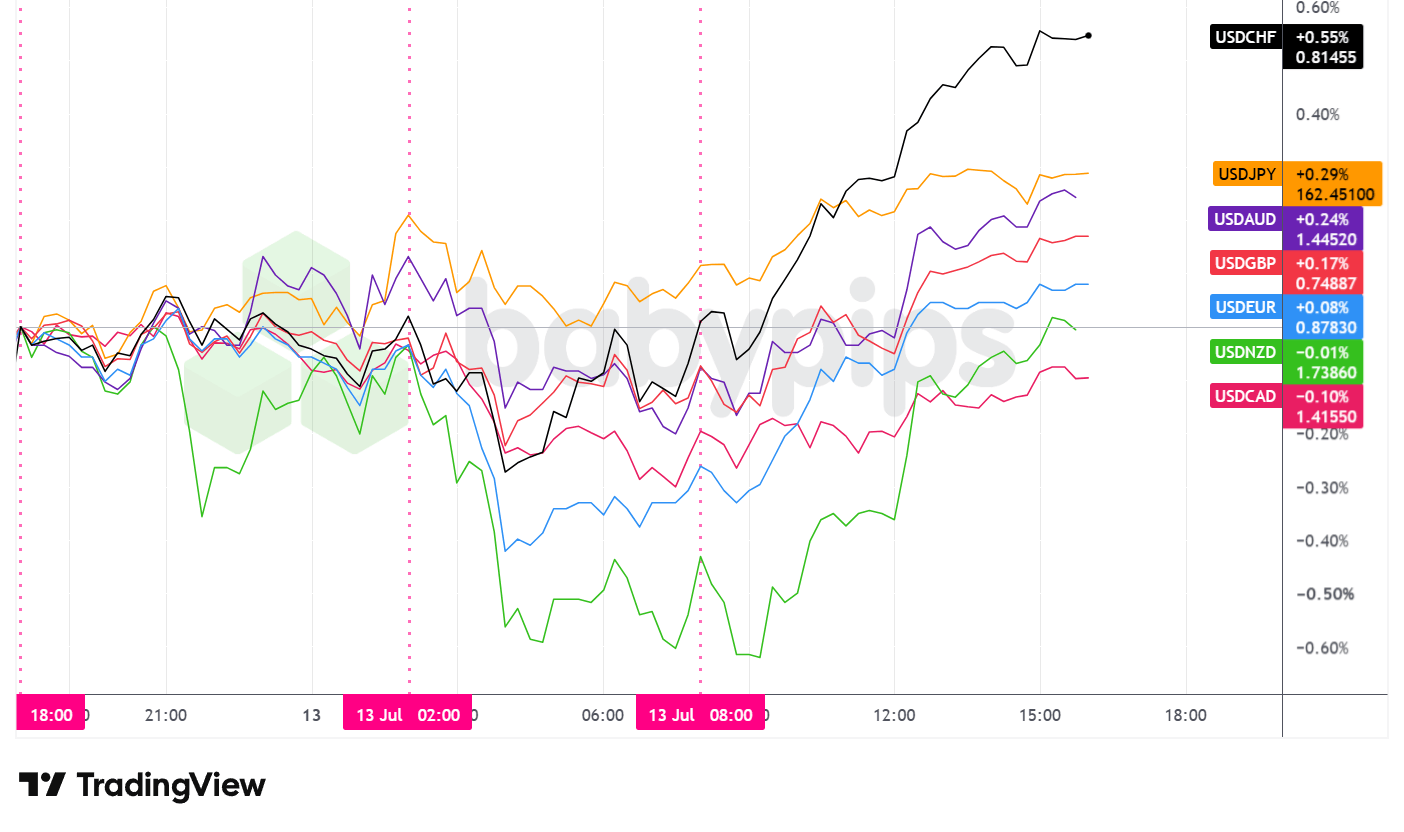
Overlay of USD vs. Majors – Chart Faster With TradingView
The U.S. dollar finished Monday as a net outperformer against the majors, recovering from an early-session dip to close higher against most of its peers. The Dollar Index firmed to around 101.3.
During the Asian session, the dollar index gapped higher from Friday’s close, likely in reaction to military escalation between the U.S. and Iran over the weekend. But USD quickly stabilized and traded choppy/sideways, arguably neutral heading into the London session, with no single Asia catalysts to point to driving direction.
After the London open, the dollar fell against the major currencies before finding a bottom and rebounding slightly heading into the U.S. session. There were no fresh catalysts to drive direction, so an argument could be made that some of the softness came on profit taking from the Asia gap higher.
During the U.S. session, the dollar rebounded against the majors and held that bid into the close. The recovery aligned with Trump’s Hormuz announcement and Waller’s warning on core inflation, with money markets moving to price roughly even odds of a Fed rate hike as soon as July.
At the Monday close, the dollar was a net outperformer, advancing against every major except the Canadian dollar, with the New Zealand dollar finishing roughly flat. Its strongest gain came against the Swiss franc. The loonie’s resilience likely drew support from the sharp rally in crude oil, a key driver for the commodity-linked currency.
Promoted: Protecting your trading capital starts with securing your access. Don’t let a weak password be the single point of failure for your brokerage or prop firm accounts. LastPass simplifies your digital life by generating and storing complex, encrypted passwords for every site you use.
Try LastPass for Free Today!
Disclosure: We may earn a commission from our partners if you sign up through our links, at no extra cost to you.
Upcoming Potential Catalysts on the Economic Calendar
- New Zealand NZIER Business Confidence for June 30, 2026 at 10:00 pm GMT
- New Zealand Visitor Arrivals for May 2026 at 10:45 pm GMT
- U.K. BRC Retail Sales Monitor for June 2026 at 11:01 pm GMT
- Australia Westpac Consumer Confidence Change for July 2026 at 12:30 am GMT
- Australia NAB Business Confidence for June 2026 at 1:30 am GMT
- China Balance of Trade for June 2026 at 3:00 am GMT
- Japan Industrial Production Final for May 2026 at 4:30 am GMT
- Japan Capacity Utilization Rate for May 2026 at 4:30 am GMT
- Germany Wholesale Prices for June 2026 at 6:00 am GMT
- Swiss Producer & Import Prices for June 2026 at 6:30 am GMT
- China Monetary Developments for June 2026
- Bank of England Governor Bailey Speech at 8:00 am GMT
- U.S. NFIB Business Optimism Index for June 2026 at 10:00 am GMT
- U.S. ADP Employment Change Weekly for June 27, 2026 at 12:15 pm GMT
- U.S. CPI Growth Rate for June 2026 at 12:30 pm GMT
- U.S. Fed Chair Warsh Testimony at 2:00 pm GMT
- U.S. Fed Barr Speech at 4:40 pm GMT
- U.S. Fed Goolsbee Speech at 5:00 pm GMT
- U.S. Fed Cook Speech at 5:30 pm GMT
- U.S. Fed Bowman Speech at 6:55 pm GMT
Tuesday’s calendar is headlined by the June U.S. CPI report, with headline inflation expected to cool, followed ninety minutes later by Fed Chair Warsh’s first appearance before Congress in the role. With oil prices elevated and rate-hike odds climbing, traders will likely watch whether a soft inflation print can offset the inflationary pull of higher energy costs. The path of the U.S.-Iran conflict and the status of Hormuz remain the dominant wildcard heading into the print.
Stay frosty out there, forex friends!
When major geopolitical news breaks, markets don’t react in a single, predictable wave. This recap shows how the Iran escalation triggered an initial spike in oil, followed by a deeper analytical repricing across equities, bonds, and the dollar. Premium members can read our lesson:
📖 From Data to Price Action: What Happens When Big News Hits
Reading this helps you understand what actually happens in the FX market the moment major news lands, how the initial spike differs from the secondary analytical move, and why understanding that cascade helps you trade the reaction instead of getting caught in it.
And if you’re not a Premium subscriber yet, consider joining.
With Babypips Premium, you get full access to School of Pipsology lessons that help you understand not just which assets are reacting, but the precise cascade of how news flows through oil, inflation expectations, Fed policy, and currency values.