


President Trump declared the U.S.-Iran ceasefire “over” on Wednesday after a fresh exchange of strikes, driving oil higher and pulling stocks, gold, and bitcoin lower. Minutes from the Fed’s June meeting landed in the afternoon and showed a few officials had wanted to raise rates, which reinforced bets on tighter policy and lifted Treasury yields. The dollar still drifted lower against most majors, giving back ground to every G10 currency except the yen.
Check out the forex news and economic updates you may have missed in the latest trading session!
Forex News Headlines & Data:
- Following reciprocal military strikes between the U.S. and Iran that caused a significant spike in oil prices, Donald Trump declared the temporary ceasefire “over,” leaving traders to brace for potential market volatility.
- Australia Building Permits Final for May 2026: -1.1% m/m (-1.1% m/m forecast; -3.4% m/m previous)
- Australia Private House Approvals Final for May 2026: 2.8% m/m (2.8% m/m forecast; -1.0% m/m previous)
- RBNZ Interest Rate Decision for July 8, 2026: 2.5% (2.25% forecast; 2.25% previous)
- Japan Eco Watchers Survey Outlook for June 2026: 45.7 (42.0 forecast; 40.7 previous)
- U.S. MBA 30-Year Mortgage Rate for July 3, 2026: 6.58% (6.57% previous)
- U.S. MBA Mortgage Applications for July 3, 2026: -2.2% (0.0% previous)
- U.S. Wholesale Inventories for May 2026: 0.1% m/m (0.3% m/m forecast; 0.6% m/m previous)
- U.S. EIA Crude Oil Stocks Change for July 3, 2026: 3.0M (-3.78M previous)
- U.S. FOMC Minutes (June 16–17, 2026): the FOMC decided to maintain the target federal funds rate at 3.5% to 3.75% amid solid economic growth and stable labor market conditions. However, policymakers highlighted that inflation remains elevated due to recent supply shocks and strong AI-related demand, reaffirming their commitment to achieving long-term price stability.
Promoted: Scale Your Central Bank Strategies
As the Aussie trades higher and geopolitical shocks whipsaw traders, navigating the 2026 macro landscape requires more than just a good entry—it requires a partner that has seen it all before.While new firms come and go with the volatility, The5ers has spent the last 10 years perfecting a funding model that works for the trader. It’s why over 1.6 million traders worldwide trust them to provide the capital and scaling needed to turn market analysis into meaningful professional growth.
Learn more about The5ers Disclosure: We may earn a commission from our partners if you sign up through our links, at no extra cost to you.
Broad Market Price Action:
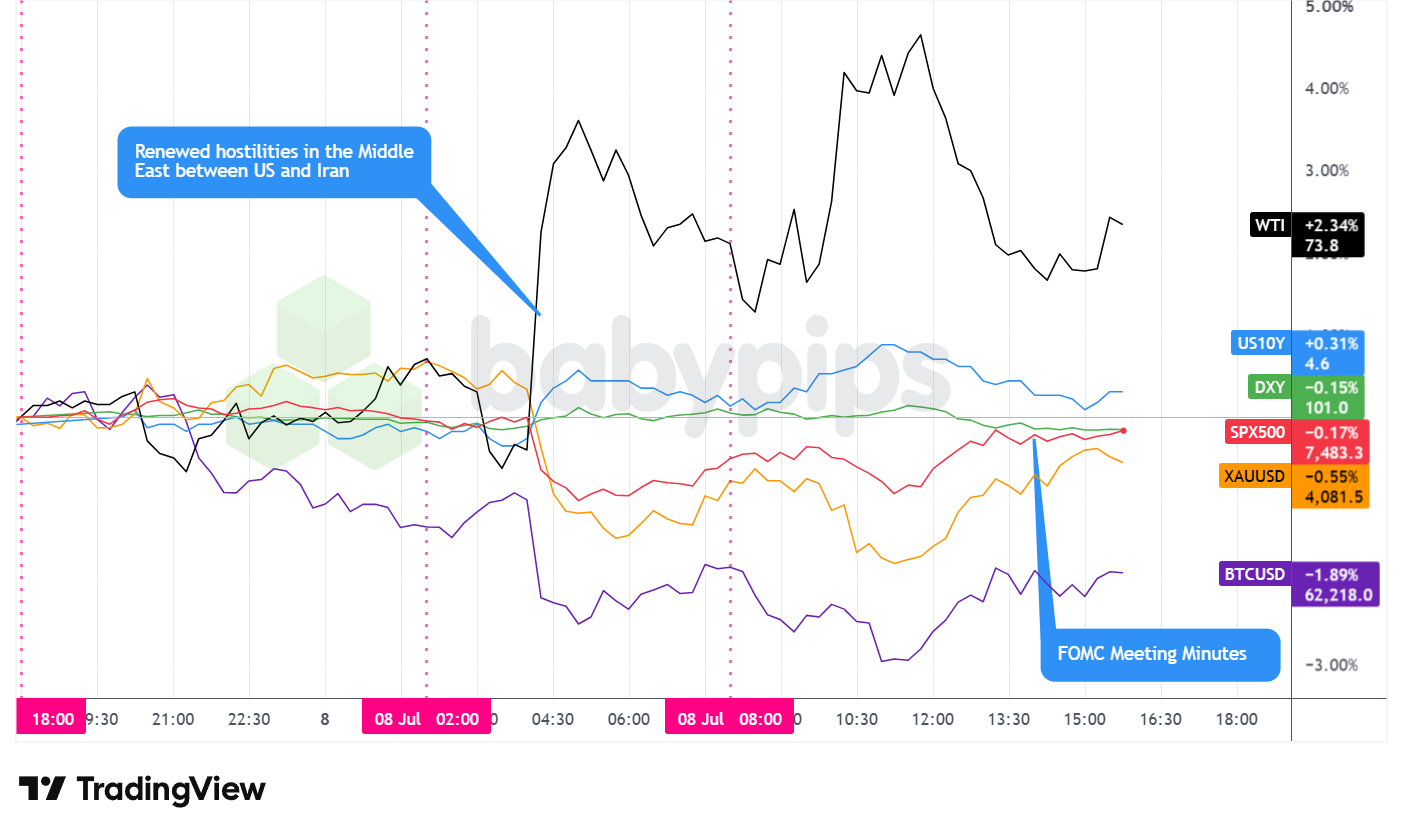
Dollar Index, Gold, Oil, S&P 500, U.S. 10-yr Yield, Bitcoin Overlay – Chart Faster With TradingView
Renewed hostilities in the Middle East set the tone for Wednesday. Oil jumped, equities and precious metals sold off into the European morning, and Treasuries came under pressure as traders raised the odds of Fed rate hikes.
WTI crude led the day, climbing roughly 2.3% to trade around $73.8. The move began after the U.S. struck Iranian targets and the Treasury revoked the waiver that had allowed Iranian oil sales, then gathered pace once Trump called the ceasefire finished. Prices spiked toward $75.7 intraday before easing back through the US afternoon, possibly as traders weighed the risk of disrupted flows through the Strait of Hormuz against Trump’s suggestion that the standoff could resolve quickly.
The S&P 500 finished near 7,483, down about 0.17%, a small loss that masked a sharp intraday swing. The index dropped toward 7,420 in early European trading as the Iran headlines hit, then clawed back most of the decline across the US session. The recovery appeared to line up with Trump’s comment that he did not expect the war to reignite, and chip-related names helped steady the tape.
Gold slipped roughly 0.55% to around $4,081, an unusual result on a day of rising geopolitical risk. The metal ran up near $4,133 overnight before dropping to about $4,022 as the session developed, then recovered part of the loss. The soft close possibly reflected the pull of rising rate-hike expectations and firmer yields, which tend to work against a non-yielding asset and appeared to offset whatever safe-haven bid the Iran news generated.
The 10-year Treasury yield rose about 0.3% on the day, holding in the 4.5% area and pressing toward its June high. Higher oil prices and the afternoon Fed minutes, which showed policymakers growing more worried about inflation, pushed money markets to price a greater chance of rate increases later this year.
Bitcoin fell around 1.89% to roughly $62,218, sliding to about $61,454 at its worst before stabilizing. No crypto-specific catalyst stood out, and the move likely tracked the broader risk-off mood and the day’s shift toward tighter rate expectations.
Promoted: Profitable Trading Isn’t Reserved for Wall Street.
Most traders quietly wonder if consistent profitability is actually achievable for someone like them—or if it’s just a story people tell. Jack Schwager’s newest book, “Market Wizards: The Next Generation,” answers that question directly. The legendary author behind the original Market Wizards series interviews a new generation of successful traders—many self-taught—who built real wealth and income through the markets. Their common thread isn’t genius or insider access. It’s a deliberate process, disciplined risk management, and the conviction to take trading seriously as a pursuit worth mastering.
If that sounds like something worth exploring, this is a good place to start.
Get Market Wizards: The Next Generation on Amazon!
Disclosure: We may earn a commission from our partners if you sign up through our links, at no extra cost to you.
FX Market Behavior: U.S. Dollar vs. Majors
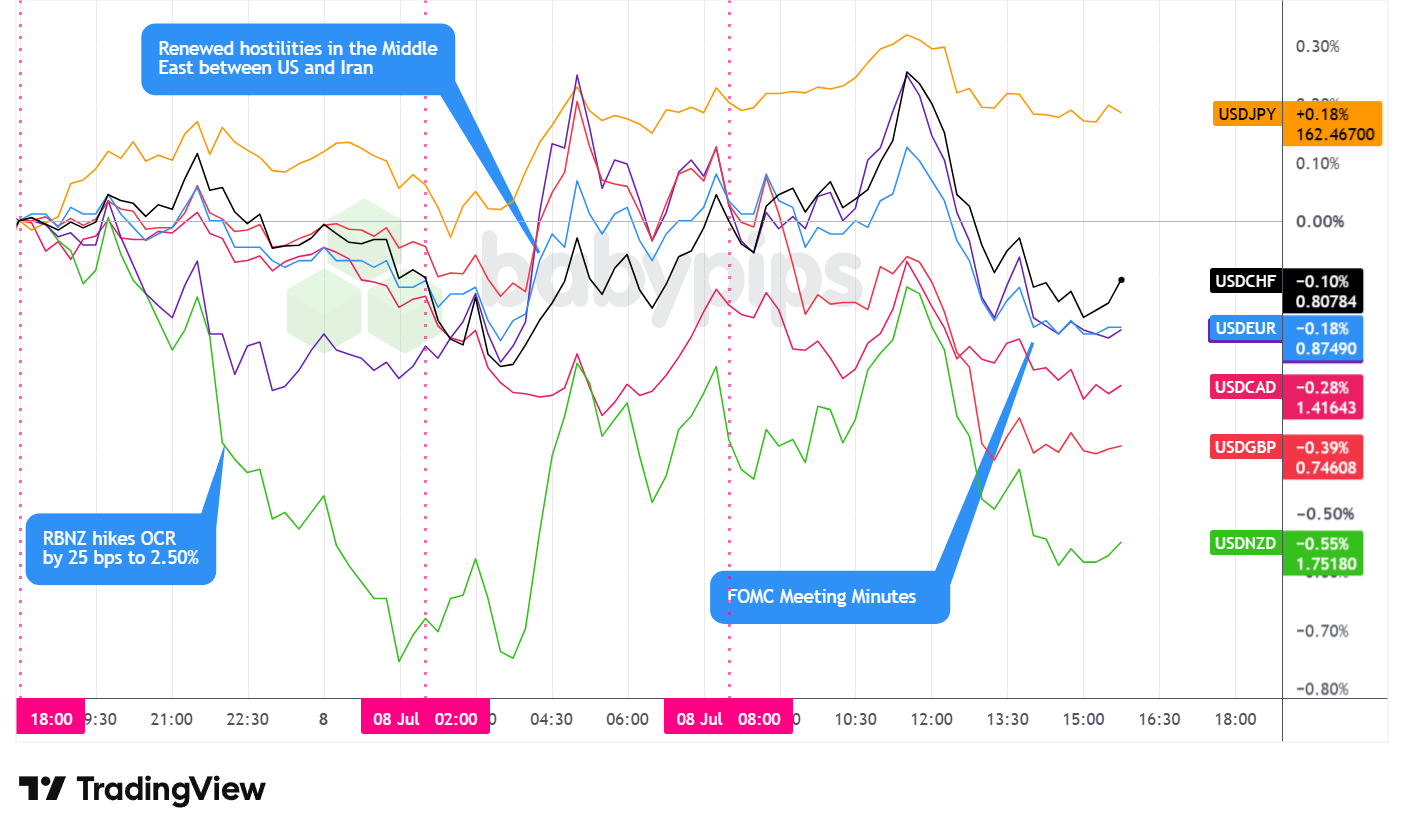
Overlay of USD vs. Majors – Chart Faster With TradingView
The U.S. dollar ended Wednesday lower against every major currency except the Japanese yen, with the dollar index easing about 0.15%.
During the Asian session, the dollar traded mixed but with a net lower lean. The clearest move came from the New Zealand dollar, which jumped after the RBNZ raised its Official Cash Rate by 25 basis points to 2.50%. Markets had positioned for a hold at 2.25%, so the hawkish surprise made the Kiwi the strongest major on the day.
Shortly after the London open, the dollar steadied and then rebounded through mid-morning before pulling back and chopping into the US open. The renewed U.S.-Iran hostilities ran through this window, and the greenback’s brief firming possibly reflected a short-lived safe-haven bid before broader dollar softness took over. The ECB’s Escriva offered little that was new, repeating that the bank would keep its options open and decide meeting by meeting.
After the US session open, the dollar again traded mixed, popped higher in a sharp spike around the London close, then reversed and drifted lower through the afternoon. The June FOMC minutes, released at 2:11 pm ET, revealed that a few officials had seen a case for hiking in June and that concern over inflation was building. That read leaned hawkish, yet the dollar still slipped into the close, which suggests it was taking its cue more from the broad risk backdrop and positioning than from the rate outlook alone.
At Wednesday’s close, the dollar sat lower against the Kiwi, pound, Canadian dollar, euro, and franc, roughly in that order of weakness, while it held a small gain against the yen. The yen’s underperformance fit the usual pattern for a currency that tends to lag when Treasury yields climb.
Promoted: Keep Your Automated Edge Running 24/7.
Your algorithmic strategy shouldn’t rely on your home Wi-Fi. In high-volatility events, execution speed and uptime are what separate a winning backtest from a live market success. ForexVPS provides ultra-low latency, dedicated trading servers that keep your algos executing trades around the clock without interruption. Stop letting connectivity issues erode your edge.
Explore VPS plans at ForexVPS!
Disclosure: To help support our free daily content, we may earn a commission from our partners if you sign up through our links, at no extra cost to you.
Upcoming Potential Catalysts on the Economic Calendar
- U.S. Consumer Credit Change for May 2026 at 7:00 pm GMT
- New Zealand Business NZ PMI for June 2026 at 10:30 pm GMT
- U.K. RICS House Price Balance for June 2026 at 11:01 pm GMT
- China CPI & PPI Growth Rates for June 2026 at 1:30 am GMT
- Germany Balance of Trade for May 2026 at 6:00 am GMT
- Japan Machine Tool Orders for June 2026 at 6:00 am GMT
- ECB Monetary Policy Meeting Accounts at 11:30 am GMT
- U.S. Initial Jobless Claims for July 4, 2026 at 12:30 pm GMT
- U.S. Fed Williams Speech at 1:00 pm GMT
- U.S. Existing Home Sales for June 2026 at 2:00 pm GMT
- U.S. Fed Logan Speech at 5:30 pm GMT
Thursday’s calendar leans toward inflation and central bank signals. China’s CPI and PPI prints offer an early read on global price pressures, the ECB’s meeting accounts should show how divided the Governing Council is, and U.S. initial jobless claims will test the labor-market picture the Fed flagged this week.
Fed speakers Williams and Logan could add color on how the committee weighs renewed energy-driven inflation risk. Traders will keep one eye on the Iran situation throughout, since fresh headlines can move oil and risk sentiment at any hour.
Stay frosty out there, forex friends!
On Wednesday, the Fed’s hawkish minutes on inflation should have supported the dollar, but it weakened instead. This happens because global risk sentiment, not just interest rates, drives currency flows. Premium members can read our lesson:
📖 Risk-On / Risk-Off: How Global Mood Moves Currencies
Reading this helps you understand how the market’s appetite for risk drives currency flows, which pairs win when traders feel bold, and how to check the risk environment before entering any trade.
And if you’re not a Premium subscriber yet, consider joining.
With Babypips Premium, you get full access to School of Pipsology lessons that help you understand how risk sentiment, not just rates, drives currency moves.