


New Zealand just snapped a three-year streak. On July 8, the RBNZ raised its Official Cash Rate 25 basis points to 2.50%, its first hike since mid-2023. Markets saw this one coming. What they didn’t fully bank on: a chunk of major banks were still calling for a hold right up until the announcement dropped. And the RBNZ’s own follow-up guidance? About as noncommittal as a trader who says “maybe” to every setup. More hikes, sure. Just don’t ask when.
RBNZ July 2026 Decision: Key Takeaways
- The hike: 25 basis points, from 2.25% to 2.50%. First increase in three years
- The vote that wasn’t: All six committee members backed the move by consensus; two flagged upside inflation risk, four (Governor included) called it balanced
- Inflation, cooling: Annual inflation likely peaked at 3.9% in the June quarter, heading to 3.3% by September and 2% by mid-2027
- The oil assist: A partial reopening of the Strait of Hormuz knocked oil and petrochemical prices sharply lower since May
- Growth, wobbling: The recovery lost momentum in the June quarter as the energy shock bit; a bounce is expected from September
- More hikes teased: The RBNZ says further increases are likely, timing unclear; analysts pencil in the OCR near 3.00% by year-end
- Kiwi bounced: NZD rose roughly 0.4% against the greenback to trade near $0.57 after the announcement
So What Exactly Did the RBNZ Just Do?
Let’s break down the jargon first. New Zealand’s central bank, the RBNZ, raised its Official Cash Rate (OCR) by 25 basis points, from 2.25% to 2.50%. Think of the OCR as the master dial for the entire economy: turn it up, and borrowing gets more expensive everywhere, from mortgages to business loans. A basis point is one-hundredth of a percent, so 25 of them equal 0.25%, no more, no less.
Here’s the interesting part. The RBNZ’s Monetary Policy Committee, a six-person panel led by Governor Anna Breman, reached this decision by consensus. No vote needed. Compare that to May, when the same six-person committee split three-three and Breman had to break the tie herself, in favor of holding. This time, per the RBNZ’s own record of the meeting, two members flagged inflation risks as tilted to the upside. The other four, Breman included, called the risks balanced. Either way, all six landed on the same number.
Why Hike Now, When Oil Prices Just Cooled Off?
Good question, and it’s the whole story. Since May, a partial reopening of the Strait of Hormuz, the shipping lane that carries a massive share of the world’s oil, sent global oil and fuel-linked prices sliding. That took the sharpest edge off the RBNZ’s inflation worries from its May forecasts, which had assumed much pricier oil for the rest of 2026.
But cheaper oil wasn’t a green light to sit tight. At the press conference, Breman explained that the RBNZ saw 2.25% as somewhat below neutral, the setting that neither stimulates nor restrains the economy. In her words, the bank is “removing some of that stimulatory monetary policy and gradually moving towards neutral.” Translation: rates were still giving the economy a boost, and the RBNZ decided that boost wasn’t needed anymore.
There’s a second reason too, and it’s more about optics than economics. The committee worried that holding steady might let financial conditions loosen further, through a softer Kiwi dollar or lower rate expectations, quietly undoing progress already made. Hiking now closes that door.
Promoted: Scale Your Central Bank Strategies
As the Aussie trades higher and geopolitical shocks whipsaw traders, navigating the 2026 macro landscape requires more than just a good entry—it requires a partner that has seen it all before.While new firms come and go with the volatility, The5ers has spent the last 10 years perfecting a funding model that works for the trader. It’s why over 1.6 million traders worldwide trust them to provide the capital and scaling needed to turn market analysis into meaningful professional growth.
Learn more about The5ers Disclosure: We may earn a commission from our partners if you sign up through our links, at no extra cost to you.
Is the Kiwi Economy Actually Bouncing Back?
Kind of. New Zealand’s economy grew 0.8% in the March quarter, a touch softer than the RBNZ expected, though revisions to earlier data mean overall output landed slightly higher than assumed. Then the recovery hit a speed bump. The RBNZ says domestic activity slowed again in the June quarter, with softer card spending and weaker services and manufacturing survey readings all pointing the same direction: demand is cooling.
Housing isn’t helping much either. Prices were down 0.4% year-over-year as of May, and new home building contracted in the first quarter, even as consents for new homes kept climbing. The picture varies a lot by sector too. Exporters like agriculture and tourism are holding up just fine, while discretionary retail and construction are struggling.
The RBNZ expects things to turn a corner in the September quarter as fuel costs ease and confidence returns. Its in-house forecasting model, nicknamed Kiwi-GDP, currently points to 0.6% growth for that quarter. Whether that forecast holds will be the first real test of today’s call.
What’s Next for RBNZ Policy?
The RBNZ says further hikes “appear likely at upcoming meetings,” but won’t pin down a date. Future moves hinge on incoming data, how businesses set their prices, and how much slack is left in the economy. Mark your calendar for September 2, when the RBNZ’s next scheduled review lands alongside a full Monetary Policy Statement and fresh forecasts.
Analysts expect the OCR to land around 3.00% by the end of 2026, likely through two more quarter-point moves in September and December. Capital Economics goes a step further, expecting the RBNZ to hike roughly every other meeting until the OCR tops out near 3.25%.
Markets are already leaning the same way. Interest rate pricing implies about a 60% chance of another hike in September, with roughly 38 basis points of total tightening baked in by year-end. Translation: one more hike looks like the safer bet right now, not two.
What Does This Mean for NZD Traders?
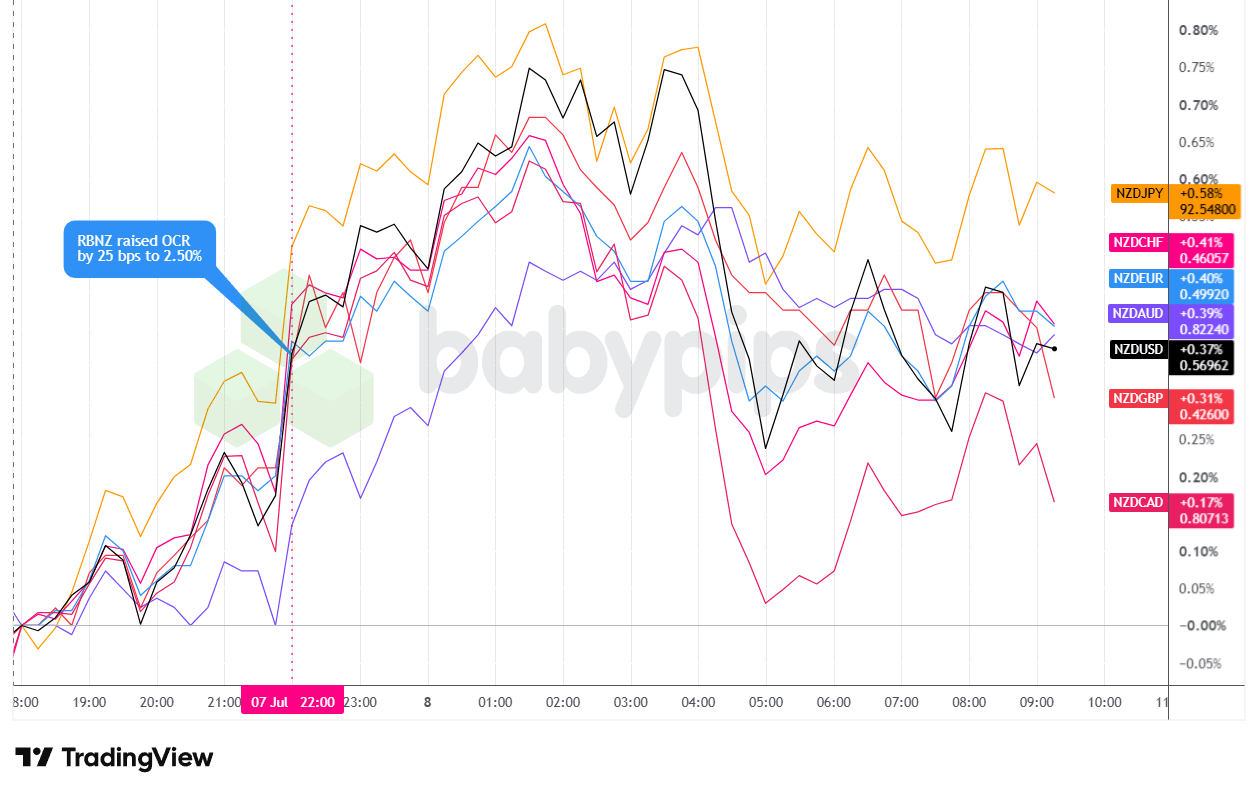
Overlay of NZD vs. Major Currencies Chart Faster with TradingView
The Kiwi dollar popped on the news, gaining about 0.4% to trade near $0.5699 against the US dollar. That partly claws back an overnight dip of roughly 0.3%, triggered by fresh Iran-related tensions that briefly pushed oil prices back up. Higher rates usually support a currency because they make NZD-denominated assets more appealing to yield-hungry investors.
Don’t get too comfortable with that move, though, as there are arguments that this could be calleds a dovish hike: the RBNZ delivered the increase markets wanted, but stopped short of promising a fast follow-through. A hike paired with cautious guidance tends to produce a smaller, shorter-lived currency pop than a hike with a clear “more coming soon” signal attached.
If you trade NZD/USD or AUD/NZD, circle two dates. New Zealand’s next inflation report lands July 21, and the RBNZ’s next full policy statement drops September 2. A soft inflation print could push the next hike back. A hot one could pull it forward.
Promoted: Scale Your Central Bank Strategies
As the Kiwi dollar reacts to the RBNZ’s first hike in three years, navigating a shifting rate landscape takes more than a good entry. It takes a partner that has seen a cycle turn before.
While newer firms come and go with the volatility, The5ers has spent the last 10 years perfecting a funding model that works for the trader. That’s why over 1.6 million traders worldwide trust them to provide the capital and scaling needed to turn market analysis into meaningful professional growth.
Learn more about The5ers
Disclosure: We may earn a commission from our partners if you sign up through our links, at no extra cost to you.
Frequently Asked Questions About the RBNZ Rate Decision
What is the Official Cash Rate (OCR), in plain English?
It’s the interest rate the RBNZ charges banks for overnight loans, and it’s the single biggest lever New Zealand’s central bank has for controlling inflation. Raise it, and borrowing gets pricier across the board, from mortgages to business loans. That tends to cool spending and, eventually, prices.
Why should forex traders care about an RBNZ rate decision?
Because interest rates change how attractive a currency is to hold. Higher rates generally mean a stronger NZD, since investors get a better return for parking money in New Zealand. Rate decisions also move markets more than most data releases, because they reset expectations for months of policy at once.
Why hike now instead of holding steady?
The committee decided 2.25% was still below a neutral, non-stimulative level, and the economy didn’t need that extra push anymore. Falling oil prices, thanks to the partial reopening of the Strait of Hormuz, eased the RBNZ’s biggest inflation worry from May and gave it room to act.
How did the NZD react?
It rose about 0.4% against the US dollar, trading near $0.5699 shortly after the announcement. That partly reverses an overnight dip tied to fresh Middle East tensions. Since the hike came with cautious guidance rather than a clear “more to come” signal, some analysts expect the bounce to fade.
When’s the RBNZ’s next move?
Mark September 2, 2026, for the next scheduled review and full Monetary Policy Statement. Markets currently price in roughly a 60% chance of another 25 basis point hike that day. New Zealand’s June quarter inflation data, due July 21, will do a lot to shape that call.
How high could rates climb from here?
Most major New Zealand banks see the OCR landing around 3.00% by the end of 2026, via two more quarter-point hikes. Some economists put the RBNZ’s neutral rate as high as 3.25% to 3.50%, meaning the hiking cycle could still have room to run into 2027.
When a central bank announces a rate decision, most traders focus only on whether rates go up or down. What they miss is that markets have already priced in most of the move before the announcement, and it’s the central bank’s forward guidance that determines how the currency actually reacts. Premium members can read our lesson:
📖 How to Trade Central Bank Decisions Using Market Expectations
Reading this helps you understand what “priced in” actually means, how to read market-implied probabilities for any central bank, and what to watch on decision day so you know whether a hike will strengthen or weaken a currency.
And if you’re not a Premium subscriber yet, now’s a good time to join. With Babypips Premium, you get full access to School of Pipsology lessons that help you understand not just what a central bank decided, but how to read between the lines of what they signaled for the future.