


Well, that escalated fast. President Trump just told reporters at the NATO summit that the ceasefire with Iran is “over.”
Here’s the chain of events: Iran hit three commercial ships in the Strait of Hormuz. The U.S. answered with strikes on more than 80 targets overnight.
Oil popped as much as 6% before most trading desks had even opened. Before you refresh your charts in a panic, here’s the catch: neither side has actually torn up the deal. Trump himself left the door open for talks.
US-Iran Ceasefire: Key Takeaways
- Ceasefire status: “done,” according to Trump. He called it over at the NATO summit in Ankara, Turkey, though he says talks can continue.
- The spark: Iran hit three commercial ships in the Strait of Hormuz on Monday and Tuesday.
- The response: The U.S. hit more than 80 targets inside Iran overnight, including air defenses and small Revolutionary Guard boats.
- The retaliation: Iran struck back at Bahrain and Kuwait. Kuwait shot down two ballistic missiles and 13 drones, and no one was hurt.
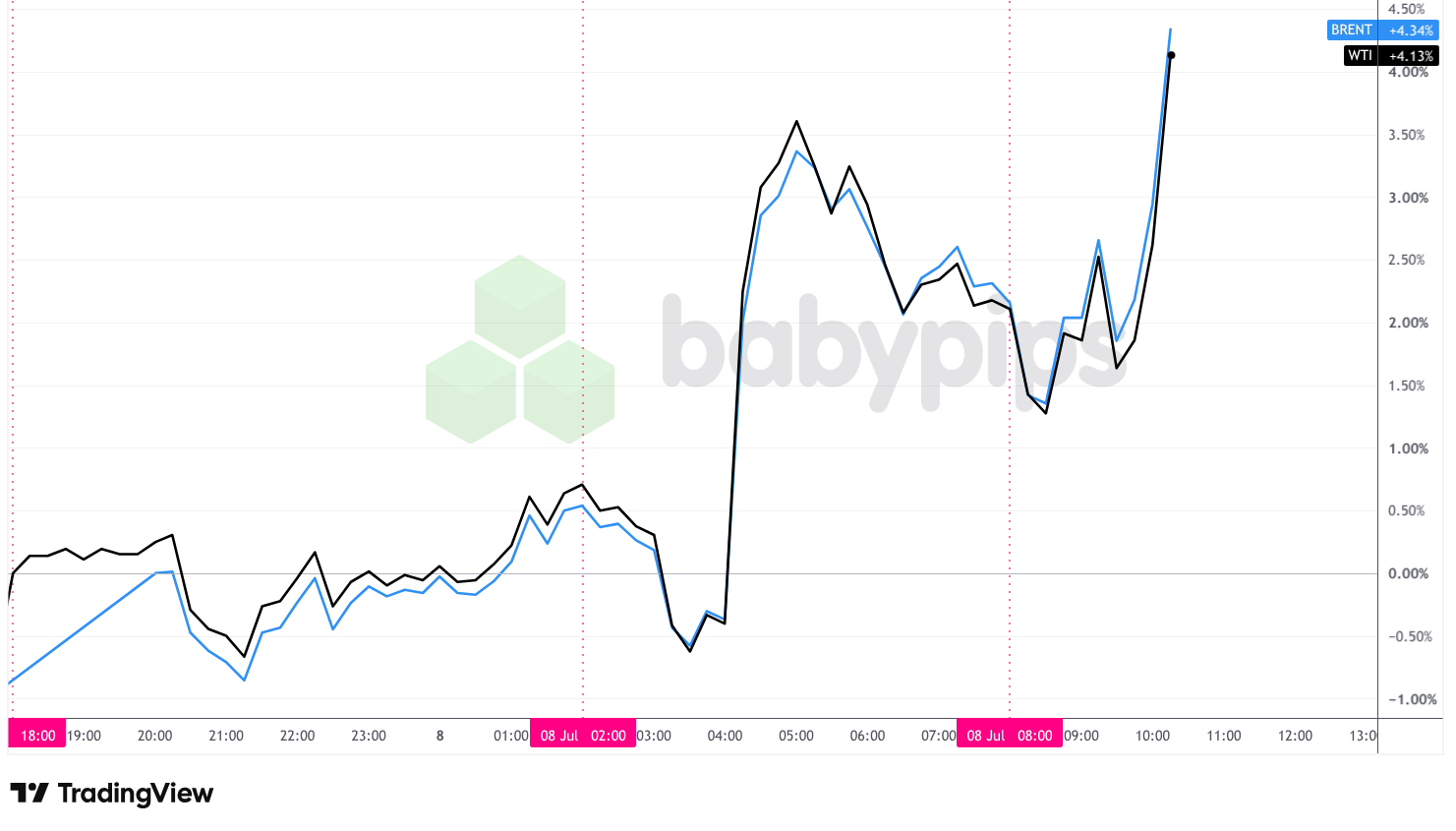
- The oil move: Brent and WTI crude both jumped 5% to 6%.
- The sanctions clawback: The U.S. pulled Iran’s oil-sales waiver, a big piece of June’s deal.
- The wildcard: Fed minutes drop later today, adding a second catalyst for the dollar.
So What Actually Happened Today?
Think of this as a chain reaction, not a single event. It started Monday and Tuesday, when Iran hit three commercial ships in the Strait of Hormuz.
That’s the narrow shipping lane between Iran and Oman that carries about a fifth of the planet’s oil. Squeeze that lane, and you’re squeezing the whole world’s energy supply.
The U.S. didn’t wait around. U.S. Central Command, or CENTCOM (the military command running U.S. operations in the Middle East), hit back overnight with strikes on more than 80 targets across Iran. Air defenses, radar sites, and dozens of small Revolutionary Guard boats used to threaten shipping all got hit.
Iran hit back Wednesday morning at U.S.-linked bases in Bahrain and Kuwait. Kuwait’s military says it shot down two ballistic missiles and 13 drones. Nobody was hurt.
Then, hours later at the NATO summit in Turkey, a reporter asked Trump the obvious question: is the ceasefire over? “As far as I’m concerned, it’s over,” he said. He also called Iran’s leadership sick and negotiations a waste of time, though he left the door open for talks to continue.
Why Did This Ceasefire Just Blow Up?
Rewind to February 28. That’s when U.S. and Israeli strikes on Iran kicked off a four-month war. On June 17, the two sides signed a Memorandum of Understanding, or MOU.
That’s a preliminary agreement, not a full treaty, that both sides agree to follow while hammering out something permanent. You might see it called the Islamabad Memorandum too. It gave both countries 60 days to negotiate, with the clock set to run out in mid-August.
The deal was a straight trade. Iran reopens the Strait of Hormuz. The U.S. eases the sanctions blocking Iranian oil sales. Simple, in theory. In practice, the fight is over who actually controls that strait. Iran wants to pick the routes ships take and charge tolls for the privilege. The U.S. says no tolls and no restrictions, full stop.
This isn’t even the first time the deal has cracked. A similar flare-up happened in late June. Talks had already stalled before this week’s attacks, partly because Iran paused everything for a days-long funeral for its Supreme Leader, Ayatollah Ali Khamenei. U.S. and Israeli strikes killed him earlier in the war.
Promoted: Volatility Like This Is Exactly What Your Strategy Was Built For.
Headlines like today’s move markets fast, and a small account makes it hard to size positions the way your analysis actually deserves. FTMO is a global prop firm with a 4.8★ rating on 40K+ reviews, serving traders since 2015. No time limits. Free trials. Up to $200K in demo capital to trade moves like this one.
Start a free trial with FTMO!
Disclosure: To help support our content, we may earn a commission from our partners if you sign up through our links, at no extra cost to you.
How Wild Did Oil and the Dollar React?
WTI Crude Oil – Chart Faster With TradingView
Oil moved exactly like you’d expect. Brent crude spiked as much as 6% to around $78 to $79 a barrel. WTI, the main U.S. oil benchmark, jumped a similar amount to around $74 to $75. Three weeks ago, both were sitting closer to $69 to $70. That’s a real move.
The dollar? Barely blinked. The U.S. Dollar Index sits near a one-week high, but nobody is piling in. It seems that the market has learnt to take Trump’s comments with a pinch of salt. Or in other words: traders have seen this movie before, and they’re not betting the house on round two just yet.
Stock futures dipped, and bond yields climbed. The 10-year Treasury yield, what the U.S. government pays to borrow money for 10 years, pushed toward 4.58%. That’s the bond market bracing for inflation, not calm.
Does This Change the Fed’s Plans?
Maybe. Here’s why today is a double catalyst for the dollar. The Fed releases minutes from its June meeting later today, the first one run by new Chair Kevin Warsh. Everyone wants to know how seriously the committee is eyeing more rate hikes, meaning higher borrowing costs meant to cool inflation.
Now stack a 6% oil spike on top of that. Pricier oil means pricier everything downstream, exactly the kind of inflation the Fed hates fighting. Andrew Jackson, a strategist at Ortus Advisors, said rising oil prices and bond yields raise the odds of a more hawkish Fed. Hawkish means more likely to raise rates than cut them.
Nothing is locked in yet. This is a headline risk, not a done deal. But if oil holds these gains into next month’s data, watch rate-cut hopes fade fast.
What Should Forex Traders Actually Do Now?
Textbook geopolitics says the dollar, yen, and Swiss franc should all get bought up hard as safe havens: currencies traders trust when things get scary.
That’s only half happening here. The dollar is firm, not soaring. That tells you the market still gives decent odds to this cooling off, the same way it has every time since June.
Three things to watch.
- Does Iran hit back again tonight? Trump already promised more strikes if it does.
- Does shipping through the Strait of Hormuz slow down again?
- And what do today’s Fed minutes actually say?
Any one of these could flip today’s calm into a real trend.
If you trade oil-linked currencies like the Canadian dollar or Norwegian krone, a sustained oil rally usually works in your favor. For everyone else, forget the economic calendar this week. The Gulf is driving the bus.
Promoted: The Strategy Is Half the Battle. Your Mindset Is the Rest.
Today’s headlines are the kind that blow up trading plans. A ceasefire collapsing, oil spiking 6% in minutes, Fed minutes landing on top of it all. Knowing the fundamentals isn’t enough if panic ends up making your next click for you.
In “Unknown Market Wizards” (⭐ 4.6★ | 1,400+ reviews on Amazon), Jack Schwager interviews successful traders to show that their edge isn’t just knowledge. It’s psychological resilience and rigid risk control. Learn how the “wizards” stay clinical on days exactly like this one.
Master Your Trading Mindset with Unknown Market Wizards!
Disclosure: We may earn a commission from our partners if you sign up through our links, at no extra cost to you.
Frequently Asked Questions About the US-Iran Ceasefire
What is the U.S.-Iran ceasefire, and why should I care as a trader?
It’s a memorandum of understanding signed June 17 that paused a four-month war. It reopened the Strait of Hormuz and gave both sides 60 days to hash out something permanent. You should care because that strait carries about a fifth of the world’s oil. Mess with it, and oil prices move. Oil prices move inflation. Inflation moves currencies.
Why did Iran attack ships in the Strait of Hormuz?
Iran says it has the right to control which routes ships take through the strait, and to charge for passage. The U.S. flatly rejects that. Iran hit three commercial ships Monday and Tuesday, and Washington called it a straight-up violation of the ceasefire.
Is this a full-blown war again?
Maybe, but nobody’s confirmed it yet. Trump called the ceasefire “over,” then immediately said talks can continue. Iran hasn’t formally buried the deal either. Call this a serious escalation, not a confirmed return to all-out war.
How much did oil actually move today?
Brent crude jumped as much as 6% to around $78 to $79 a barrel. WTI, the U.S. benchmark, rose about the same to around $74 to $75.
What does this mean for the dollar?
Less drama than you’d guess. The dollar firmed to around a one-week high, but traders aren’t chasing it. They’ve watched similar flare-ups cool down since June without spiraling into a wider war.
What’s the next thing to watch?
Further Iranian retaliation, any slowdown in Strait of Hormuz shipping, and today’s Fed minutes. The 60-day window from the June deal runs into mid-August, so there’s still time for both sides to step back from the edge.
When a geopolitical crisis hits, traders don’t always behave the way simple theory says they should. Premium members can read our lesson:
📖 Geopolitical Risk, Trade Policy, and Safe Haven Flows
Reading this helps you understand how geopolitical shocks move currency prices, which safe havens actually capture the flows, and why market expectations sometimes matter more than the event itself.
And if you’re not a Premium subscriber yet, consider joining.
With Babypips Premium, you get full access to School of Pipsology lessons that help you understand how geopolitical shocks ripple through currency markets and which safe havens benefit most when traders get nervous.