The Bank of England (BOE) held its benchmark interest rate at 3.75% on Thursday, with no hike, no cut, and nothing unexpected in the statement.
And yet GBP fell against every major currency the moment the decision hit the news wires. The move looked less like a typical market reaction and more like a trapdoor opening.
This might seem contradictory to newer traders, but it reflects one of forex’s more predictable dynamics, and it’s worth understanding why.
So What Actually Happened at the BOE?
The MPC (Monetary Policy Committee, the BOE body responsible for setting interest rates) voted 6 to 3 to keep the Bank Rate at 3.75%, marking its sixth straight hold. Pill, Mann, and Greene each voted for an immediate hike to 4%, while the other six members chose to wait.
The BOE also announced a major overhaul of its quantitative tightening program. All gilt sales will be paused until April 2027, sales of long-dated gilts have ended permanently, and the bank’s £488 billion portfolio will be wound down over eight years.
The 30-year gilt yield fell more than 10 basis points on the news. The bond market and the pound moved in opposite directions, which is exactly what can happen when a central bank eases one policy lever while holding another steady.
That dovish QT shift mattered because markets had priced in roughly a 30% chance of a rate hike heading into the decision. The hold itself wasn’t a surprise, but the broader policy package still fell short of what traders had hoped for.
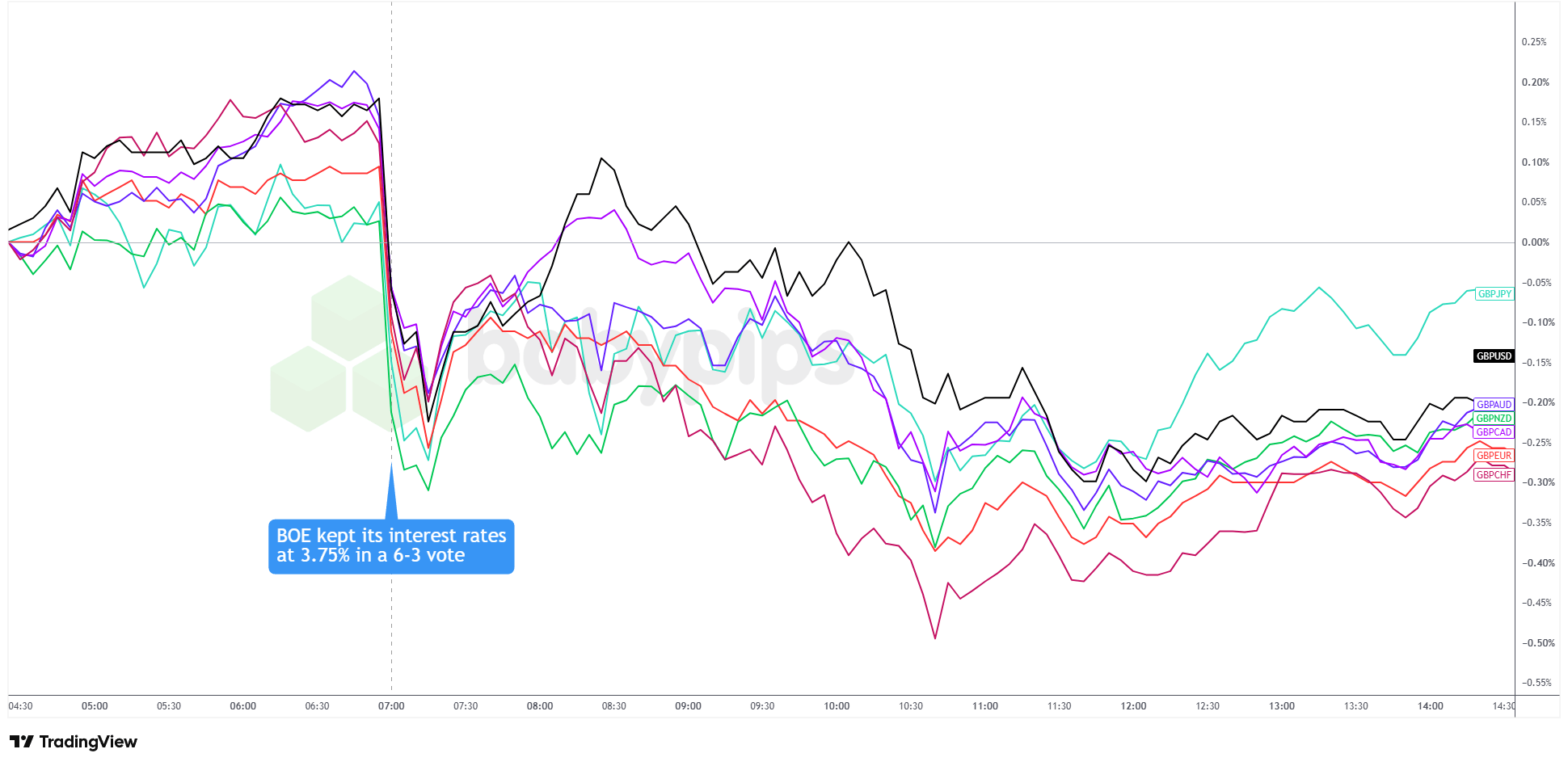
GBP 5-minute Forex Chart Faster with TradingView
As soon as the statement dropped, every GBP pair fell together in one steep move, with GBP/AUD and GBP/NZD taking the biggest hits. Both pairs were already under pressure before the announcement, as AUD and NZD had benefited from the previous session’s upbeat market mood and New Zealand’s stronger-than-expected GDP report. The BOE decision simply added fuel to a move that was already underway.
As we can see, the pound never managed a meaningful recovery, as attempts to buy the dip quickly ran out of steam. By day’s end, Sterling was the weakest major currency, losing about 0.40% to 0.45% to AUD and NZD while seeing more limited losses to USD and CAD.
Promotion: TradeZella’s new AI trading partner can break down and analyze your trades & build a game plan, freeing up time and energy to focus on the next moves!
Start Your Trading Journey with Tradezella & use code “PIPS20” for 20% off your first purchase!
Disclosure: To help support our free daily content, we may earn a commission from our partners if you sign up through our links, at no extra cost to you.
Why Were Traders Expecting More?
The selloff makes more sense through the lens of relative disappointment. Markets had already partly positioned for a hike before Thursday, and when the BOE didn’t deliver one, three factors made the reversal even sharper.
The first was the vote itself. Three dissenters isn’t a minor result inside the MPC. Pill, Mann, and Greene are influential senior voices, and their support for a hike showed that the case for tighter policy is alive and well within the committee. Markets often treat voting patterns like these as clues about what’s coming next, and for good reason.
The second factor was what other major central banks were doing. Thursday’s BOE hold came one day after the Federal Reserve raised its policy rate to a range of 3.75% to 4.00% and released hawkish projections showing that 16 of 18 officials expected at least one more move by the end of the year. The European Central Bank raised rates earlier this month, while the Bank of Japan is expected to lift its rate to 1.25% today.
Against that backdrop, the BOE stood out as the only major central bank that hadn’t tightened in response to the energy shock. Relative policy divergence, or the gap between interest rate biases across major economies, is a powerful driver of currency flows. Simply put, standing still while your peers are raising rates rarely does your currency any favors.
The third factor was the BOE’s own inflation outlook. U.K. inflation is running at 3.1%, its fastest pace since March, with energy costs doing much of the damage. The bank’s own forecasts show inflation climbing slightly above 4% in the first quarter of 2027 as another round of household energy bill increases works its way through the economy.
Governor Bailey was also direct about the risk of second-round effects, which happen when higher energy costs spill into wages and prices across the broader economy. He warned that the longer energy prices remain elevated, the more likely it becomes that Bank Rate will need to rise. In other words, markets treated Thursday’s hold as a delay, not the end of the road.
When three members are already voting to move and the committee is openly worried about inflation, a hold was always going to disappoint.
What Does This Mean for the Pound From Here?
The November 5 MPC meeting is now the main event for GBP traders. It will include updated quarterly forecasts and a press conference with Governor Bailey, making it a natural opportunity for the BOE to change course. Some analysts already see a hike to 4.00% as their base case, provided energy prices remain near current levels.
Note that energy conditions matter. Brent crude is trading near $101 per barrel, and the conflict in the Middle East shows no clear sign of ending anytime soon. The MPC’s own minutes described the situation as more prolonged than previously expected. If second-round effects begin appearing in wages and broader inflation data, analysts expect the BOE to act.
The U.K. budget is also due on October 28, just before the November meeting, adding another piece to the puzzle. Any fiscal loosening could lift the inflation outlook and strengthen the case for a hike.
The pound now needs a hawkish catalyst to recover Thursday’s losses. Without one, a worsening energy backdrop could add even more pressure. And if the BOE holds again in November, traders may find themselves watching the same relative disappointment story play out all over again.
The Bottom Line
Relative disappointment drove Thursday’s move. The pound fell because the outcome markets had assigned a 30% chance never materialized, forcing GBP to reprice that gap. Currencies react to decisions to do nothing all the time, and understanding that dynamic is one of the most useful lessons a developing trader can learn.
The bigger picture for sterling remains conditional. The BOE is caught between a global tightening cycle and a domestic economy where second-round inflation risks are building but haven’t appeared in the data yet. That tension could keep the pound reactive rather than directional, with each new report prompting traders to recalculate the odds of a November hike.
Between now and November 5, energy prices and signals from MPC members are the two big things to watch.
Watch For
The November 5 BOE meeting is the next major binary for GBP. Analysts lean toward a hike to 4.00% if energy prices stay elevated, and markets are already pricing strong odds.
The UK budget on October 28 arrives just before and could shift the inflation calculus. Brent crude above $100 keeps November firmly in play.
This article’s explanation for why GBP fell centers on monetary policy divergence, the gap in interest rate direction between the BOE and its peers. Premium members can read our lesson:
📖 What Central Banks Actually Do: A Guide to Monetary Policy
Reading this helps you understand how monetary policy divergence drives currency flows, what the full central bank toolkit looks like beyond the rate decision itself, and why the BOE standing still while the Fed, ECB, and BoJ all tightened put GBP at a structural disadvantage.
And if you’re not a Premium subscriber yet, now’s a good time to sign up.
With Babypips Premium, you get full access to School of Pipsology lessons that help you understand not just what happened at the BOE meeting, but the policy divergence framework that explains why GBP reacts the way it does when other central banks move and the BOE doesn’t.