

UK inflation held at 2.8% year-over-year in May 2026, matching April and coming in below the 3.0% market forecast for the second month running. But services inflation — the Bank of England’s key domestic price gauge — jumped from 3.2% to 3.7%, its fastest reading in months. With the Bank of England announcing its rate decision tomorrow, today’s split print gives policymakers headline relief — but raises a fresh concern in the detail.
UK Inflation May 2026: Key Takeaways
- CPI headline: +2.8% year-over-year in May 2026 — unchanged from April, below the market consensus forecast of 3.0%
- Monthly CPI: +0.2% in May — well below April’s +0.7% and the +0.4% market forecast
- Services inflation: 3.7% year-over-year in May, sharply up from 3.2% in April — the Bank of England’s most closely-watched inflation category
- Core CPI (excluding food, energy, alcohol, and tobacco): 2.6% in May, up slightly from 2.5% in April
- Transport inflation: 6.8% year-over-year — highest since December 2022; motor fuel prices up 24.6% year-over-year to 157.4p per litre
- Food inflation: 2.2% year-over-year — lowest since December 2024; food prices fell 0.1% month-on-month in May
- What’s next: Bank of England rate decision tomorrow (Thursday, June 18, 12:00 GMT); hold at 3.75% widely expected as the Iran-U.S. ceasefire eases near-term energy price pressure
What Were UK Inflation Results for May 2026?
UK CPI inflation held at 2.8% year-over-year in May 2026, according to the Office for National Statistics (ONS) bulletin released this morning. That matches April’s reading exactly and came in below both the market consensus forecast of 3.0% and the Bank of England’s own April projection for Q2. The broader CPIH measure — which adds owner-occupiers’ housing costs to standard CPI, making it the ONS’s most comprehensive inflation gauge — also held steady at 3.0% year-over-year.
On a monthly basis, prices rose just 0.2% in May — well below April’s 0.7% monthly gain and the 0.4% analysts had expected. To put the annual figure in context: UK CPI hit a recent high of 3.3% in March 2026, driven largely by the energy-price shock from the Iran-U.S. conflict. It then fell to 2.8% in April, partly because a lower Ofgem energy price cap and a temporary removal of renewable energy levies from bills cut household energy costs. May has held at that same level for a second consecutive month.
Promoted: Is Your Small Account Holding Your Strategy Back?
Trading $100 isn’t the same as trading $100k. Emotional discipline & trading flexibility is easier when you have the right backing. FTMO is a global prop firm with a 4.8★ rating on 40K+ reviews, serving traders since 2015! No time limits. Free trials. Up to $200K in Demo Capital.
Start a free trial with FTMO!
Disclosure: To help support our content, we may earn a commission from our partners if you sign up through our links, at no extra cost to you.
What Drove UK Inflation in May 2026?
Two opposing forces played tug-of-war in May — and ended up roughly canceling each other out. Transport pushed prices sharply higher. Transport inflation rose to 6.8% year-over-year — the highest since December 2022. Motor fuel prices surged 24.6% year-over-year, with the average petrol price reaching 157.4 pence per litre — the highest since November 2022. Air fares also jumped 10.3% between April and May 2026.
Easter timing amplified the airfare spike. Easter fell in early April 2026, before the ONS pricing window opened. That left more air bookings to fall into May, inflating the month-on-month comparison. There was also an upward effect from Vehicle Excise Duty (VED), the annual tax paid to register a car in the UK, due to a base effect from a one-off correction that reduced the VED index in May 2025 but did not repeat this year.
Pulling in the opposite direction: food and housing. Food and non-alcoholic beverage prices rose just 2.2% year-over-year — the slowest pace since December 2024 — and actually fell 0.1% month-on-month, driven by cheaper meat, dairy, and vegetables. Owner-occupiers’ housing costs (an CPIH component tracking the cost of owning your home) also continued to ease, slowing to 3.3% year-over-year in May from 3.6% in April — the lowest since June 2022. Grant Fitzner, Chief Economist at the ONS, described the result as inflation holding steady “as various price movements offset each other,” with transport pushing prices up and food pulling them back down.
Why Is Services Inflation Rising Even as the Headline Holds Flat?
Services inflation measures price changes in activities rather than physical goods — things like restaurant meals, hotel stays, hairdressers, and airline tickets. It matters more to central banks than energy-driven inflation because it reflects domestic costs: mainly wages and the demand for services inside the UK economy. Energy prices can fall quickly when oil gets cheaper. Services prices tend to stay elevated longer — hence the term sticky inflation.
In May 2026, CPI services inflation jumped to 3.7% year-over-year, up sharply from 3.2% in April. Think of it this way: the headline CPI number held flat partly because cheaper food and easing housing costs offset costlier petrol. That’s a temporary relief. But if wages keep rising and businesses pass those costs on to customers through higher service prices, that underlying pressure doesn’t simply disappear when oil prices fall.
Core CPI — which strips out energy, food, alcohol, and tobacco to give a cleaner picture of underlying price pressure — also ticked up to 2.6% year-over-year in May, from 2.5% in April. By contrast, goods prices slowed to 2.0% year-over-year. The goods side of the economy is helping. The services side is not — and the Bank of England will be watching that 3.7% reading very closely tomorrow.
What Does the UK Inflation Report Mean for the Bank of England?
The Bank of England announces its next rate decision tomorrow (Thursday, June 18) at 12:00 noon GMT. The benchmark Bank Rate currently stands at 3.75%, held there at the April 30 MPC meeting on an 8-1 vote — with one member already voting for an immediate hike to 4.0%. A hold at 3.75% is the near-universal market expectation for Thursday.
Today’s data gives the BoE some cover to hold. The headline CPI came in below the Bank’s own April forecast for Q2 inflation — and a major new development this week helps further: the U.S. and Iran agreed to a ceasefire, and the Strait of Hormuz — the critical passage through which roughly 20% of global oil and gas flows — is beginning to reopen. Energy prices are already falling as a result. Economists at advisory firm Pantheon Macroeconomics forecast the MPC will signal readiness to act if needed, while choosing to hold rates this week absent any major late surprises from data released ahead of Thursday’s meeting.
But the longer-term challenge remains. Services inflation is rising. The Ofgem energy price cap is due to increase again in July. Independent forecasters surveyed by HM Treasury in May expect UK CPI inflation to climb to approximately 3.5% by the final quarter of 2026. Any relief from the Iran ceasefire could prove temporary — and the BoE is expected to stay watchful rather than pivot to cuts any time soon.
What Does UK Inflation Mean for GBP Traders?
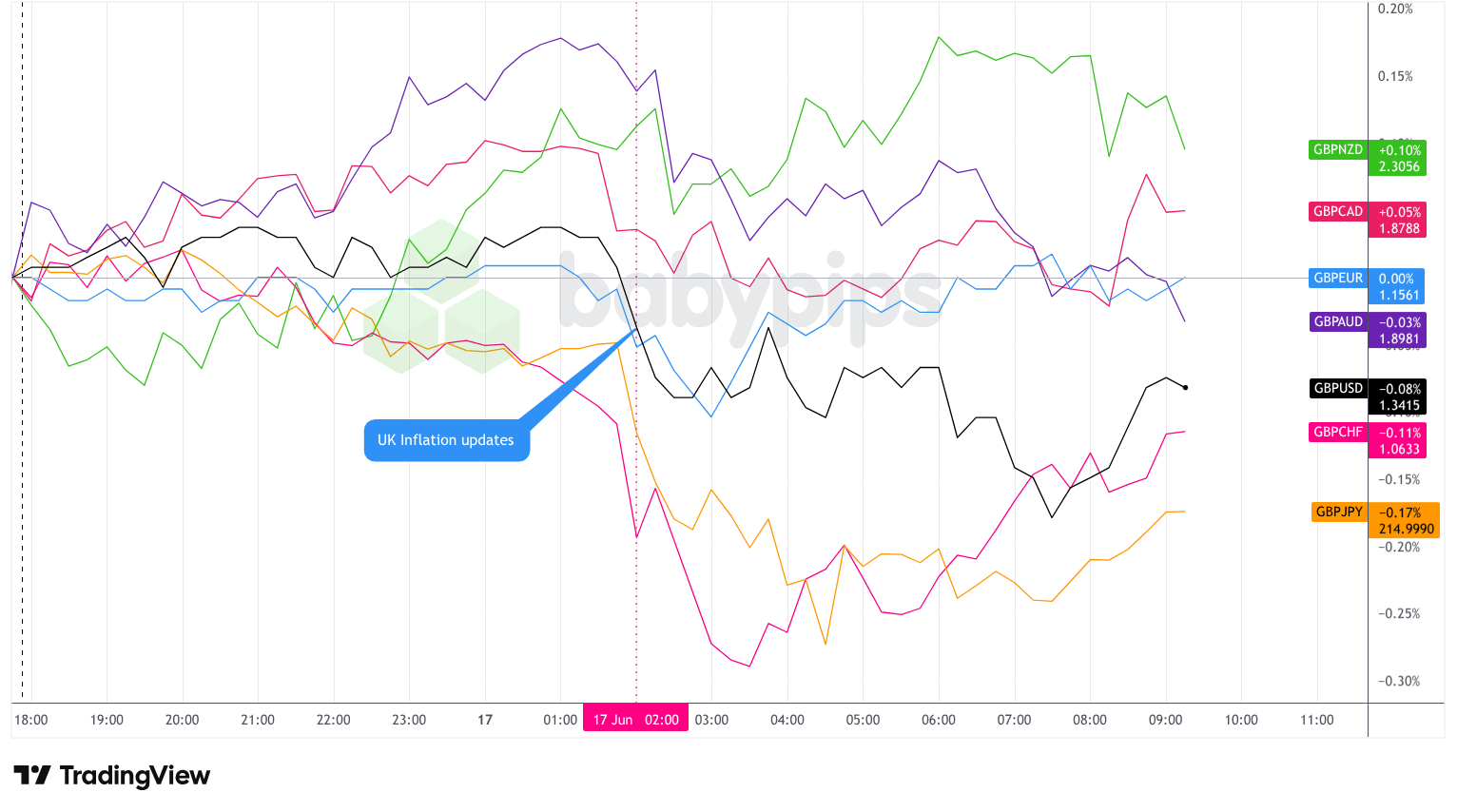
Overlay of GBP vs. Major Currencies – Chart Faster with TradingView
Sterling moved slightly lower after the data release, with GBP/USD trading around 0.05% lower on the day near 1.3420. That reaction reflects the mechanics of FX (foreign exchange): a below-forecast CPI print reduces the probability of a near-term rate hike. Fewer expected rate hikes mean less demand for a currency, so GBP softened modestly. The print was also below the Bank of England’s own forecast, which removes more urgency around an imminent policy tightening.
The Iran-U.S. ceasefire is now reshaping the broader rate outlook far more than any single CPI reading. Falling oil prices arrived at a convenient moment for both the Fed and the BoE — as cheaper energy should reduce inflation pressure and allow both central banks to adopt a more measured tone heading into their rate meetings this week. For sterling, that means the energy-shock risk premium that had been building in currency markets is starting to unwind.
For GBP traders, tomorrow’s BoE announcement is the main event. Watch two things closely: the vote split (any additional hawkish dissenters beyond April’s lone member would signal rising rate-hike risk later in 2026) and the language on services inflation. If the Bank sounds alarmed about the 3.7% services reading and hints at future hikes, GBP could find support. A more relaxed tone — leaning on the ceasefire as justification for patience — would likely see sterling drift further lower against the dollar and euro in the near term.
Promotion: TradeZella’s new AI trading partner can break down and analyze your trades & build a game plan, freeing up time and energy to focus on the next moves!
Start Your Trading Journey with Tradezella & use code “PIPS20” for 20% off your first purchase!
Disclosure: To help support our free daily content, we may earn a commission from our partners if you sign up through our links, at no extra cost to you.
Frequently Asked Questions About UK CPI Inflation
What is UK CPI inflation, and why does it matter for forex traders?
CPI (Consumer Prices Index) measures how fast the prices of everyday goods and services are rising in the UK. The Bank of England targets a 2% CPI rate and adjusts its benchmark Bank Rate to keep inflation near that level. For forex traders, CPI matters because it directly drives rate expectations: higher-than-forecast inflation raises the probability of rate hikes, which typically boost GBP; lower-than-forecast inflation can reduce rate-hike bets and weaken sterling.
What happened to UK inflation in May 2026?
UK CPI held at 2.8% year-over-year in May 2026, matching April and coming in below the 3.0% market forecast. On a monthly basis, prices rose just 0.2% — below the 0.4% expected. Transport costs pushed inflation higher, while lower food prices and easing housing costs pulled it back down. The result was a flat headline print that still left inflation well above the Bank of England’s 2% target.
What is services inflation, and why does the Bank of England care so much about it?
Services inflation tracks price changes in non-physical activities — restaurants, hotels, professional services, and transport services. Unlike goods prices, services inflation is driven mainly by domestic wages and demand rather than global energy costs. That makes it “stickier”: it doesn’t fall as quickly when oil gets cheaper. In May 2026, CPI services inflation jumped from 3.2% to 3.7%, signaling that domestic price pressures inside the UK economy are still building — a concern the Bank of England will weigh heavily alongside the more benign headline figure.
What is the Bank of England expected to do on June 18, 2026?
Markets widely expect the Bank of England to hold its Bank Rate at 3.75% at Thursday’s MPC meeting. The below-forecast CPI headline and the Iran-U.S. ceasefire both reduce the urgency for an immediate rate hike. However, traders will watch the vote split and the MPC’s language around services inflation closely for any signal that a rate hike might come later in 2026.
What is the UK inflation outlook for the rest of 2026?
Despite the May surprise to the downside, most forecasters expect UK CPI to climb higher in the second half of 2026. Independent forecasters surveyed by HM Treasury in May project CPI reaching approximately 3.5% by the final quarter of the year. The Ofgem energy price cap is set to rise in July, and base effects will make year-on-year comparisons tougher in coming months. The Iran ceasefire may soften some of that pressure, but with services inflation already accelerating, the Bank of England’s challenge is far from over.
A below-forecast inflation print might seem like good news, but it weakened sterling instead. That’s because currency markets don’t react to headline numbers, they react to the gap between what was priced in and what actually happened. Premium members can read our lesson:
📖 Market Expectations: Why Good News Can Tank a Currency
Reading this helps you understand why deviation from expectations drives price action, how rate expectations move currencies, and what actually causes a currency to weaken when the headline data looks encouraging.
And if you’re not a Premium subscriber yet, now’s a good time to sign up.
With Babypips Premium, you get full access to School of Pipsology lessons that help you understand not just what the economic data says, but how the market has already priced that data in before release, and what that means for your trading decisions.