


The Reserve Bank of New Zealand (RBNZ) decided by consensus to hold the Official Cash Rate (OCR) at 2.25% Reserve Bank of New Zealand at its April Monetary Policy Review today — and honestly, no one was surprised. This was the second consecutive meeting at which the RBNZ left rates unchanged, as policymakers continue to navigate a tricky economic landscape shaped largely by what’s going on in the Middle East.
Key points from the RBNZ’s April Monetary Policy Review:
- OCR held at 2.25% by consensus for the second straight meeting Reserve Bank of New Zealand
- Annual CPI came in at 3.1% in Q4 2025; RBNZ now forecasts inflation rising to ~3.0% in Q1 2026 and 4.2% in Q2
- Interest rate cuts were not discussed; the debate centered on whether to begin rate normalization earlier or later Westpac IQ
- Rate hikes were discussed but the committee was not close to hiking at this meeting
- The Committee stands ready to act decisively if core inflation or wage growth accelerates materially Reserve Bank of New Zealand
- Full economic forecasts and an updated OCR projection will be published at the May Monetary Policy Statement
Since the RBNZ’s February Monetary Policy Statement, events in the Middle East have materially altered the outlook and the balance of risks for both inflation and economic growth in New Zealand. In the near term, inflation is expected to increase and the economic recovery to weaken.
The central bank highlighted that disruptions to global supply chains and higher oil prices are expected to lead to higher inflation and weaker growth, particularly in countries heavily dependent on Middle East energy — including many of New Zealand’s key trading partners in Asia.
On the domestic side, annual CPI stood at 3.1% in Q4 2025, and the RBNZ now expects inflation to increase to around 3.0% in Q1 2026 and 4.2% in Q2, driven largely by higher fuel costs and spillovers into transport, food, and other energy-sensitive components.
The RBNZ was careful to flag that it’s not just sitting on its hands, though. The Committee is vigilant to any generalized inflationary pressure and stands ready to act decisively to ensure that inflation reaches the 2% midpoint of the target band in the medium term.
Notably, the MPC debated the options of an earlier vs. later start to interest rate normalization, and interest rate cuts were not discussed at all. At the post-meeting press conference, Governor Anna Breman confirmed the MPC discussed raising rates at today’s meeting, but noted there were no strong advocates for hiking at this time and that the committee was not close to hiking.
Promotion: Master your trading psychology with AI-powered insights! TradeZella helps you track, backtest, and eliminate bad habits automatically! Click on the link and use code “PIPS20” to save 20%!
Disclosure: To help support our free daily content, we may earn a commission from our partners if you sign up through our links, at no extra cost to you.
Market Reactions
New Zealand Dollar vs. Major Currencies: 15-min
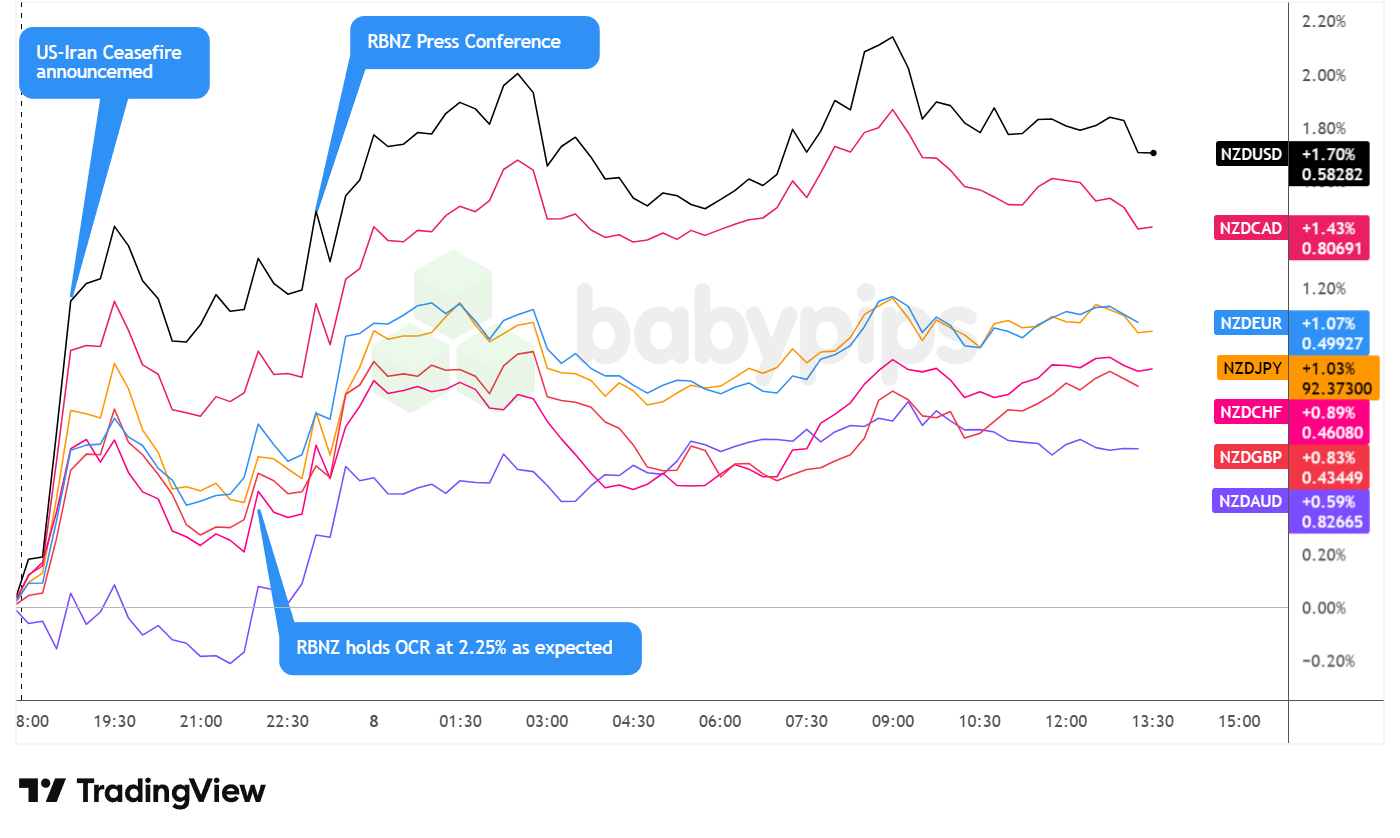
NZD Overlay 15-min – Chart Faster with TradingView
Looking at the NZD overlay chart, the Kiwi started climbing sharply during the early Wednesday Asian session before the RBNZ decision even hit the wires. That early surge was driven by the US-Iran ceasefire news. US President Donald Trump agreed to suspend Iran bombing for two weeks, conditional on Iran reopening the Strait of Hormuz, which triggered a broad wave of risk-on sentiment across currency markets and weighed heavily on the safe-haven US Dollar.
When the RBNZ rate decision dropped at 2:00 AM GMT on April 8, NZD/USD was already trading well above the 0.5700 mark. The OCR hold did little to move the needle on its own, but traders then turned attention to Governor Breman’s press conference for further guidance. The NZD became the clear outperformer against the USD, helped by both the positive Middle East development and remarks in the RBNZ’s post-meeting presser, where Governor Breman said the MPC discussed the possibility of raising rates at both the April and May meetings, and noted the “frequency of rate hikes could be every meeting or every second meeting.”
Why Does This Matter for Forex Traders?
The RBNZ decision this week is a good reminder that central bank events don’t happen in a vacuum. The Kiwi’s big move today had more to do with geopolitics than with the rate decision itself — the hold was fully priced in. What shifted the dial was the hawkish tone from Governor Breman, who made clear that rate hikes are back on the table if inflation pressures persist.
Westpac has already pulled forward its forecast for the first RBNZ OCR hike to September, and sees risks skewed toward an even earlier start if second-round inflation effects accumulate. For NZD traders, that means the currency’s direction from here will likely hinge on two things: how the Middle East situation evolves and whether upcoming inflation data confirms the RBNZ’s near-term price forecasts. The RBNZ noted that if core inflation or wage growth accelerates materially, it would respond decisively. Watch this space.
Promoted: Capitalize on Central Bank Volatility Without Risking Your Own Funds
As today’s RBNZ decision and sudden Middle East developments showed, forex markets can shift gears in an instant. When fundamental drivers and geopolitical news create this kind of massive volatility, trading the swings requires deep focus—and enough capital to make your edge count.
If you have the right fundamental bias but a restrictive personal account size, Funded Trading Plus can help. They offer evaluation packages starting at just $89.00. Prove your skills with simple, fair rules, and you can double your account every 10% up to $2,500,000.
Learn more about Funded Trading Plus!
Disclosure: To help support our content, we may earn a commission from our partners if you sign up through our links, at no extra cost to you.