On Trump’s self-imposed “Power Plant Day” deadline to strike crucial Iranian infrastructure, the United States and Iran agreed on a two-week ceasefire brokered by Pakistan.
Iran agreed to allow safe passage through the Strait of Hormuz. Markets, which had been walking a tightrope for weeks, exhaled in unison.
Then risk rallies turned into a full-on stampede. Markets that had been bracing for disaster suddenly saw a path out and made a run for it.
Quick Recap: What Happened Lately?
Let’s rewind. For roughly five weeks, the Strait of Hormuz – the narrow waterway through which roughly 20% of the world’s traded oil flows – had been effectively blocked due to the US-Iran conflict. Oil prices had surged above $110 per barrel, inflation fears had ratcheted higher, and global markets were on high alert.
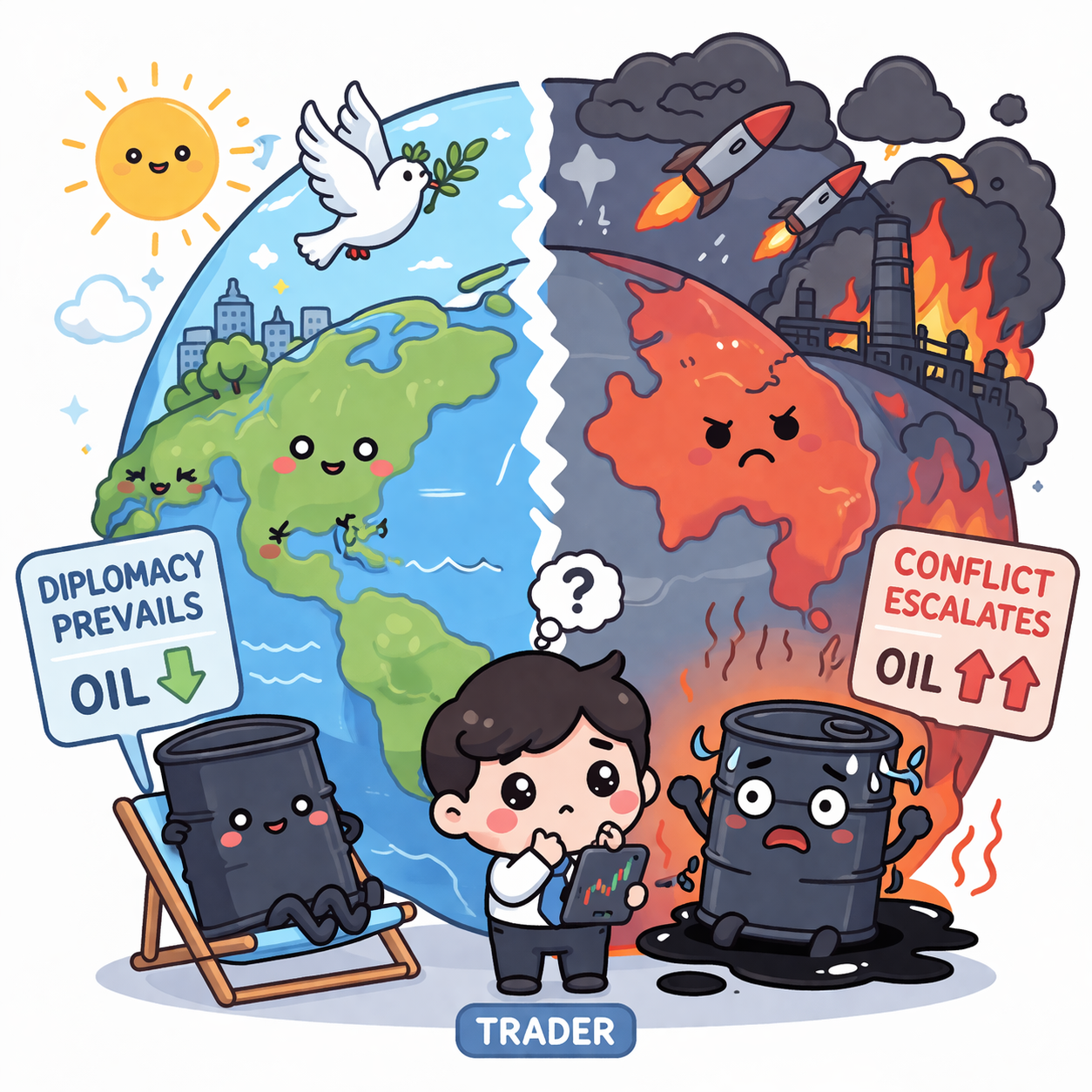 Traders were essentially pricing in two dramatically different worlds: one where diplomacy prevailed and oil came back down, and another one where Trump followed through on threats to destroy Iranian infrastructure, potentially sending oil even higher.
When the ceasefire was announced (mediated by Pakistan, which proposed a two-week pause tied to Iran reopening the Strait), markets immediately flipped into what traders call “risk-on” mode (an environment where investors feel comfortable taking on more risk, buying stocks and higher-yielding assets, and selling safe havens like gold and the US dollar).
A few terms worth knowing:
- Risk-on: Investors feel optimistic → they buy stocks, sell safe havens
- Risk-off: Investors feel fearful → they buy gold, USD, bonds, sell stocks
- Safe haven: An asset expected to hold or gain value during turmoil (e.g., gold, USD, JPY)
- Geopolitical risk premium: The extra price baked into assets (like oil) due to conflict fears
Promoted: Capitalize on Geopolitical Headlines Without Risking Your Own Funds.
When US-Iran developments spark safe-haven unwinding, market volatility tends to stay elevated. Why risk your personal capital during extreme volatility?
Most proprietary firms terminate your evaluation account if you execute a trade during a major headline, but FundedNext permits news trading across all models.
Test your risk sentiment thesis with up to $300,000 in simulated capital, and take advantage of their Free Trial to experience the platform risk-free.
Explore FundedNext and Start Your Free Trial!Disclosure: We may earn a commission from our partners if you sign up through our links.
Why Did Markets React the Way They Did?
Crude Oil Fell Hard
The Strait of Hormuz closure had been the single biggest driver of elevated oil prices. With the waterway set to reopen under the ceasefire terms, the “supply disruption” that had been propping up prices was suddenly expected to ease. WTI crude fell approximately $18.64 per barrel in after-hours trading following the announcement — one of the sharpest single-session drops in nearly six years.
This is a big deal for forex traders, as oil is priced in US dollars, and its price ripples through the currencies of oil-importing and oil-exporting nations in very different ways. A sharp drop in oil prices tends to:
- Weaken petrocurrency pairs like USD/CAD (Canada is a major oil exporter; cheaper oil can weigh on the Canadian dollar)
- Help oil-importing currencies — most notably the Japanese yen (JPY), since Japan imports approximately 90% of its crude from the Middle East
The yen, which had been under intense pressure as rising oil costs widened Japan’s import bill, likely found some relief (at least temporarily) in the ceasefire news.
The S&P 500 Reversal
The S&P 500 had spent Tuesday’s regular session down roughly 1.2%, with traders unwilling to commit to either side of the trade ahead of the 8 p.m. deadline.
When the ceasefire was confirmed, the index reversed sharply. Equities surged as the chaos driven by the Middle East conflict appeared to take a breather.
So, why did stocks react this way?
Cheaper oil directly reduces costs for businesses (think: airlines, logistics companies, manufacturers) and eases the inflationary pressure that had been pushing the Federal Reserve toward keeping interest rates higher for longer. Lower rates are generally good for stocks because they make borrowing cheaper and future corporate earnings more valuable today.
Gold’s Safe Haven Unwinding
Gold (XAU/USD) had been trading in the $4,650–$4,680 range as recently as April 7, with its price supported by a cocktail of geopolitical fear, inflation concerns, and central bank buying.
The ceasefire announcement broke gold out of that range to the upside, with XAU/USD spiking to $4,850 on broad USD weakness before pulling back toward the $4,800 area.
This is a classic pattern: gold tends to rise when uncertainty spikes and fall when it eases. However, it’s worth noting that gold likely won’t collapse dramatically, as structural support (central bank buying, lingering inflation, and the fact that this is only a two-week ceasefire) remains in place.
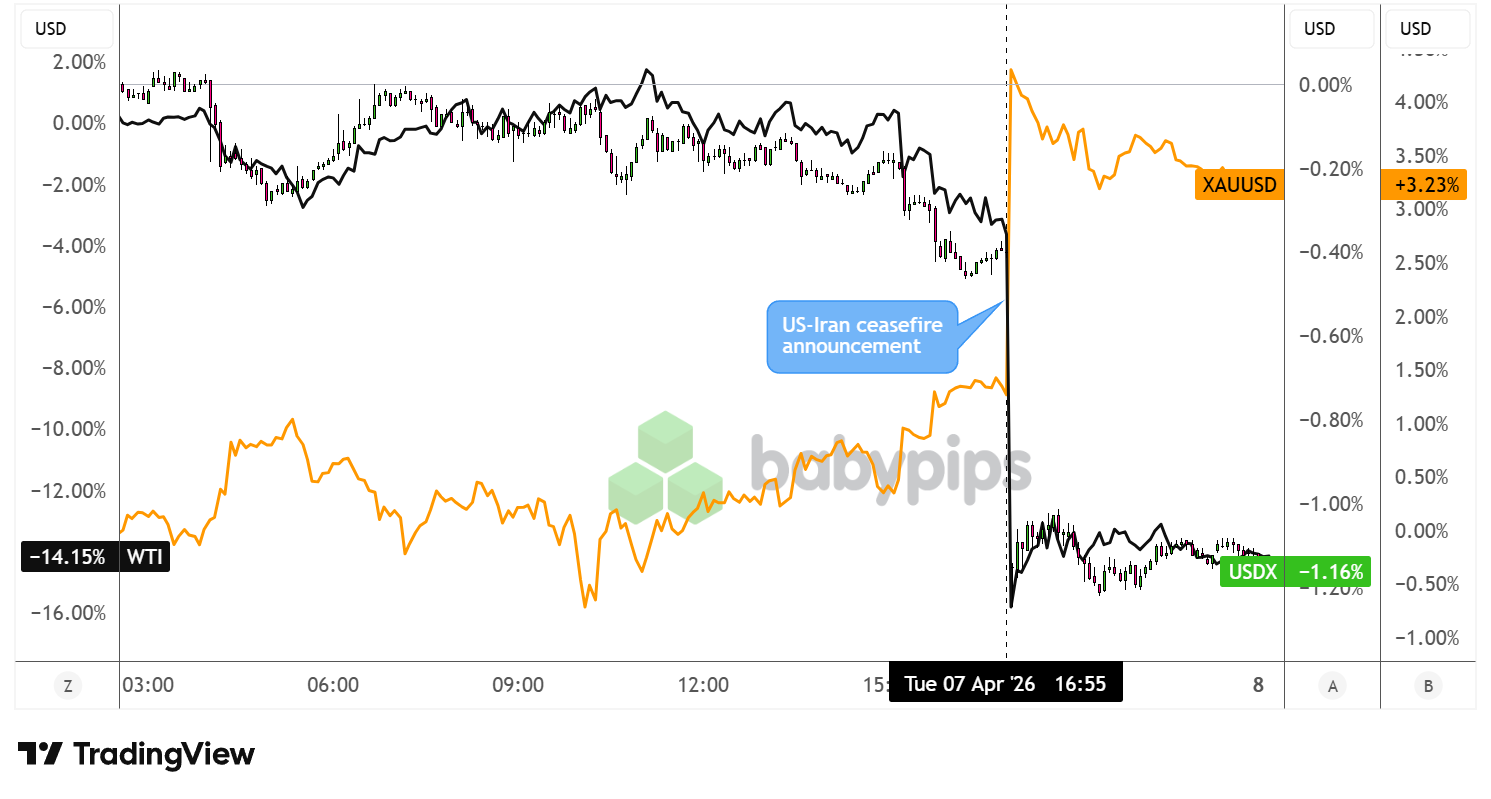
Overlay of WTI Crude Oil, USDX, and Gold: 5-min Chart Faster with TradingView
USD: The Complicated One
The US dollar’s reaction was the most nuanced. During the conflict, the US dollar index had been hovering near 100–100.60, supported by two forces: safe haven demand (investors park money in dollars during crises) and a hawkish Fed narrative.
With the ceasefire, the safe-haven bid for dollars partly softened, so Treasury yields and the dollar fell alongside the ceasefire announcement. EUR/USD was seen surging above 1.1600, GBP/USD climbed toward 1.3400, and AUD/USD advanced toward 0.7005 — all reflecting a softer greenback as risk appetite improved.
But here’s the catch: a ceasefire that brings oil prices down also potentially eases inflation pressure on the Fed, which could eventually open the door to rate cuts. Rate cuts typically weaken a currency. So the dollar faces a double headwind: reduced safe-haven demand and the prospect of a less hawkish Fed down the road.
What Does This Mean for Markets?
The latest ceasefire illustrates one of the most important lessons in the market: geopolitical events create binary outcomes, and currencies tend to move sharply when those outcomes resolve.
Consider what happened across the board:
- Oil-linked currencies (CAD, NOK) came under pressure as energy prices fell
- Safe haven currencies (JPY, CHF) and assets (gold) pulled back as fear subsided
- Risk-sensitive currencies (AUD, NZD, GBP) and equity markets rallied on improved sentiment
- The US dollar softened as its dual safe-haven + high-yield appeal was tested simultaneously
It’s also a reminder that markets price in expected outcomes. For weeks, traders had been partially anticipating some form of resolution: the S&P 500 had managed to stay remarkably resilient despite five weeks of Hormuz being closed, reportedly because strong economic data was preventing a full-scale panic.
When the resolution finally came, the market didn’t have to “discover” a new reality, it had to confirm one it had already partly been pricing in. That explains why the moves, while sharp, weren’t necessarily chaotic.
One key caveat is that this is only a temporary two-week ceasefire, not a peace deal.
It may simply lead to more talks in Islamabad, and markets may be getting ahead of themselves if they assume the geopolitical risk premium disappears entirely.
Key Takeaways
- Risk-on / risk-off is real and fast. When major geopolitical risks resolve (even temporarily), the market rotation from safe havens into risk assets can happen in minutes, not hours. Oil, gold, stocks, and currencies all moved simultaneously.
- Oil is a currency-mover. The link between energy prices and currencies like JPY, CAD, and AUD is not academic — it showed up in real-time this week. Japan is the world’s biggest buyer of Middle Eastern crude, which is why yen traders watch oil.
- The US dollar doesn’t always go up in a crisis. While the USD benefited from safe haven demand during the conflict, the ceasefire softened it, showing that multiple forces (safe haven flows, rate expectations, risk appetite) compete for control of the dollar at any given time.
- Geopolitical events can create binary trades. The market spent weeks rangebound, waiting for a resolution. Traders who were positioned aggressively in either direction faced significant risk. The ceasefire also remains fragile — two weeks is not a peace treaty.
- Watch the oil-inflation-Fed chain. Cheaper oil → lower inflation → potentially easier path for Fed rate cuts → implications for USD and all dollar pairs. This transmission mechanism is one of the most important in all of macro trading.
Promoted: Master Your Execution During Macro Shocks
When ceasefire news trigger risk rallies, does your execution stay clinical or get emotional? TradeZella’s trade replay tool lets you revisit your past trades tick-by-tick. See exactly where your entry slipped or why you hesitated, so you can dominate the next volatility spike with a data-driven playbook.
Start Your Journal with Tradezella and use code “PIPS20” to save 20% on your first purchase!
Disclosure: To help support our free daily content, we may earn a commission from our partners if you sign up through our links, at no extra cost to you.