


The Reserve Bank of Australia (RBA) voted 8-1 to raise its cash rate target by 25 basis points to 4.35% today, marking its third consecutive hike and unwinding all of the rate cuts made last year. The decision was largely anticipated by markets, as covered and previewed in the BabyPips.com Event Guide.
- Inflation is expected to remain above target “for some time,” with risks still tilted to the upside
- The Middle East conflict has pushed energy prices sharply higher, with signs of second-round effects on broader goods and services prices
- CPI inflation for December 2025 was revised up to 4.8% (from a previous forecast of 4.2%)
- Trimmed mean inflation was 3.8% for December 2025 and is forecast at 3.5% for June 2026
- GDP growth forecasts were cut for 2026 — now pegged at 1.3% for both the June and December quarters (down from 1.8% and 1.6% previously)
- Unemployment currently sits at 4.3% and is expected to rise gradually to 4.7% by mid-2028
- The Board sees the cash rate rising a further 35 basis points to 4.70% by the end of 2026, based on market pricing
What Did the RBA Say?
In its statement, the Board made clear that it isn’t done yet. The RBA noted that “inflation is likely to remain above target for some time and that the risks remain tilted to the upside, including to inflation expectations.”
The central bank highlighted that while capacity pressures in the Australian economy were already elevated before the Middle East conflict broke out, the war in Iran made an already-difficult inflation picture even messier. Fuel prices spiked sharply, and the Board flagged that higher fuel prices are adding to inflation and that there are indications this is likely to have second-round effects on prices for goods and services more broadly.
That second-round concern is the big one. When energy prices bleed into the cost of everything else — freight, food, retail — it’s a lot harder for the RBA to simply look through the shock and wait it out.
The Board was also candid about the growth trade-off. GDP forecasts for 2026 were trimmed lower, with household consumption expected to take a hit from weaker real incomes as higher prices eat into spending power. That said, the RBA’s baseline scenario assumes the conflict de-escalates in the near term, with oil prices pulling back gradually over the coming quarters.
On the “bluntness” of the tools at its disposal, Governor Michele Bullock didn’t sugarcoat things at the post-meeting press conference. When pressed about the squeeze on Australian households, she acknowledged the difficulty head-on:
“People often say to me, ‘you must have a better thing than the interest rate.’ Well we don’t, it’s all we have. The interest rate is the tool we’ve got. It’s blunt.” — Michele Bullock, RBA Governor
The RBA also noted that Australia has taken a more hawkish lead compared to many of its peers. The U.S. Federal Reserve left rates on hold last week, while the ECB and Bank of England are still debating whether to act. The RBA’s three-hike streak puts it out front — a reversal from last year, when Australia had been pointing to not needing to raise rates as high as other central banks.
Promoted: Why wait to get funded? Get paid 15% while you’re still in the challenge.
Most prop firms make you wait until you’re “Pro.” FundedNext pays you a 15% profit share even during your Evaluation phases. Pass the test and get paid for it. No time limits, no news trading restrictions! CFD & Futures evaluations, & free to join monthly competitions available.
Start a Challenge or Free Trial at FundedNext!
Disclosure: We may earn a commission from our partners if you sign up through our links, at no extra cost to you.
Market Reactions
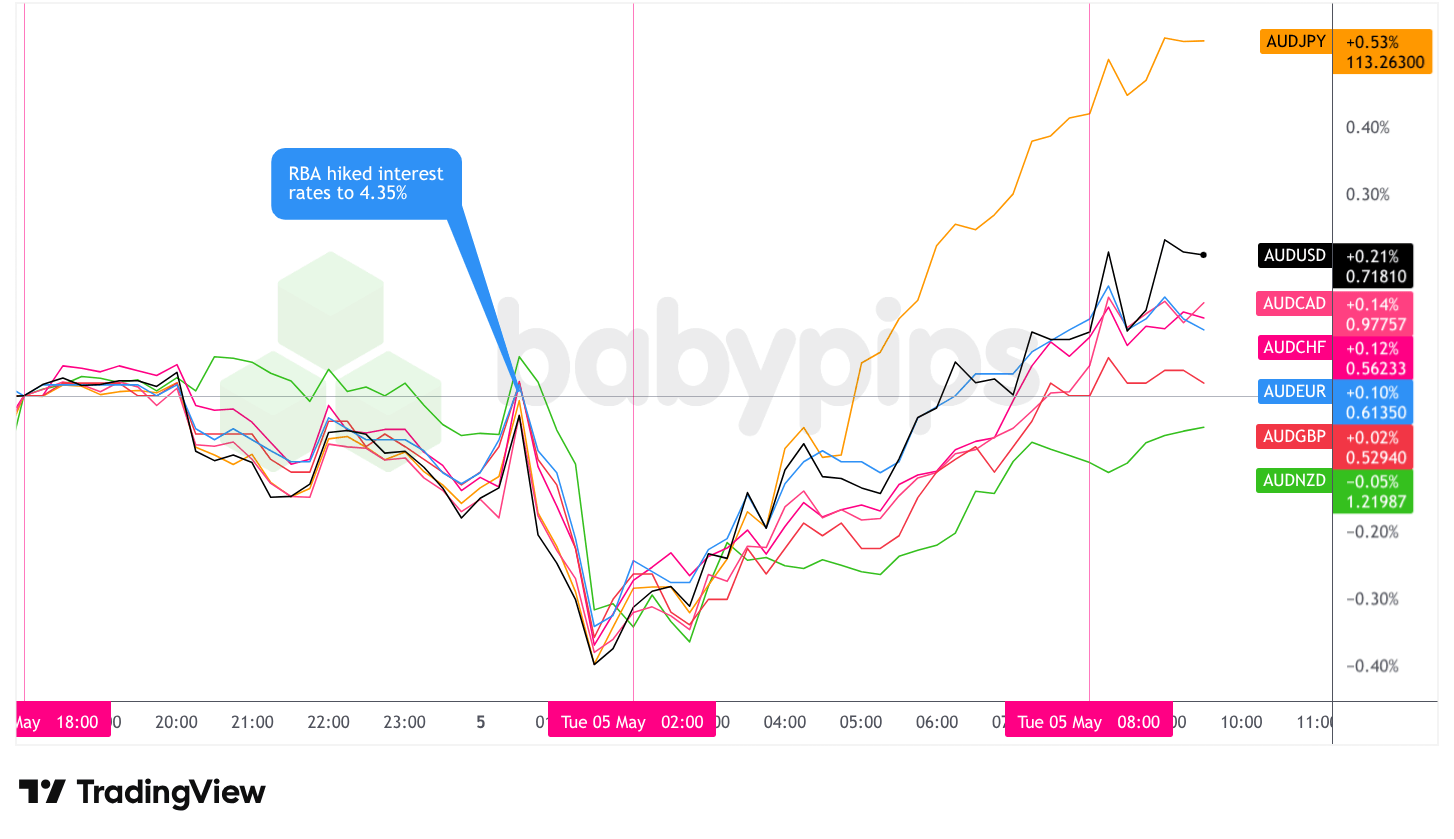
Overlay of AUD vs. Major Currencies – Chart Faster With TradingView
The Aussie’s reaction to the hike was a bit of a head-scratcher at first glance. Rather than immediately rallying on a rate hike, AUD/USD dipped sharply in the 15-minute candles following the decision — dropping from around the 0.7165 area to near the 0.71358 support level around 00:30 AM ET. That kind of “sell the news” move after a hike that was ~70% priced in going into the meeting isn’t unusual, and the RBA’s downgraded growth forecasts may have also given some traders a reason to take chips off the table.
What happened next told a different story, though. Buyers stepped in consistently throughout the Asian and early European sessions, and by around 08:00 AM ET, AUD/USD had clawed back all its losses and broken above the 0.71715 resistance level. The pair was trading near 0.71851 at the time of writing, up about 0.27% on the day, likely due to a combinations of further hike expectations and broad risk-on vibes as the ceasefire between the U.S. and Iran remains in place.
With another hike potentially on the table for June and markets pricing the cash rate heading toward 4.70% by year-end, the interest rate story should remain a tailwind for AUD — at least as long as the global energy situation doesn’t take a sharply negative turn for the Australian economy.
⚠️ This article is for informational purposes only and does not constitute investment or trading advice.
This article covers the RBA’s rate decision and the immediate market reaction, but understanding what was priced in, what surprised the market, and how to prepare for different scenarios is essential to reading any central bank announcement correctly. Premium members can read our lesson:
📖 How to Trade Central Bank Decisions Using Market Expectations
Reading this helps you understand what “priced in” actually means, how to read market-implied probabilities before a decision, and the four scenarios every trader needs to prepare for on central bank decision days.
And if you’re not a Premium subscriber yet, consider joining now.
With Babypips Premium, you get full access to School of Pipsology lessons that help you understand not just what a central bank decided, but what the market had already expected, which scenario actually played out, and where the trading opportunity lives.