The Reserve Bank of Australia (RBA) held its cash rate at 4.35% at its June 2026 meeting, pausing after three consecutive hikes that raised borrowing costs by 0.75 percentage points since February. The decision was unanimous and widely expected — but Governor Michele Bullock made clear this is a pause, not a pivot. Underlying inflation is still above the RBA’s target, the board kept the door open to further hikes, and a brand-new U.S.–Iran peace deal has made the path forward genuinely uncertain.
RBA June 2026 Decision: Key Takeaways
- Cash rate held at 4.35%: The RBA paused after three straight 25-basis-point hikes in February, March, and May 2026 — a total of 75 basis points of tightening since the start of the year.
- Unanimous hold; no rate cut discussed: All board members voted to hold. Governor Bullock confirmed no one on the board considered a rate cut at this meeting.
- Headline CPI at 4.2% in April: Australia’s annual inflation rate fell from 4.6% in March to 4.2% in April — still well above the RBA’s 2–3% target.
- Trimmed mean (core) inflation at 3.4% in April: The RBA’s preferred underlying inflation measure actually ticked higher month-over-month, from 3.3% to 3.4% — moving in the wrong direction.
- Unemployment at 4.5% in April: The jobless rate came in above the RBA’s own Q2 forecast of 4.2%, adding weight to the case for a pause.
- AUD/USD subdued near 0.7050: The Australian dollar is trading under mild pressure, partly giving back a rally sparked by a U.S.–Iran interim peace deal announced earlier this week.
- Next meeting August 10–11, 2026: Major Australian banks are now sharply divided — some see a cut, one sees another hike.
What Did the RBA Decide at Its June 2026 Meeting?
The RBA’s Monetary Policy Board voted unanimously to hold the cash rate at 4.35% on June 16, 2026. This ends a run of three consecutive 25-basis-point hikes — in February, March, and May — that lifted rates by a combined 0.75 percentage points from 3.60% at the start of the year. A basis point is one one-hundredth of a percentage point — so 75 basis points equals 0.75%.
The hold was no surprise. Our Event Guide showed that the markets forecasted a pause. Markets had priced in essentially zero chance of a move the moment the May hike was announced. After the May meeting, Bullock had already described the 4.35% rate as “a bit restrictive” and signaled the board needed time to see how the economy was responding.
At her post-meeting press conference, Bullock was measured but firm. “If we need to increase rates again, we will,” she said, noting the board was in a much stronger position than at the start of the year, when rates were 75 basis points lower. The RBA’s formal statement added that it would do “what it considers necessary to achieve that outcome, including increasing the cash rate target further if required.”
Promoted: Navigating RBA Volatility? Get the Capital You Need to Trade the Aussie.
As Governor Bullock navigates sticky inflation and shifting rate expectations, the Australian dollar is facing a new era of unpredictable swings. While the RBA’s pause and the latest U.S.–Iran peace deal create uncertainty for some, they create prime opportunities for disciplined traders. Don’t let a lack of liquidity hold you back from capitalizing on these macroeconomic shifts.
Alpha Capital Group provides access to simulated funded accounts from $5K to $200K, starting at $40, you can execute high-conviction setups with the professional position sizing they deserve. Join 250K+ traders in 180+ countries today!
Learn more about Alpha Capital Group!
Disclosure: We may earn a commission from our partners if you sign up through our links, at no extra cost to you.
Why Did the RBA Pause After Three Straight Hikes?
Rate hikes don’t work instantly. The full impact of higher borrowing costs on household spending and business investment typically takes 12 to 18 months to show up in the data. After three hikes in rapid succession, the RBA needed to step back and see what was actually happening in the economy before moving again.
The data gave it good reasons to wait. Consumer spending is slowing. Housing prices are falling in some Australian capital cities. The unemployment rate rose to a higher-than-expected 4.5% in April, above the RBA’s own forecast of 4.2% for the June quarter — a sign the labor market is cooling. Business investment is still growing, and credit remains available, but the broader economy is clearly slowing as intended.
Oil prices also mattered. The RBA noted that oil prices “have eased in recent weeks”, partly because the U.S. announced an interim peace agreement with Iran this week. That deal includes plans to reopen the Strait of Hormuz — the narrow waterway through which roughly 20% of the world’s oil normally flows. If energy costs stay lower, one of the biggest drivers of Australia’s inflation surge fades, giving the board more room to hold.
Is Australian Inflation Actually Getting Better?
The picture is mixed. Headline inflation fell to 4.2% year-on-year in April 2026, down from 4.6% in March — a genuine improvement. Transport and fuel costs, which had surged due to the Middle East conflict, eased slightly in April as oil prices retreated from their peak.
But the trimmed mean — also called underlying or core inflation, which strips out the most volatile price swings to show the true underlying trend — rose to 3.4% in April, up from 3.3% in March. That is the measure the RBA watches most closely, and it moved in the wrong direction. Both readings remain above the RBA’s 2–3% inflation target band.
Higher energy costs are also spreading through the economy in a process economists call “second-round effects.” This happens when an initial price shock — like surging fuel costs — pushes up the price of other goods and services: transportation, construction materials, food, and housing. The RBA’s May outlook forecast headline inflation peaking near 4.8% in the June 2026 quarter, with the trimmed mean peaking around 3.9%. That said, the peace deal — if it holds — could bring those forecasts down materially.
How Does the U.S.–Iran Peace Deal Change the Outlook?
The energy shock from the Middle East conflict was the single biggest reason the RBA restarted its rate-hike cycle in 2026. If that shock is now unwinding — because the U.S.–Iran peace deal is reopening the Strait of Hormuz and stabilizing global oil supply — the RBA may have much less work to do.
The RBA acknowledged this shift in its statement, noting oil prices have eased. But it was careful: “Resolution of the conflict in the Middle East is at an early stage,” it said, warning that there are still plausible scenarios where inflation ends up higher and growth lower than expected. The peace deal is new and its durability is not yet certain.
What Does the RBA Hold Mean for AUD/USD Traders?
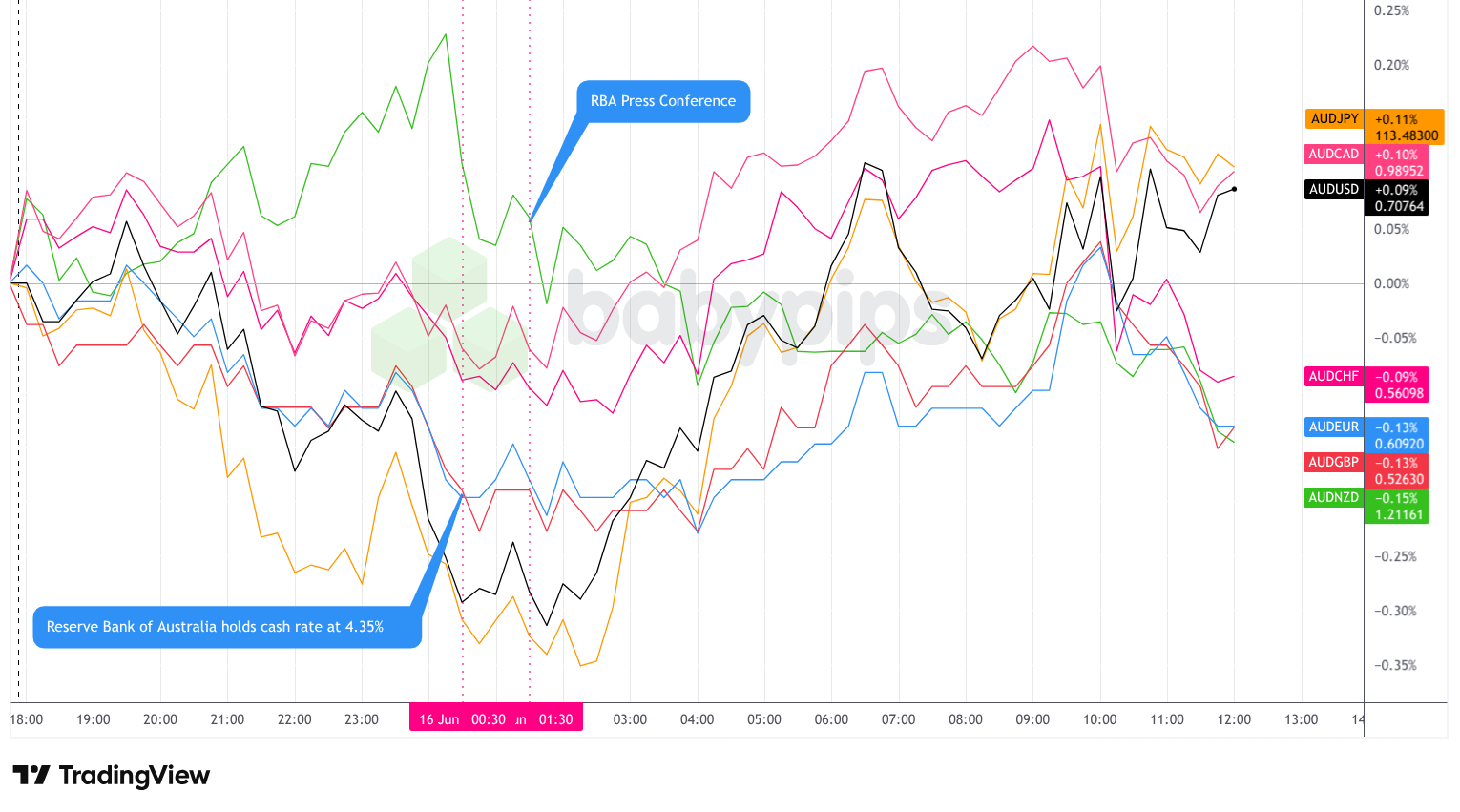
Overlay of AUD vs. Major Currencies – Chart Faster with TradingView
The Australian dollar (AUD) is trading under modest pressure today, near 0.7050 against the U.S. dollar (AUD/USD), after the RBA’s hold delivered no surprise. A rate decision that matches expectations rarely moves a currency much on its own — traders had already priced this in. The bigger story for AUD is what happens next.
This week’s U.S.–Iran peace announcement had briefly pushed AUD/USD up around 0.5% — investors saw lower oil prices as reducing the inflation pressure that had been driving RBA hikes, and the Aussie had already reached a four-year high in early May. After today’s hold, AUD gave back part of that peace-deal rally — a sign markets are now questioning whether the RBA has much more tightening ahead.
There are additional headwinds. China’s retail sales fell 0.6% year-on-year in May, missing forecasts of a flat reading — weak Chinese demand is a direct negative for AUD since China is Australia’s largest trading partner. Meanwhile, the U.S. Federal Reserve is expected to hold its own rate at 3.50–3.75% this week, limiting how much the interest rate gap between the U.S. and Australia can widen in AUD’s favor. The key question for traders: does the peace deal hold, and does Australian inflation fall fast enough to keep the RBA on the sidelines?
Promoted: Profitable Trading Isn’t Reserved for Wall Street.
Most traders quietly wonder if consistent profitability is actually achievable for someone like them—or if it’s just a story people tell. Jack Schwager’s newest book, “Market Wizards: The Next Generation,” answers that question directly. The legendary author behind the original Market Wizards series interviews a new generation of successful traders—many self-taught—who built real wealth and income through the markets. Their common thread isn’t genius or insider access. It’s a deliberate process, disciplined risk management, and the conviction to take trading seriously as a pursuit worth mastering.
If that sounds like something worth exploring, this is a good place to start.
Get Market Wizards: The Next Generation on Amazon!
Disclosure: We may earn a commission from our partners if you sign up through our links, at no extra cost to you.
Frequently Asked Questions About the RBA June 2026 Rate Decision
What did the RBA decide at its June 2026 meeting?
The Reserve Bank of Australia held its cash rate at 4.35% on June 16, 2026. The vote was unanimous. It follows three consecutive 25-basis-point hikes in February, March, and May that raised rates by a total of 0.75 percentage points from 3.60% at the start of the year.
What is the RBA cash rate and why does it matter for traders?
The cash rate is Australia’s benchmark interest rate — the rate the RBA sets for overnight lending between banks. When it rises, banks pass higher borrowing costs on to households and businesses through mortgages and loans. A higher cash rate slows spending and is designed to reduce inflation. For forex traders, rising rates typically support the Australian dollar by attracting yield-seeking investors; falling rates tend to weaken it.
Is Australian inflation still above the RBA’s target?
Yes. Headline inflation fell to 4.2% year-on-year in April 2026, down from 4.6% in March, but still well above the RBA’s 2–3% target range. The trimmed mean — the RBA’s preferred core measure — actually ticked up to 3.4% in April from 3.3%. Both readings remain too high for the RBA to consider rate cuts.
Will the RBA cut or hike rates at its next meeting in August 2026?
Economists are genuinely split. Commonwealth Bank, NAB, and ANZ are now forecasting a possible rate cut in August, particularly if the U.S.–Iran peace deal keeps oil prices lower and inflation cools more quickly than expected. Westpac is on the other side, predicting another hike in both August and September. The RBA’s next meeting is August 10–11, 2026.
What does the RBA decision mean for the Australian dollar (AUD)?
AUD/USD is trading near 0.7050 — subdued after the hold, which was fully expected. The Aussie is partly giving back a rally that came from the U.S.–Iran peace deal. If the peace deal holds and reduces oil-driven inflation, the case for more RBA hikes weakens, which could put downward pressure on AUD. Weak Chinese economic data adds a further headwind for the currency.
The RBA’s June hold was fully expected, yet the Australian dollar struggled after an initial bounce from the U.S.-Iran peace deal. Many traders miss the real driver of FX reactions. Premium members can read our lesson:
📖 Market Expectations: Why Good News Can Tank a Currency
Reading this helps you understand why rate decisions that match forecasts rarely move currencies, how geopolitical shocks initially push prices before expectations reset, and why the deviation from market pricing drives price action more than the headline number itself.
And if you’re not a Premium subscriber yet, now’s a good time to join.
With Babypips Premium, you get full access to School of Pipsology lessons that help you understand not just what rate decisions say, but why markets react the way they do to news, and how to trade the expectations rather than chase the initial shock.