


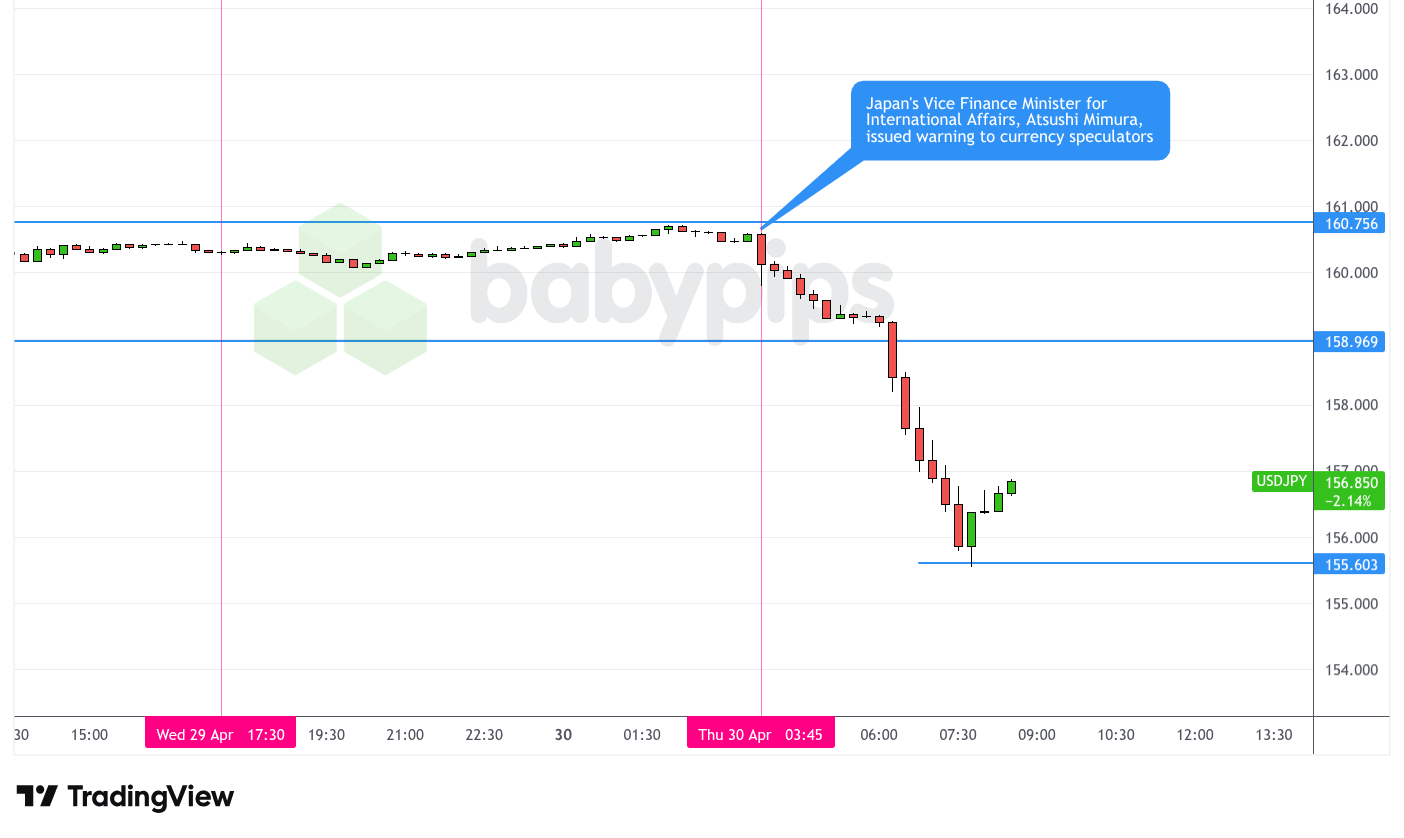
The Japanese yen surged sharply on Thursday after Japan’s Vice Finance Minister for International Affairs, Atsushi Mimura, issued a blunt, extraordinary warning to currency speculators — one that immediately sent USD/JPY into a steep nosedive from a fresh 21-month high.
Key Points
- USD/JPY topped out at 160.73 before collapsing sharply on the intervention warning
- Vice Finance Minister Mimura told markets: “Let me say this as my final advisory if you want to escape” — a direct shot at yen bears
- The drop marks the yen’s strongest daily gain since mid-March 2026
- The move follows a hawkish-leaning BoJ hold on Tuesday and a deeply divided Fed decision on Wednesday
- Finance Minister Katayama confirmed she discussed FX directly with U.S. Treasury Secretary Scott Bessent, raising the risk of coordinated intervention
What Triggered the Spike?
USD/JPY 15-min Forex Chart Faster with TradingView
USD/JPY pushed to an intraday high of 160.73 during the early morning London session before Mimura issued his stark warning. The pair then tumbled sharply, posting its strongest daily gain since mid-March 2026.
The warning was not a routine statement. The use of “final” advisory language was an unmistakable signal to short-yen speculators that direct market intervention — where the government sells dollars and buys yen — could be imminent.
Finance Minister Katayama separately confirmed that she told G7 members Japan is watching FX with a “high sense of urgency,” and that she had discussed the situation directly with U.S. Treasury Secretary Scott Bessent in bilateral talks, agreeing to stay in close contact. That detail is significant — direct bilateral communication with the U.S. Treasury raises the possibility of coordinated action, which would be far more powerful than Japan acting alone.
Promoted: Day traders & Scalpers have better odds of making great decisions if they see market catalysts right away, including comments from government officials like situation we saw today in Japan. Get the real-time feed that pros use to catch the news.
Join FinancialJuice for Free to learn more!
Disclosure: We may earn a commission from our partners if you sign up through our links, at no extra cost to you.
Why Was the Yen So Vulnerable in the First Place?
The yen had been grinding steadily weaker for days heading into today’s blow-off. A combination of structural forces has kept the currency under pressure throughout 2026.
The Bank of Japan’s 0.75% interest rate, compared to the Fed’s upper limit of around 3.75%, continues to encourage carry trades — where investors borrow cheaply in yen and invest in higher-yielding currencies elsewhere. Changes in this rate gap remain the main driver of short-term price movements.
The BoJ did hold its policy meeting on Tuesday, and the result was more hawkish than the headline suggested. The central bank kept rates at 0.75% but saw a 6-3 vote split, with three board members calling for an immediate hike — the most divided the BoJ has been since Kazuo Ueda took the helm. The BoJ also raised its core inflation forecast to 2.8% and trimmed its growth outlook to 0.5%, citing Middle East conflict disruptions to energy flows. Despite this, the yen barely reacted, as markets focused more on Japan’s weakening growth picture than on the hawkish dissents.
On the other side of the equation, the Fed held its benchmark rate steady between 3.50% and 3.75% on Wednesday in its most divided decision since 1992, with three dissenting policymakers who no longer believe the bank should communicate a bias toward easing. Fed Chair Jerome Powell also warned that near-term inflation expectations are rising. A hawkish Fed means the U.S.-Japan rate gap isn’t going anywhere fast — and that keeps the carry trade attractive and the yen under structural selling pressure.
Market Reactions
Overlay of JPY vs. Majors – Chart Faster with TradingView
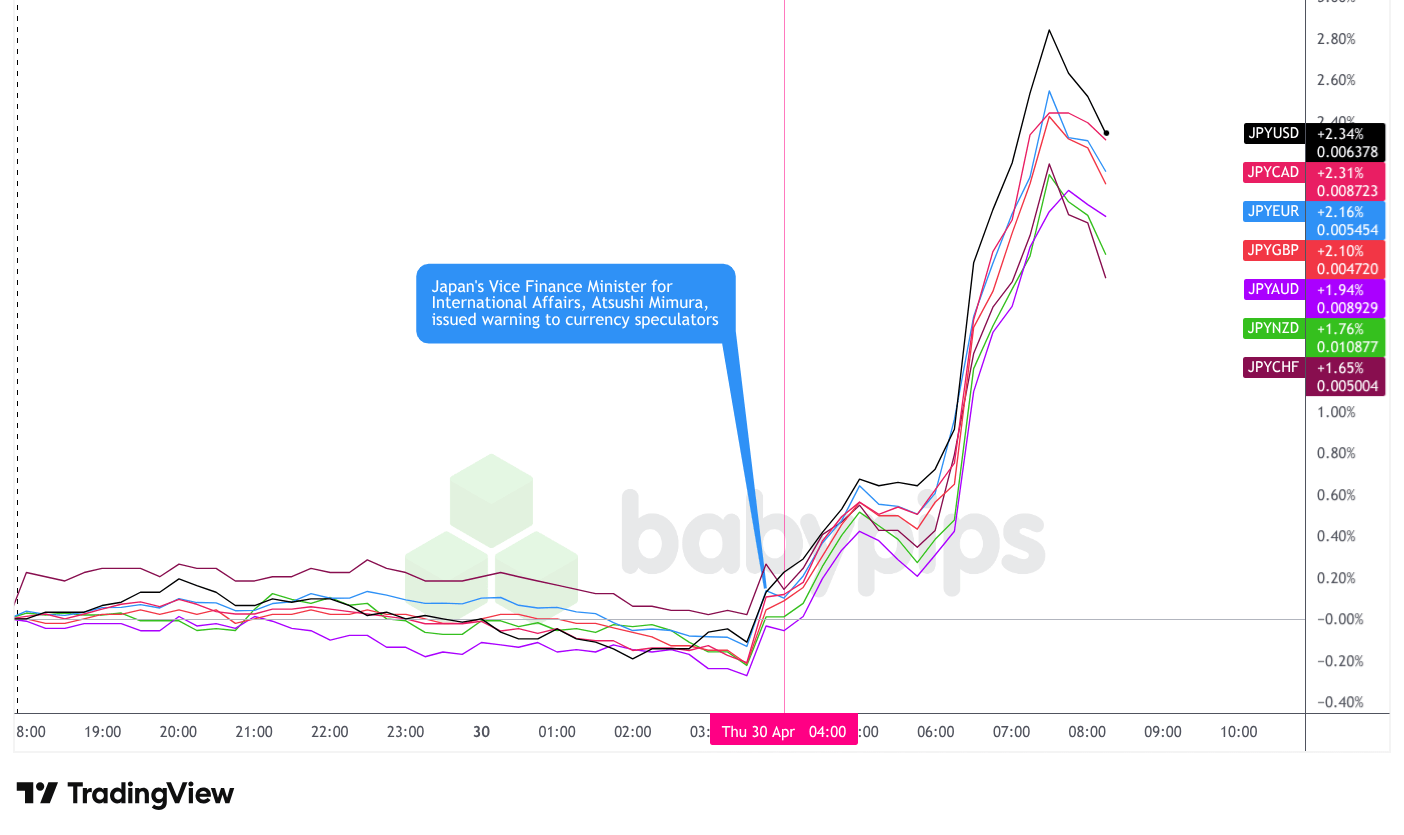
The JPY overlay chart also tells the story clearly, showing the yen’s surge against every major currency simultaneously. The yen continued to power higher through the morning London session, peaking around 07:30 EDT before pulling back slightly as some traders took some profit ahead of the U.S. session open.
Promotion: If your confidence has grown in your market awareness & strategies with this market recap, and you wanna take action, Maven Trading can help. They provide simulated funding challenges starting as low as $13, allowing you to trade major pairs with professional-sized capital. No time limits mean you can take swing plays on these market themes without the pressure of a ticking clock.
Learn More About Maven Trading Today!
Disclosure: We may earn a commission from our partners if you sign up through our links, at no extra cost to you.