The Bank of Japan (BOJ) kept its benchmark interest rate unchanged at 0.75% today, pausing its rate hike cycle as Middle East conflict clouds the economic outlook. The decision came in a 6-3 vote — the most divided the Policy Board has been under Governor Kazuo Ueda’s tenure.
Key Takeaways
- Policy rate held at 0.75% in a 6-3 vote, the biggest split under Ueda’s governorship
- Three dissenters (Nakagawa, Takata, and Tamura) pushed for a hike to 1.0%
- BOJ slashed its growth forecast for this fiscal year in half, down to 0.5%
- Core inflation forecast raised to 2.8% for this fiscal year, above expectations
- Ueda flagged sharply reduced confidence in the bank’s economic baseline outlook
- June 16 rate hike odds sit at 66% in overnight swap markets
Official April 28 BOJ Monetary Policy Statement
What Did the BOJ Decide?
The BOJ’s nine-member Policy Board voted to leave the overnight call rate at around 0.75%, a widely expected outcome after the Middle East conflict — stemming from a U.S.-Iran war — derailed what had been a live chance of a hike as recently as early April.
The three dissenters weren’t just the usual hawks. Alongside longtime rate-hike advocates Hajime Takata and Naoki Tamura, consensus-leaning member Junko Nakagawa crossed over to vote for an immediate increase to 1.0%. Their shared argument: upside risks to prices have grown under still-accommodative financial conditions, and the BOJ should be moving its rate closer to neutral.
The BOJ also made a subtle but notable tweak to its forward guidance language. The bank dropped the word “improvement” when describing conditions that would warrant further hikes, replacing it with “developments.” In plain terms, that means the BOJ may feel more comfortable raising rates even as growth slows — as long as the price situation demands it.
In its statement, the BOJ flagged that it will “pay particular attention to the impact of the future course of the situation in the Middle East on financial and foreign exchange markets and on Japan’s economic activity and prices.”
What Did Ueda Say at the Press Conference?
Governor Ueda’s press conference gave markets a lot to chew on — and not in a clean direction.
On the one hand, he was candid about why the BOJ stood pat: “If I were to sum up the main reason for stand-pat in one sentence, it’s that the certainty of meeting our baseline outlook has declined quite significantly this time.” That’s a notable admission for a central bank that had been on a steady normalization path.
On the other hand, he refused to close the door on a June hike: “I believe there is a possibility that we could raise interest rates” if price risks worsen and a major economic downturn is avoided. He also addressed the lopsided vote head-on, noting that the split reflects a genuinely difficult policy environment — one where a supply shock is simultaneously weighing on growth and pushing prices higher.
These conflicting ideas likely left yen traders dazed and confused on where their biases should lean, likely leaving the yen susceptible to exogenous drivers, like rising oil prices and a stronger U.S. dollar, along with several other major central bank monetary policy statements ahead.
Promoted: Day traders & Scalpers have better odds of making great decisions if they see market catalysts right away. Get the real-time feed that pros use to catch the news.
Join FinancialJuice for Free to learn more!
Disclosure: We may earn a commission from our partners if you sign up through our links, at no extra cost to you.
Market Reactions
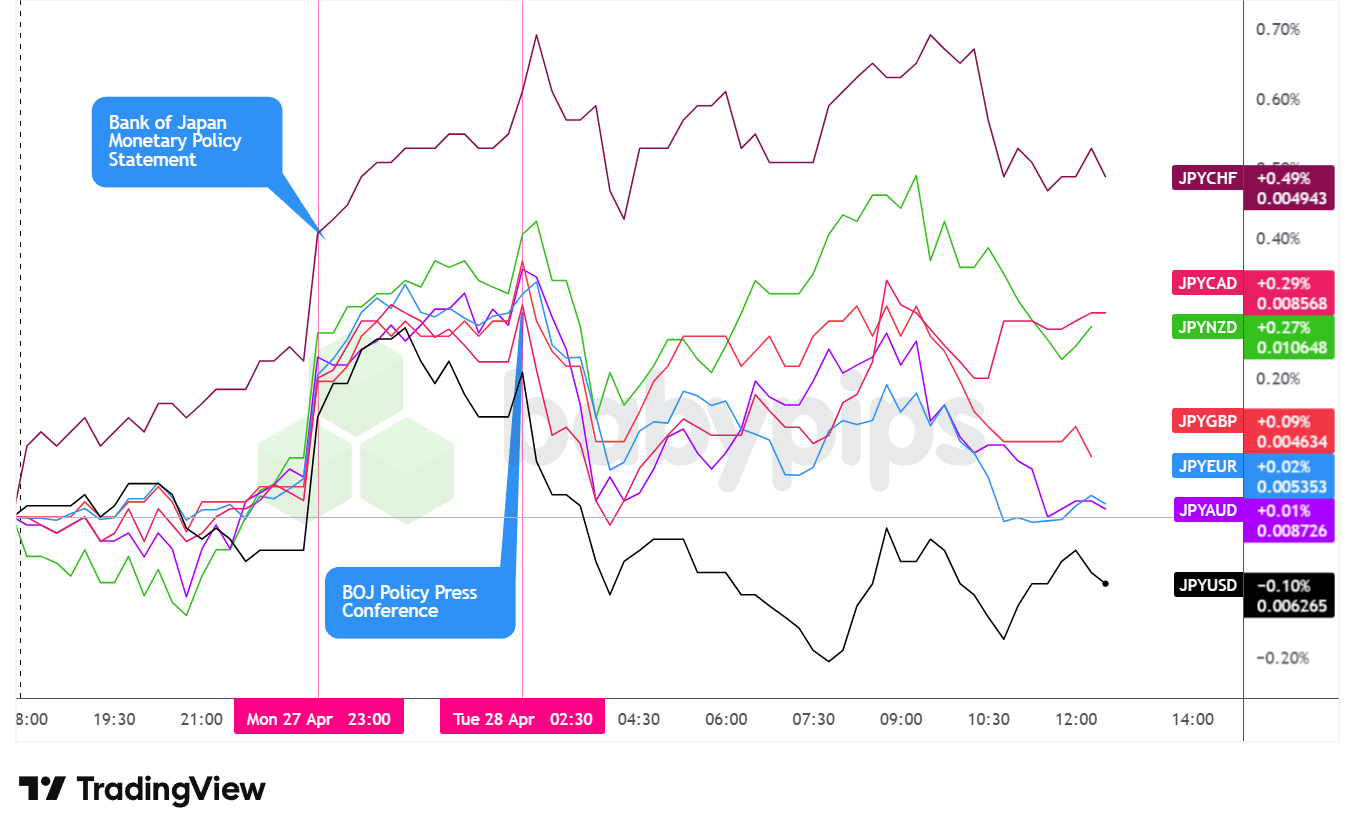
Overlay of JPY vs. Majors – Chart Faster with TradingView
When the statement dropped, the yen surged broadly — a clean buy-the-yen response as traders likely processed the 6-3 vote as a hawkish signal pointing toward a June hike. The yen briefly tested the 159.00 level against the dollar.
But the mood shifted once Ueda started talking. During the press conference (which began around 2:30 AM ET), the yen reversed lower as the governor emphasized declining confidence in the BOJ’s economic baseline. Again, this idea that rate hikes are still possible while the chances of a potential slowdown in growth likely had they yen moving more on exogenous factors like the increasing price of oil on the session (Japan imports roughly 95% of the oil it consumes).
The divergence between USD and the rest of the yen crosses is reflective of the USD strength on the session, which likely compounded the yen’s vulnerability as Ueda’s more cautious tone possibly disappointed traders who had priced in a hawkish lean.
With Japan’s national holidays coming up and the Fed, Bank of England, and ECB all set to make their own decisions this week, it’s import to note that thin liquidity conditions could leave the yen exposed if it drifts back toward the 160 line.
Promoted: Navigating BOJ Volatility? Get the Capital You Need to Trade the Yen.
As Governor Ueda navigates the Bank of Japan’s most divided policy split yet, the yen is facing a new era of unpredictable swings. While 6-3 votes and shifting inflation forecasts create uncertainty for some, they create prime opportunities for disciplined traders. Don’t let a lack of liquidity hold you back from capitalizing on these macroeconomic shifts.
Alpha Capital Group provides access to simulated funded accounts from $5K to $200K, starting at $40, so traders can execute high-conviction setups with the professional position sizing they deserve. Join 250K+ traders in 180+ countries today!
Learn more about Alpha Capital Group!
Disclosure: We may earn a commission from our partners if you sign up through our links, at no extra cost to you.