


The S&P 500 touched its first record high since mid-August on Tuesday as Treasury yields eased and the dollar slipped against the euro and pound. Oil fell about 2.5% before the U.S. open and made up the loss by the afternoon. Bank of Japan Governor Ueda left October hike bets unchanged, and the yen lagged.
Check out the forex news and economic updates you may have missed in the latest trading session!
News Headlines & Data:
- New Zealand NZIER Business Confidence for September 30, 2026: 43.0% (15.0% forecast; 8.0% previous)
- Australia Westpac Consumer Confidence Change for October 2026: -4.7% (-1.2% forecast; -5.2% previous)
- Australia ANZ-Indeed Job Ads for September 2026: 2.2% m/m (-1.3% m/m forecast; 2.5% m/m previous)
- Germany Factory Orders for August 2026: -10.6% m/m (-0.6% m/m forecast; 2.5% m/m previous)
- Bank of Japan Governor Ueda does little to challenge recent market sentiment against a back-to-back interest rate increase this month
- Swiss Unemployment Rate for September 2026: 3.0% (2.8% forecast; 3.0% previous)
- Euro area Retail Sales for August 2026: 0.8% y/y (0.5% y/y forecast; 0.6% y/y previous)
- ADP Employment Change Weekly for September 19, 2026: 23.75k (20.0k previous)
- Canada Balance of Trade for August 2026: 4.2B (1.4B forecast; 0.77B previous)
- U.S. Balance of Trade for August 2026: -105.6B (-102.2B forecast; -88.6B previous)
- Canada Ivey PMI s.a for September 2026: 58.2 (65.0 forecast; 64.3 previous)
- New Zealand Global Dairy Trade Price Index for October 6, 2026: 1.2% (-1.1% previous)
Broad Market Price Action:
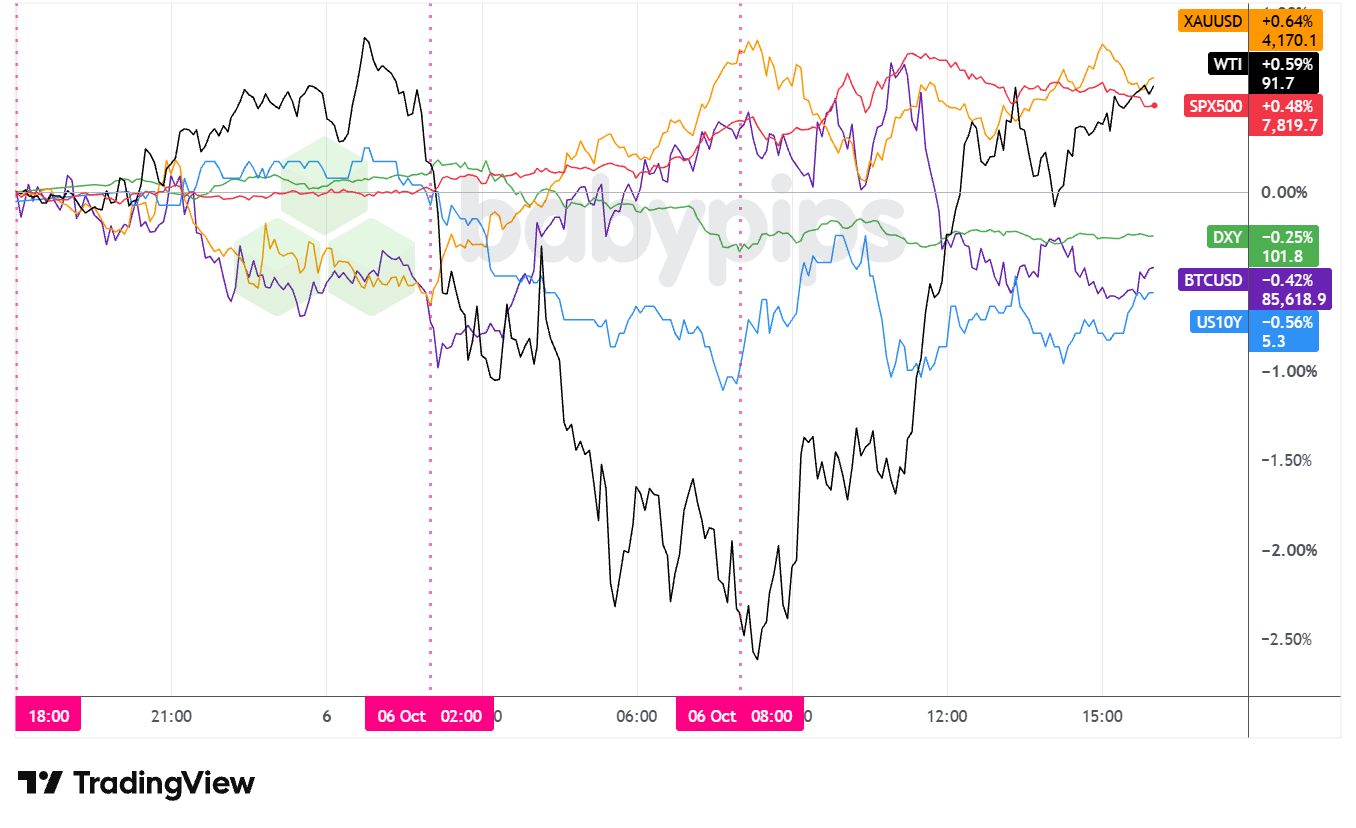
Dollar Index, Gold, Oil, S&P 500, U.S. 10-yr Yield, Bitcoin Overlay – Chart Faster With TradingView
Risk sentiment improved on Tuesday as Treasury yields retreated from multi-decade highs and pressure on French bonds eased. Most of the repricing came during European hours, and the U.S. afternoon stayed quiet except for oil.
The S&P 500 rose about 0.5% to near 7,820 after it touched its first record high since mid-August near 7,840 around 11:20 am ET. The index added about 0.4% between 2:00 and 8:00 am ET while Treasury yields eased and oil slid, and a dip to near 7,800 at 8:45 am ET proved shallow. The AI trade appeared to lead the advance, with Nvidia’s market value approaching $6 trillion, AMD’s chief executive forecasting strong chip demand for the next few years, and Alphabet agreeing to buy nuclear power from Constellation Energy. Analysts expect third-quarter S&P 500 profits to grow about 25% from a year earlier, and earnings season begins in about a week. The index slipped about 0.3% from its high into the afternoon with no clear catalyst.
WTI crude swung through a range of about $3 and gained about 0.6% to near $91.70. It held near $91 until 2:00 am ET, fell about 2.5% to near $89.00 by 8:00 am ET, and touched a low near $88.80 at 8:20 am ET. No single catalyst stood out for the slide, although rising Middle East crude exports and a planned G7 release of emergency stockpiles may have weighed on prices. WTI recovered about 3% from 8:00 am ET to a high near $91.73 around 3:50 pm ET, which may reflect supply concerns as hostilities between Saudi Arabia and Yemen’s Houthis escalated, including attacks on two Saudi airports on Monday evening.
The 10-year Treasury yield held near 5.31% overnight, slid to a low near 5.25% around 7:40 am ET, and bounced to near 5.30% around 9:50 am ET while oil rebounded from its lows. It traded near 5.28% late in the afternoon, about 3 basis points below its starting level and off its highest level since 2002. The early slide may reflect easing pressure on French bonds, and softer U.S. jobs data on Friday cut the odds of an October Fed hike to below one in four.
Gold slid about 0.6% to near $4,117 by 2:00 am ET, climbed about 1.4% to near $4,177 by 8:00 am ET as the dollar and Treasury yields fell, and traded between about $4,145 and $4,180 for the rest of the day. It ended up about 0.6% near $4,170. The narrow afternoon range may reflect a U.S.-Iran stalemate and inflation data risk capping the upside.
Bitcoin fell about 1% to a low near $85,140 around 2:10 am ET, climbed about 1.4% to near $86,320 by 7:35 am ET, and reached a high near $86,600 around 10:55 am ET. It faded to near $85,600 by late afternoon, down about 0.4% on the day. With no Bitcoin-specific news, the swings may reflect broader risk appetite, since the low arrived as the dollar peaked and the high arrived as the 10-year yield dipped to near 5.26%.
FX Market Behavior: U.S. Dollar vs. Majors
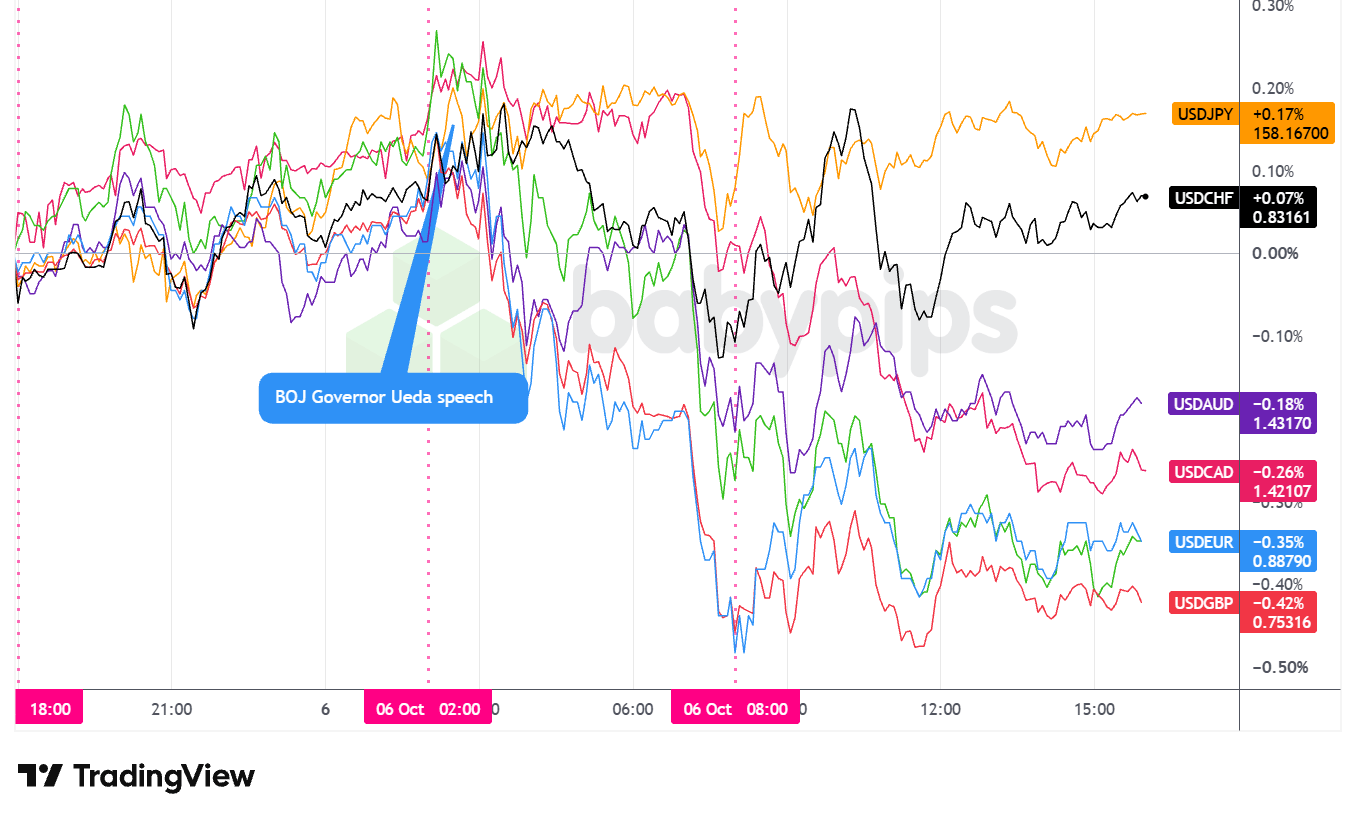
Overlay of USD vs. Major Currencies – Chart Faster With TradingView
The dollar index lost about 0.25% to near 101.8 as the euro and pound gained the most. The dollar fell about 0.4% against the pound and kiwi, about 0.35% against the euro, about 0.25% against the Canadian dollar and about 0.2% against the Australian dollar. It gained about 0.2% against the yen and 0.1% against the Swiss franc.
During the Asia session, the dollar edged higher against all seven majors, and the dollar index rose about 0.1% to near 102.2 by 2:00 am ET. New Zealand’s NZIER business confidence jumped to 43.0 against a 15.0 forecast, yet the kiwi slipped about 0.1%. The drift in the major pairs potentially reflected positioning ahead of Bank of Japan Governor Ueda’s speech.
During the London session, the dollar peaked near 2:10 am ET and reversed, with the dollar index sliding about 0.45% to near 101.76 by 8:00 am ET. USD/JPY pushed to near 158.2 around 2:30 am ET, close to the time Ueda said the BOJ will keep raising rates but offered little sign of a hike this month. Overnight index swaps priced about a 12% chance of an October increase, down from as high as 40% last week, and about 90% by December. The yen ended the session flat against the dollar while the other six majors gained.
The euro led the retreat, with EUR/USD climbing from near 1.121 to near 1.128 between 2:10 and 8:00 am ET. Germany’s August factory orders plunged 10.6% m/m against a 0.6% forecast decline at 2:00 am ET, and the euro held near its lows for about an hour before it started to climb around 3:10 am ET. The pound gained about 0.5% and the kiwi about 0.4%. The dollar slid in two legs, from about 3:10 am ET and from about 7:10 to 8:00 am ET, and the second leg coincided with the 10-year yield falling to its session low.
During the U.S. session, the dollar index bounced about 0.1% from its 8:00 am ET low to near 101.85, after a high near 101.95 around 10:20 am ET. The dollar regained about 0.1% against the euro and 0.2% against the Swiss franc. The Canadian dollar firmed, with USD/CAD sliding from a high near 1.4254 at 8:30 am ET to near 1.4210 as WTI gained about 3%. Canada’s trade surplus came in at C$4.2 billion against a 1.4 billion forecast at 8:30 am ET, and the U.S. trade deficit widened to $105.6 billion against a $102.2 billion forecast, though the dollar showed no clear reaction to the U.S. data. USD/JPY dipped to near 157.97 around 9:30 am ET and recovered to near 158.17.
Upcoming Potential Catalysts on the Economic Calendar
- API Crude Oil Stock Change for October 2, 2026 at 8:30 pm GMT
- Australia AIG Manufacturing Index for September 2026 at 10:00 pm GMT
- Japan Reuters Tankan Index for October 2026 at 11:00 pm GMT
- Fed Logan Speech at 11:00 pm GMT
- Japan Average Cash Earnings for August 2026 at 11:30 pm GMT
- Australia Building Permits Final for August 2026 at 12:30 am GMT
- Japan Leading Economic Index Prel for August 2026 at 5:00 am GMT
- Germany Industrial Production for August 2026 at 6:00 am GMT
- France Balance of Trade for August 2026 at 6:45 am GMT
- U.K. BBA Mortgage Rate for September 2026 at 9:00 am GMT
- U.S. MBA 30-Year Mortgage Rate & Applications for October 2, 2026 at 11:00 am GMT
- EIA Crude Oil Stocks Change for October 2, 2026 at 2:30 pm GMT
- U.S. Consumer Inflation Expectations for September 2026 at 3:00 pm GMT
- FOMC Minutes at 6:00 pm GMT
The FOMC minutes at 2:00 pm ET on Wednesday carry the most weight on the calendar. The minutes may show how much conviction officials have behind the extra rate hike the Fed signaled in September, now that softer jobs and inflation data have cut October odds to below one in four. A hawkish tone could revive pressure on Treasuries and support the dollar after Tuesday’s pullback, while signs of division may extend the dollar’s slide.
Dallas Fed President Lorie Logan speaks at 7:00 pm ET tonight, and oil traders get EIA inventory data on Wednesday, with analysts expecting a 1.7 million barrel build in U.S. crude stocks. Germany’s industrial production at 2:00 am ET follows Tuesday’s drop in factory orders and may show how the euro reacts to more weak German data.
This market recap shows Treasury yields, stocks, oil, and currencies moving in sync, but many traders overlook the underlying connections between these markets. Premium members can read our lesson:
📖 What Is Intermarket Analysis?
Reading this helps you understand why higher Treasury yields ripple into FX markets, how oil prices and commodity moves affect currency strength, and the framework that ties stocks, bonds, commodities, and forex together.
And if you’re not a Premium subscriber yet, now’s a good time to join.
With Babypips Premium, you get full access to School of Pipsology lessons that help you understand how bond markets, equity moves, and commodity prices drive the currency pairs you’re watching, so you can read sessions like this one with full market context instead of missing the connections.
AI disclosure: A BabyPips editor directed and reviewed this article, and AI tools helped analyze the intraday price data, research sources, draft the text, and edit it. AI tools can misread data, make arithmetic errors, and state wrong information in a confident tone. Prices, levels, and percentage moves here are approximate because the market data was not captured at the exact close, so check the figures against your own data source before you rely on them. The explanations for market moves are possible reasons, not confirmed causes. This article is for education and is not a recommendation to trade.