


U.S. employers added a weak 29,000 jobs in September 2026, missing market forecasts ranging between 84,000 and 95,000. The unemployment rate rose to 4.2% from 4.1%, and the government cut July and August by a combined 60,000 jobs. Stock futures climbed and Treasury yields fell, because the report lowered the odds of another Fed rate hike. But August CPI inflation of 3.4% keeps the Fed on guard.
U.S. Jobs Report September 2026: Key Takeaways
- Nonfarm payrolls: +29,000 in September (the monthly count of paid U.S. jobs outside farms). Economists expected roughly 84,000 and 95,000 net new jobs.
- Unemployment rate: 4.2%, up from 4.1% in August and above the 4.1% forecast.
- Revisions: 60,000 fewer jobs in July and August combined. August fell to +133,000 from +162,000, and July shows a loss of 10,000 jobs.
- Average hourly earnings: +0.1% month-over-month to $37.81, a 3.0% gain over 12 months. August’s inflation rate was 3.4%.
- Fed hold odds: 77% for October, according to the CME FedWatch tool.
- 10-year Treasury yield: 5.18%, down nearly 6 basis points after a run to its highest level since 2002.
- Next up: September inflation data on Wednesday, October 14 at 8:30 a.m. ET, then the Fed decision on Wednesday, October 28 at 2:00 p.m. ET.
What Were the U.S. Jobs Results for September 2026?
U.S. employers added 29,000 jobs in September, according to the Bureau of Labor Statistics (BLS). That is the nonfarm payrolls number, a count of paid jobs in the U.S. outside of farms. At the time of posting, our Event Guide showed the market expectations at +90K. The reading fell below the 12-month average of 45,000 jobs per month.
The BLS rewrote the recent past. A revision is a corrected number the BLS publishes after more businesses send in their data. It cut August to +133,000 from +162,000 and moved July to a loss of 10,000 jobs from a gain of 21,000. The two months combine to show 60,000 fewer jobs than first reported.
Analysts quoted by CNBC said August looks like a rebound from weak hiring in June and July. That makes August’s spike look like a blip, a one-off move that does not change the bigger direction.
The unemployment rate, the share of workers without a job who are looking for one, rose to 4.2%. About 7.1 million people were unemployed. The participation rate, the share of adults who work or look for work, sat at 61.8%. The jobless rate has stayed between 4.1% and 4.3% since March, so September sits inside a range that has held for months.
Where Did the New Jobs Come From?
Health care did most of the lifting, adding 17,000 jobs. That is down from a monthly average of 33,000 over the past year. Hospitals added 12,000 jobs and ambulatory health care services added 13,000, while nursing and residential care facilities lost 9,000. Construction added 11,000 jobs and manufacturing added 9,000.
Finance lost ground. Financial activities shed 7,000 jobs in September and sit 129,000 jobs below a May 2025 peak. Insurance carriers account for 90,000 of those losses. The BLS said employment in all major industries changed little over the month. Picture the job market as a bus: health care kept boarding passengers, but most other stops stayed quiet.
Promoted: Have a solid trading strategy but lack the capital? FundedNext empowers disciplined traders by providing simulated trading accounts up to $200K.
Unlike other prop firms, FundedNext imposes no artificial time limits on challenges. You earn a unique 15% profit share during your evaluation. Once funded, you keep up to a 95% profit split with guaranteed 24-hour payouts. Trade CFDs or Futures your way, even during major news events.
Join over 400K traders who have received $300M+ in payouts. Ready to back your edge? Learn More About FundedNext! Limited time offer: Use code BP for discounts on both CFD & Futures plans! T&C apply.
Disclosure: We may earn a commission from our partners if you sign up through our links, at no extra cost to you.
Is the U.S. Job Market Getting Weaker?
Pay growth cooled along with hiring. Average hourly earnings, the average pay per hour for private-sector workers, rose 5 cents, or 0.1%, to $37.81. Economists expected a 0.3% gain. Over 12 months, pay is up 3.0%, down from 3.1% in August.
Inflation shrinks that raise. The consumer price index (CPI), a gauge of what households pay for goods and services, rose 3.4% over the 12 months to August. September pay growth of 3.0% trails that pace. Real wages, which measure your pay after you adjust for rising prices, lost ground on the latest readings.
The Fed’s own forecast makes the jobless rate matter more. In September, officials projected that the unemployment rate would average 4.1% in the final three months of 2026. September’s 4.2% sits above that call. The jobless rate for Black workers rose to 7.0%, the BLS said.
The broader economy sends a mixed signal. The Atlanta Fed tracks third-quarter GDP growth at 3.7%. GDP, or gross domestic product, is the total value of everything the country produces. That pace clashes with 29,000 new jobs.
What Does This Mean for the Federal Reserve?
The Fed raised its key interest rate by a quarter point on September 16, to 3.75% to 4.00%. The vote was unanimous. A quarter point equals 25 basis points, and one basis point is 0.01%. The Fed’s statement said job gains had kept pace with the workforce.
Officials signaled more tightening ahead. Sixteen of 18 officials projected at least one more quarter-point hike by December. Four of them projected two. The Fed also projected PCE inflation, its preferred price gauge, at 3.7% for 2026, which is 1.7 points above its 2% target.
The September report cools that plan for October. CNBC reported that Fed officials focus on the unemployment rate over the payroll count, and the rate rose 0.1 percentage point. Traders see a 77% chance that the Fed holds rates steady at its October meeting. Analysts told CNBC the report makes an October hike unlikely.
Two events come next. The Fed’s inflation tracker, September CPI, arrives Wednesday, October 14 at 8:30 a.m. ET. The Fed announces its decision Wednesday, October 28 at 2:00 p.m. ET. A hot CPI could revive the hike debate.
Promoted: Fed Hike Odds Fell After the Jobs Report. Want to See How Event Odds Move Too?
After the September jobs report, the CME FedWatch tool put the chance of an October Fed hold at 77%. FX traders know prices move on what the market expects, not only on what the data says.
Polymarket is a prediction market where traders buy and sell Yes/No contracts on real-world outcomes, including macro and geopolitics. Prices read like crowd-implied probabilities and can shift as headlines land. That makes them a useful companion lens when you study how event risk shows up in yields and FX.
Important: Polymarket is not available in all countries and regions due to regulation and local rules. Eligibility depends on where you are, so always confirm before signing up. Event / prediction-market trading involves a high risk of loss of capital; you can lose your stake. This is not financial advice. Disclosure: We may earn a commission from our partners if you sign up through our links, at no extra cost to you.
What Does This Mean for USD Traders?
Weak jobs data tends to pull the dollar down, because fewer rate hikes mean lower returns for dollar holders. Treasury yields, the return investors earn on U.S. government bonds, fell on the news. The 10-year yield dropped nearly 6 basis points to 5.18%. The 2-year yield, which moves most with Fed expectations, fell 6 basis points to 4.73%.
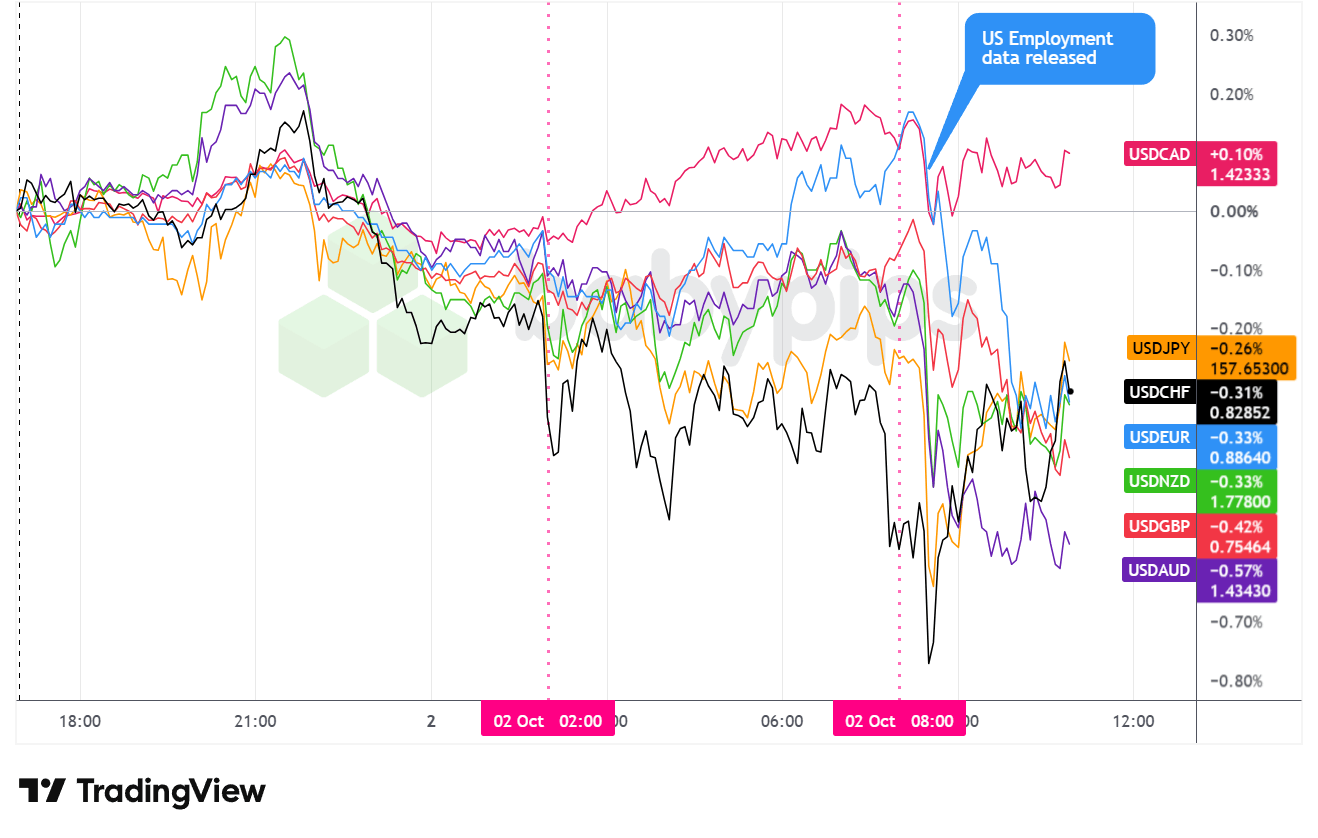
Overlay of USD vs. Major Currencies – Chart Faster with TradingView
The dollar’s reaction varied by pair. EUR/USD climbed from about 1.1232 to about 1.1278 by mid-morning in New York, a gain near 0.4%. The U.S. Dollar Index slid from near 102.1 to near 101.7. USD/JPY dipped toward 156.95 at the release and recovered to about 157.50. Prices keep moving, so check a live chart.
One soft report does not set the dollar’s direction for long. Think of the jobs report as one card in the Fed’s hand. CPI is the next card, and a hot reading can flip the story for the dollar pairs you watch.
A weak jobs report cools Fed hike bets, but hot inflation keeps the debate alive. Premium members can read our lesson, Trading Central Bank Decisions, to see how rate expectations move currency pairs and how to plan around events like the October 28 Fed decision.
Not a Premium member yet? Subscribe to BabyPips Premium for full access to School of Pipsology lessons.