


A weekend breakdown in U.S.-Iran diplomacy set the tone across markets on Monday. President Trump’s rejection of Tehran’s proposal to reopen the Strait of Hormuz lifted oil at the open and revived inflation worries, feeding a fresh bond selloff that pushed the 10-year Treasury yield toward its highest level in nearly two decades. Higher yields firmed the dollar and pressured risk assets, with gold taking the heaviest hit.
Check out the forex news and economic updates you may have missed in the latest trading session!
News Headlines & Data:
- Over the weekend, U.S. President Trump rejected Iran’s latest peace deal
- China Industrial Profits (YTD) for August 2026: 15.7% y/y (18.0% y/y forecast; 17.6% y/y previous)
- Dallas Fed Manufacturing Index for September 2026: 9.8 (1.0 forecast; 11.6 previous)
- On Monday, Federal Reserve Governor Lisa Cook said that she doesn’t see future productivity gains from artificial intelligence as enough to offset short-term price pressures
Broad Market Price Action:
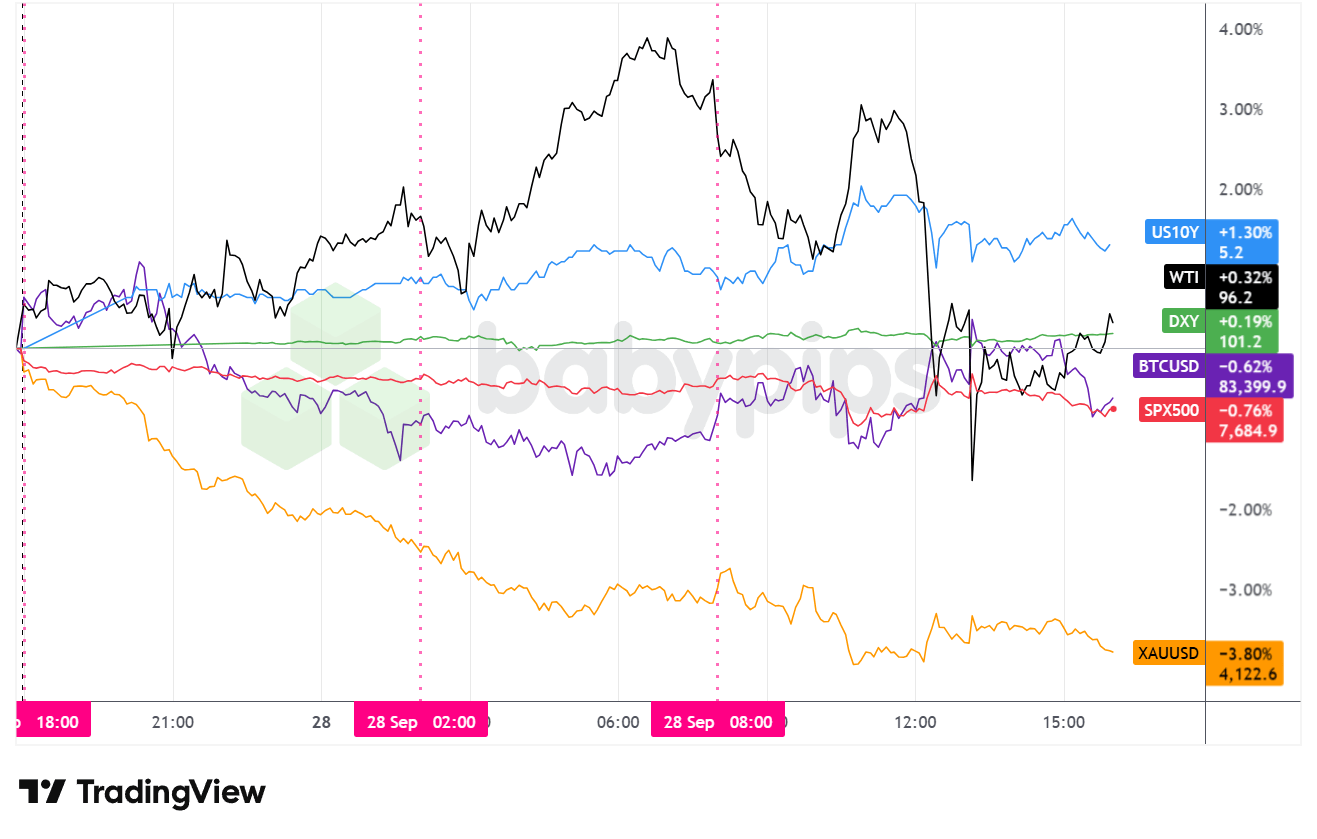
Dollar Index, Gold, Oil, S&P 500, U.S. 10-yr Yield, Bitcoin Overlay – Chart Faster With TradingView
Rising bond yields set the direction. The 10-year Treasury yield climbed for most of the day, pushing toward 5.2% and briefly higher during U.S. trading, close to levels last seen in 2007. Bets on another Fed rate hike at the October meeting firmed alongside the move.
Oil spiked early and then gave much of it back. WTI crude jumped at the Monday open on the Hormuz news and pushed above $99 during London hours, then reversed through the U.S. session to settle near $96, close to where it began. The round trip left crude little changed on the day even as the geopolitical risk premium stayed in play.
The S&P 500 spent the day underwater, sliding toward a late-morning low around 7,670 before a modest bounce trimmed the loss to roughly 0.8%. Higher borrowing costs weighed on valuations, and tech shares lagged after fresh AI-safety headlines added to the caution.
Gold was the day’s biggest loser. It fell hard from the Asian open, broke through a support shelf that had held near $4,250, and kept sliding to an intraday low around $4,116 before steadying near $4,120, a drop of roughly 3.8%. That slide, paired with rising yields and firmer Fed-hike pricing, suggests the rate backdrop outweighed gold’s usual safe-haven bid even with Middle East tensions in the headlines. Silver fell alongside it.
Bitcoin held up better than gold. It dipped through the Asian and London sessions to a low near $82,600, then clawed back during U.S. hours to finish little changed around $83,400, off about 0.6%. With no crypto-specific catalyst on the tape, its path tracked the broader risk-off tone set by higher yields and the oil-driven inflation scare.
FX Market Behavior: U.S. Dollar vs. Majors
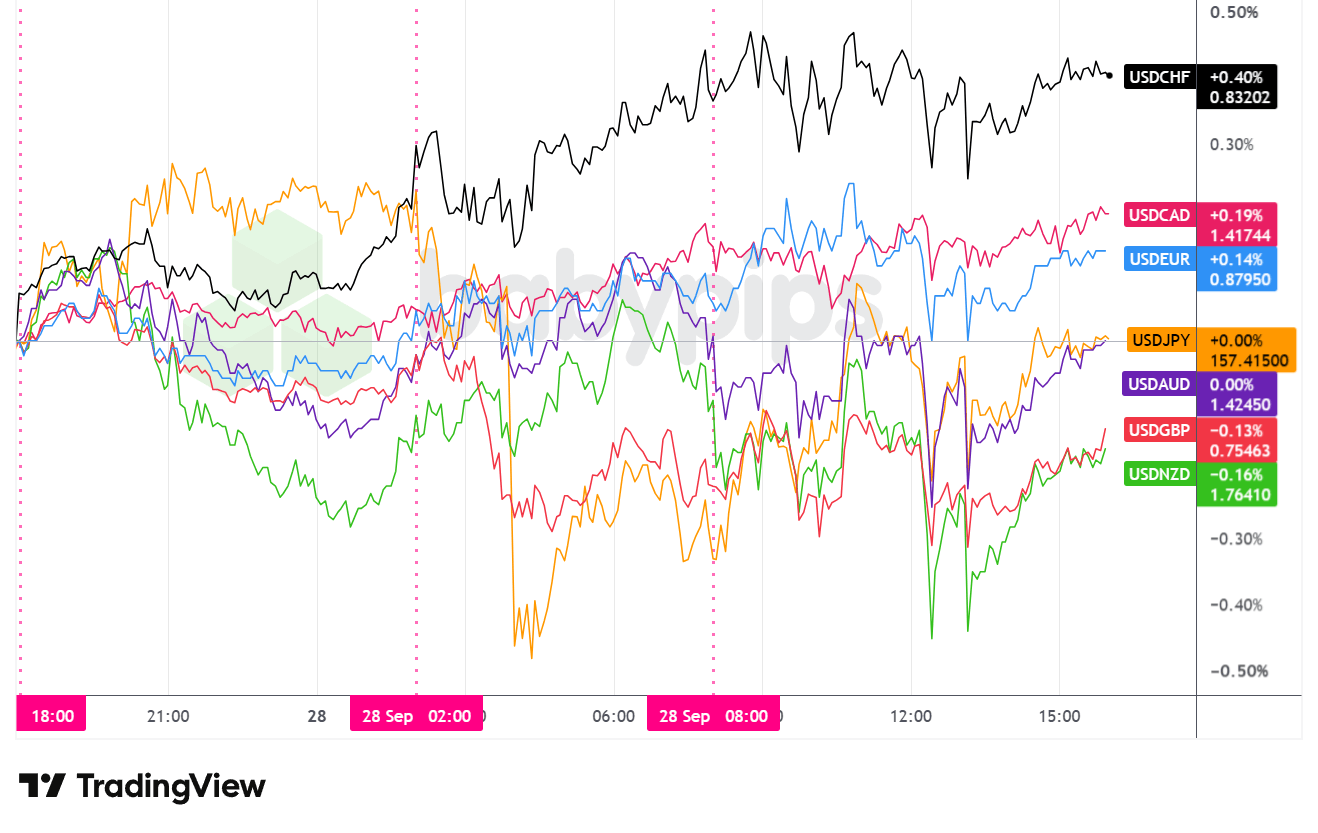
Overlay of USD vs. Major Currencies – Chart Faster With TradingView
Dollar strength ran through the FX session, in step with the move in U.S. yields. The Dollar Index edged up around 0.2%, though the gains were uneven across the majors.
Through the Asia session, majors held to ranges as the weekend Hormuz headlines kept risk appetite subdued. The kiwi and Aussie firmed early before fading, while USD/JPY drifted up toward 157.8 overnight.
The yen drew the focus in London. Japan’s top currency diplomat, Atsushi Mimura, urged markets to take Tokyo’s warning on the yen at face value, and the remarks knocked USD/JPY from around 157.5 down to near 156.65 before the pair settled closer to 157. The franc kept sliding against the dollar, and USD/CHF pushed to fresh session highs.
The dollar traded at its strongest in the U.S. session as the yield spike accelerated. USD/JPY erased its London dip to close back near 157.4, and USD/CHF ended as the standout, up around 0.4% on the day. The pound and the kiwi went the other way, finishing a shade firmer against the greenback, with USD/GBP and USD/NZD each down slightly. On net, the dollar closed mixed, gaining against the franc, Loonie, and euro, fell against the kiwi and Sterling., while the yen and Aussie landed near flat.
Upcoming Potential Catalysts on the Economic Calendar
- U.K. BRC Shop Price Inflation for September 2026 at 11:01 pm GMT
- Australia Household Spending for August 2026 at 1:30 am GMT
-
Reserve Bank of Australia Interest Rate Decision for September 29, 2026 at 4:30 am GMT
- Australia RBA Press Conference at 5:30 am GMT
- Japan Leading Indicators Index for July 2026 at 5:00 am GMT
- Swiss KOF Leading Indicators for September 2026 at 7:00 am GMT
- U.K. Monetary Developments for August 2026 at 8:30 am GMT
- Euro area Economic Sentiment & Consumer Confidence for September 2026 at 9:00 am GMT
- ECB President Lagarde Speech at 11:00 am GMT
- Canada GDP Prel for August 2026 at 12:30 pm GMT
- U.S. House Price Index for July 2026 at 1:00 pm GMT
- U.S. JOLTs Job Openings & Quits for August 2026 at 2:00 pm GMT
- CB U.S. Consumer Confidence for September 2026 at 2:00 pm GMT
- Dallas Fed Services Index for September 2026 at 2:30 pm GMT
- U.S. Fed Goolsbee Speech at 5:00 pm GMT
- U.S. Fed Williams Speech at 6:00 pm GMT
- U.S. API Crude Oil Stock Change for September 25, 2026 at 8:30 pm GMT
The Reserve Bank of Australia decision headlines the next 24 hours, and the tone of its statement and press conference will likely drive the early Asian session more than the rate call itself. The week’s heavier hitters land later, with U.S. core PCE on Wednesday and September payrolls on Friday, either of which could extend or interrupt the run in yields.
Tuesday’s U.S. session also brings three Fed speakers, and with officials sounding more wary of energy-driven inflation, their language will draw scrutiny for signals on the October meeting. Quarter-end positioning may add to the chop along the way.
When tensions in the Middle East spike oil prices and trigger inflation concerns, it’s easy to miss what’s actually moving the currency markets. Higher Treasury yields are the real driver, and Premium members can read our lesson:
📖 How Bond Yields Affect Currency Movements
Reading this helps you understand how rising yields attract foreign capital and strengthen the dollar, why gold fell despite geopolitical risk, and how to use yield differentials to identify strong and weak currencies.
And if you’re not a Premium subscriber yet, consider joining.
With Babypips Premium, you get full access to School of Pipsology lessons that help you understand not just which currencies rise and fall, but the central bank and yield-driven fundamentals beneath the price action.