


Wednesday’s session turned on easing Middle East risk and a soft U.S. jobs report. Iran and Oman moved closer to an agreement on reopening the Strait of Hormuz, trimming the energy-driven inflation risk that has weighed on rate-cut bets in recent weeks, while a much weaker than expected ADP employment report built its own case for a patient Fed, even as Kansas City’s Jeff Schmid and Minneapolis’s Neel Kashkari pushed back with hawkish remarks of their own.
Gold jumped, equities slipped despite two closely watched earnings reports, and the New Zealand dollar sank after unemployment climbed to an 11-year high.
Check out the forex news and economic updates you may have missed in the latest trading session!
News Headlines & Data:
- Federal Reserve Bank of Kansas City President Jeff Schmid said Tuesday evening that inflation is too high and that some sort of monetary policy tightening is needed
- U.S. API Crude Oil Stock Change for July 31, 2026: 2.69M (3.3M previous)
-
New Zealand Employment Change for Q2 2026: 0.5% q/q (0.1% q/q forecast; 0.2% q/q previous)
- New Zealand Unemployment Rate for Q2 2026: 5.6% (5.4% forecast; 5.3% previous)
- Australia AIG Manufacturing Index for July 2026: -19.6 (-14.0 forecast; -16.8 previous)
- Australia S&P Global Services PMI Final for July 2026: 53.6 (53.0 forecast; 50.5 previous)
- Japan Average Cash Earnings for June 2026: 3.4% y/y (3.8% y/y forecast; 3.2% y/y previous)
- Japan S&P Global Services PMI Final for July 2026: 51.2 (51.9 forecast; 52.2 previous)
- China RatingDog Services PMI for July 2026: 50.4 (53.7 forecast; 54.1 previous)
- France Industrial Production for June 2026: 0.1% m/m (0.4% m/m forecast; -0.1% m/m previous)
- Euro area S&P Global Services PMI Final for July 2026: 51.7 (51.6 forecast; 49.4 previous)
- U.K. S&P Global Services PMI Final for July 2026: 52.1 (51.8 forecast; 48.8 previous)
- Euro area PPI for June 2026: 4.6% y/y (4.5% y/y forecast; 5.9% y/y previous)
- U.S. MBA 30-Year Mortgage Rate for July 31, 2026: 6.81% (6.76% previous)
- U.S. MBA Mortgage Applications for July 31, 2026: -2.9% (-6.4% previous)
- ADP U.S. National Employment Report for July 2026: 44.0k (90.0k forecast; 98.0k previous)
-
ISM U.S. Services PMI for July 2026: 54.1 (54.5 forecast; 54.0 previous)
- U.S. ISM Services Prices for July 2026: 70.3 (66.2 forecast; 67.7 previous)
- ISM U.S. Services Employment for July 2026: 47.4 (52.0 forecast; 51.2 previous)
- U.S. EIA Crude Oil Stocks Change for July 31, 2026: 2.48M (-7.17M previous)
- Minneapolis Fed President Kashkari said on Wednesday that he thinks the Fed should “start slowly moving up” interest rates
Promoted: The Strategy Is Half the Battle. Your Mindset Is the Rest.
Wednesday’s recap covers a Hormuz de-escalation, a soft ADP report, and two Fed presidents publicly pushing for higher rates while gold surged anyway. But as any pro will tell you, reading those drivers correctly isn’t enough if you lack the discipline to execute a plan around them.
In Unknown Market Wizards (⭐ 4.6★ | 1,400+ reviews on Amazon), Jack Schwager interviews successful traders to reveal a common truth: their edge isn’t just knowledge or skills, it’s psychological resilience and rigid risk control. Whether you’re navigating shifting geopolitical themes or top-tier economic data, learn how the “wizards” stay clinical and execute when the rest of the market is emotional.
Master Your Trading Mindset with Unknown Market Wizards!
Disclosure: We may earn a commission from our partners if you sign up through our links, at no extra cost to you.
Broad Market Price Action:
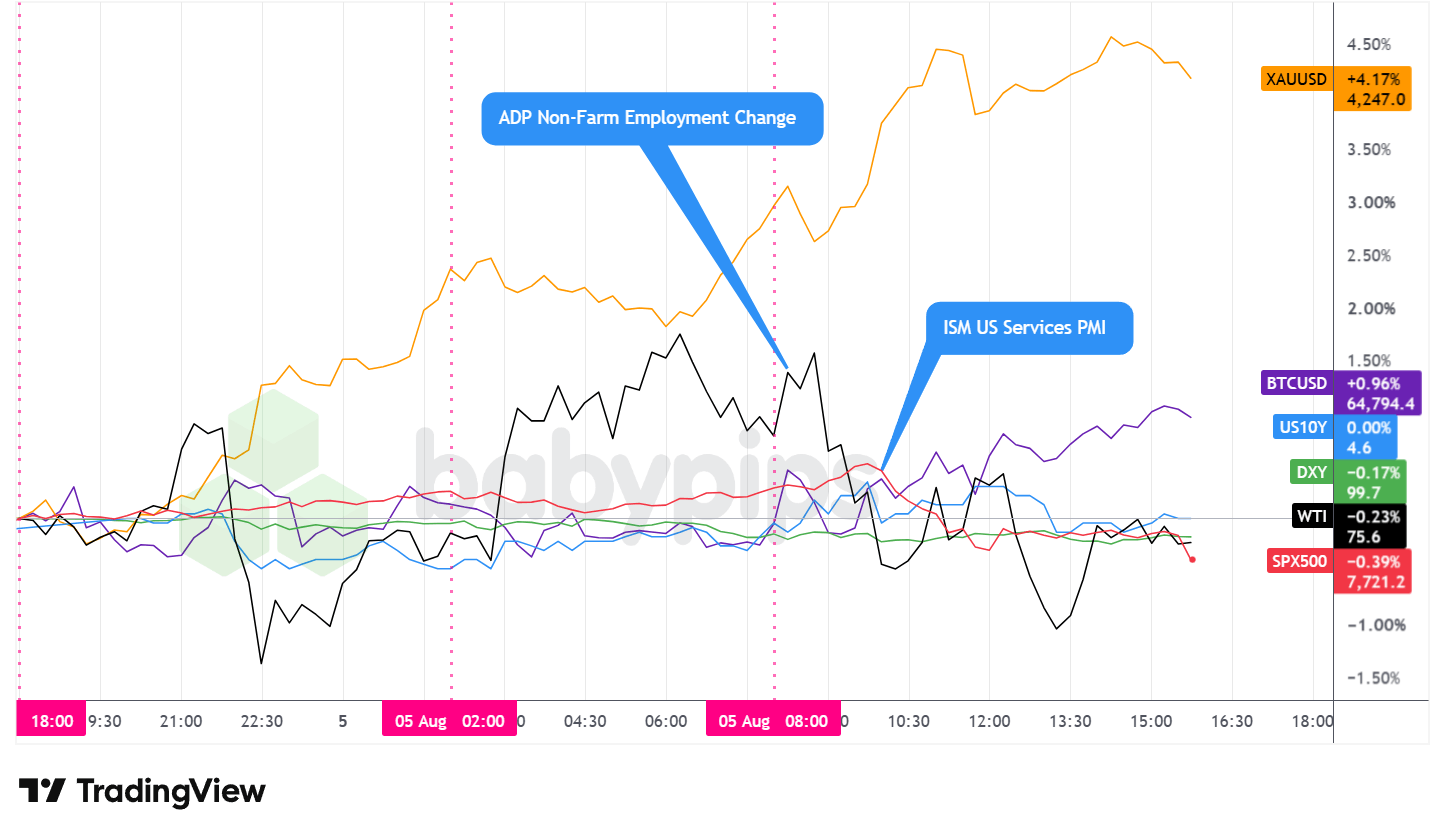
Dollar Index, Gold, Oil, S&P 500, U.S. 10-yr Yield, Bitcoin Overlay – Chart Faster With TradingView
The S&P 500 slipped 0.39% to close near 7,721, giving back part of the rally that carried the index to records earlier this week. Price climbed through the Asian and London hours and tested highs above 7,790 shortly after the U.S. open, then reversed once Wednesday’s data and two earnings reports landed. AMD beat estimates on both revenue and profit and guided third-quarter sales above consensus, yet the stock fell as investors weighed how much of that growth was already priced in. SpaceX reported revenue nearly doubling from a year earlier in its first release as a public company, but the stock dropped as capital spending far outpaced expectations, and a lockup on a large block of insider shares expires Thursday. Both names weighed on the broader tape into the close.
WTI crude eased 0.23% to settle near $75.60 a barrel. Price pushed higher through the Asian and London sessions, testing levels above $77 as the market weighed how soon the Strait of Hormuz might reopen, then gave that back once Wednesday’s U.S. data hit, settling into a choppy range through the afternoon. Iran said it had reached an agreement with Oman on a proposed shipping route through the strait, Bloomberg reported, a potential step toward reopening the waterway that helped trim the energy-driven inflation premium built into rate expectations.
Gold was the session’s standout, jumping 4.17% to trade near $4,247 an ounce. Price dipped in the Asian session before rallying from the London morning onward and holding most of that advance into the close. The move likely reflects some mix of the retreating energy-price risk tied to the Hormuz headlines and the reinforced case for Fed rate cuts that Wednesday’s soft labor data provided. Two Fed presidents pushed the opposite way. Kansas City’s Jeff Schmid argued monetary policy needs to be tighter to bring inflation back to target and flagged AI-related investment as its own inflation source. Minneapolis’s Neel Kashkari separately called for the Fed to start raising rates to curb price pressure that remains too high, according to Bloomberg. Neither comment slowed gold’s advance.
Bitcoin added 0.96% to trade near $64,794. The token chopped in a wide range during the Asian session, dipped to lows near $63,800 in the early London hours, then turned higher once the U.S. session got underway and climbed through the afternoon. The move likely tracked the same rate-cut repricing that lifted gold rather than any crypto-specific catalyst.
The 10-year Treasury yield finished roughly flat near 4.64%, though the path there was more eventful than the flat close suggests. Yields fell from highs near 4.66% in the Asian session to lows around 4.62% by the early U.S. afternoon, tracking the same repricing that followed the soft ADP report, before recovering back toward 4.64% into the close.
FX Market Behavior: U.S. Dollar vs. Majors
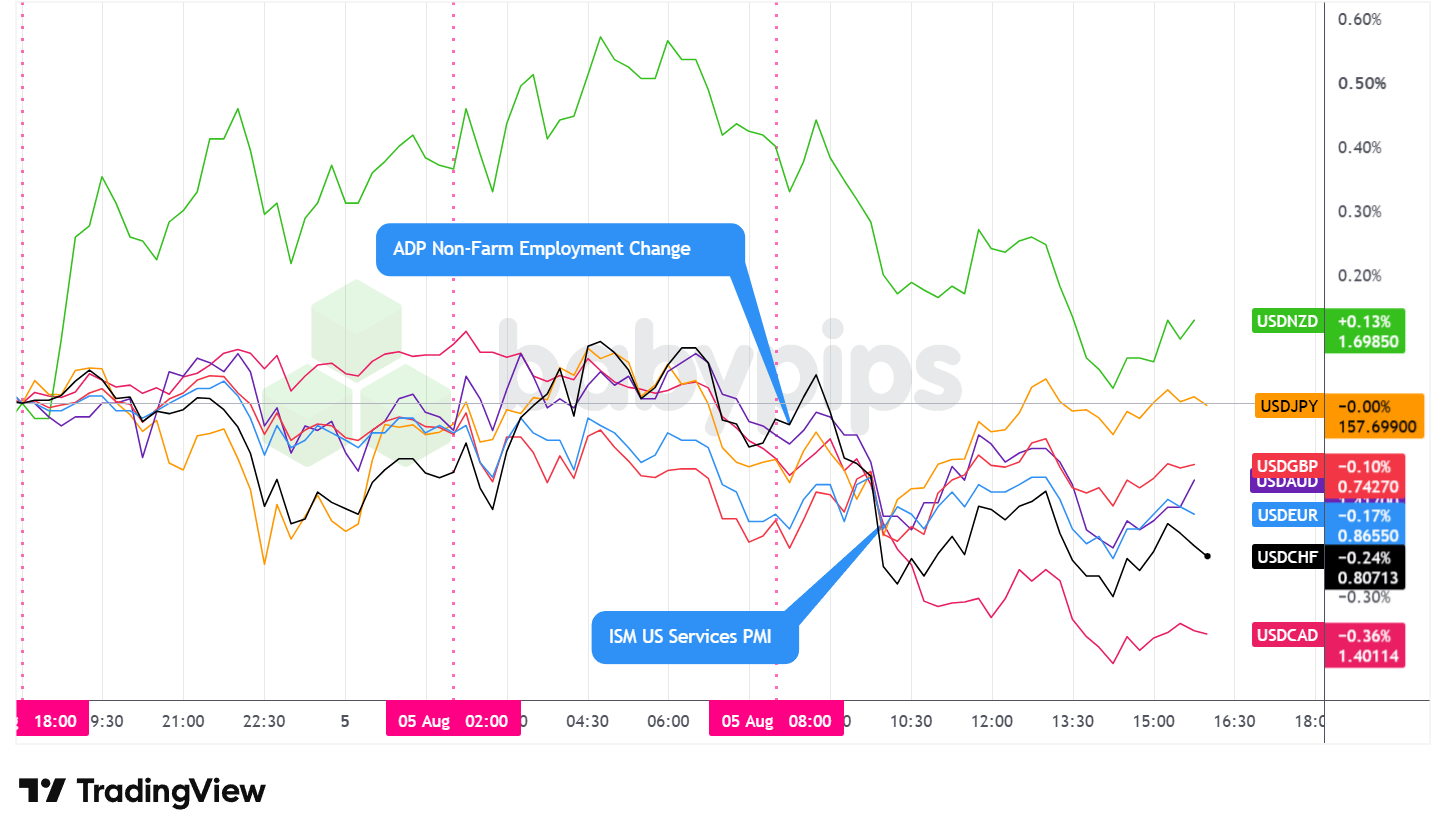
Overlay of USD vs. Majors – Chart Faster With TradingView
The U.S. dollar traded lower on Wednesday, closing mixed but arguably net negative against the majors, with the New Zealand dollar standing alone on the other side of that ledger.
During the Asian session, the dollar traded mostly sideways and choppy, with an arguably net bearish lean. The New Zealand dollar was the outlier in the group. New Zealand’s unemployment rate climbed to 5.6% in the June quarter, an 11-year high, and NZD dropped across every major pair within minutes of the release, extending lower over the following hour rather than fading back.
That mixed, choppy tone carried into the European morning. During the London session, the dollar traded mixed and choppy against the majors, initially net bullish before pulling back lower heading into the U.S. session. The dollar index tested highs near 99.9 twice, once in the overnight hours and again between roughly 4:30 and 6:00 am ET, before rolling over toward 99.75 ahead of the New York open. The yen was a partial exception to the dollar’s early strength. U.S. Treasury Secretary Scott Bessent told Japan’s public broadcaster NHK that he was confident Bank of Japan Governor Kazuo Ueda would do what is best for the economy, and separately tied Japan’s inflation problem to yen weakness and energy prices, according to Reuters. Those comments landed alongside data showing Japanese real wages rose for a sixth straight month, adding to the case for further Bank of Japan tightening.
After the U.S. session opened, the dollar continued lower and extended its decline once the ADP report showed private employers added just 44,000 jobs in July, well short of the roughly 90,000 forecast. The ISM Services report that followed added its own mixed signals. The headline read 54.1, a touch below forecast, and business activity jumped to 59.1. But the employment component sank to 47.4 and the prices paid index rose to 70.3, so a cooling labor market and sticky prices pulled traders in opposite directions. The dollar found a floor and stabilized ahead of the London close, then traded choppy for the rest of the session, testing lows near 99.63 on the index before recovering into the close.
At Wednesday’s close, the dollar was mixed and arguably net negative against the majors on a daily basis. It closed weakest against the Canadian dollar and the Swiss franc, followed by the euro, ran close to flat against sterling, the Australian dollar and the yen, and gained ground only against the New Zealand dollar.
Upcoming Potential Catalysts on the Economic Calendar
- Australia Balance of Trade for June 2026 at 1:30 am GMT
- Australia Building Permits Final for June 2026 at 1:30 am GMT
- Australia Private House Approvals Final for June 2026 at 1:30 am GMT
- Germany Factory Orders for June 2026 at 6:00 am GMT
- Swiss Unemployment Rate for July 2026 at 7:00 am GMT
- Euro area S&P Global Construction PMI for July 2026 at 7:30 am GMT
- U.K. S&P Global Construction PMI for July 2026 at 8:30 am GMT
- Euro area Retail Sales for June 2026 at 9:00 am GMT
- U.S. Challenger Job Cuts for July 2026 at 9:30 am GMT
- U.S. Initial Jobless Claims for August 1, 2026 at 12:30 pm GMT
- U.S. Unit Labour Costs Prel for June 30, 2026 at 12:30 pm GMT
- U.S. Nonfarm Productivity Prel for June 30, 2026 at 12:30 pm GMT
- Canada S&P Global Services PMI for July 2026 at 1:30 pm GMT
- U.S. Fed Musalem Speech at 9:30 pm GMT
Thursday’s calendar leans further into the labor-market question Wednesday’s ADP report reopened. Weekly initial jobless claims, along with preliminary readings on second-quarter unit labor costs and nonfarm productivity, land ahead of Friday’s more closely watched July employment report, and a soft batch would build on the case gold and Treasury yields already leaned into on Wednesday.
Fed’s Musalem closes out the day with an evening speech, arriving after a session where Schmid and Kashkari already argued the opposite side of that debate. Elsewhere, Swiss unemployment, German factory orders and euro-area retail sales offer a read on European momentum, while Australia’s trade balance and Canada’s services PMI round out the rest of the session.
Stay frosty out there, forex friends!
When major economic data hits the calendar—like Wednesday’s soft ADP report and New Zealand’s unemployment shock—the FX market’s reaction isn’t random. It follows a predictable sequence that most retail traders never see. Premium members can read our lesson:
📖 From Data to Price Action: What Happens When Big News Hits
Reading this helps you understand the initial algorithmic spike versus the secondary analytical move, why conflicting signals (like weak labor data paired with hawkish Fed commentary) can trap unprepared traders, and what actually happens in the first minutes after the calendar event.
And if you’re not a Premium subscriber yet, consider joining to unlock lessons like this one that help you navigate real-market events as they unfold.
With Babypips Premium, you get full access to School of Pipsology lessons that help you understand not just what the data print was, but how institutional traders actually interpret it and position their trades before the reaction fades