


A split Federal Reserve vote pushed longer-dated Treasury yields to some of their highest levels since 2007 on Wednesday, compounding a session already rattled by a reignited U.S.-Iran conflict and a fresh chip-stock rout across Asia. Crude oil jumped, equities sold off into the close, and the dollar finished the day weaker against every major currency except the Australian dollar.
Check out the forex news and economic updates you may have missed in the latest trading session!
News Headlines & Data:
- U.S. API Crude Oil Stock Change for July 24, 2026: 3.3M (2.6M previous)
- Australia CPI Inflation Rate for Q2 2026: 3.8% y/y (4.1% y/y forecast; 4.0% y/y previous)
- Germany Import Prices for June 2026: 6.1% y/y (6.2% y/y forecast; 6.8% y/y previous); -0.7% m/m (-0.6% m/m forecast; 0.7% m/m previous)
- Swiss Economic Sentiment Index for July 2026: 10.0 (-23.0 forecast; -25.0 previous)
- U.K. BoE Consumer Credit for June 2026: 1.81B (1.5B forecast; 1.66B previous)
- U.K. Mortgage Lending for June 2026: 7.73B (4.1B forecast; 2.89B previous)
- U.K. Net Lending to Individuals for June 2026: 9.5B m/m (5.0B m/m forecast; 4.6B m/m previous)
- U.K. Mortgage Approvals for June 2026: 58.2k (56.3k forecast; 56.21k previous)
- U.S. MBA 30-Year Mortgage Rate for July 24, 2026: 6.76% (6.69% previous)
- U.S. MBA Mortgage Applications for July 24, 2026: -6.4% (1.9% previous)
- U.S. EIA Crude Oil Stocks Change for July 24, 2026: -7.17M (2.01M previous)
- The Federal Reserve kept its benchmark interest rate unchanged at 3.5%–3.75% on July 29, 2026, citing elevated inflation—partly driven by higher global energy prices—and a solid labor market, while reaffirming its commitment to returning inflation to the 2% target. In his press conference, Chair Kevin Warsh emphasized that the committee remains data-dependent and patient, with no forward guidance on timing, but signaled that policymakers are increasingly focused on the persistence of inflation above target and are prepared to act if needed.
Broad Market Price Action:
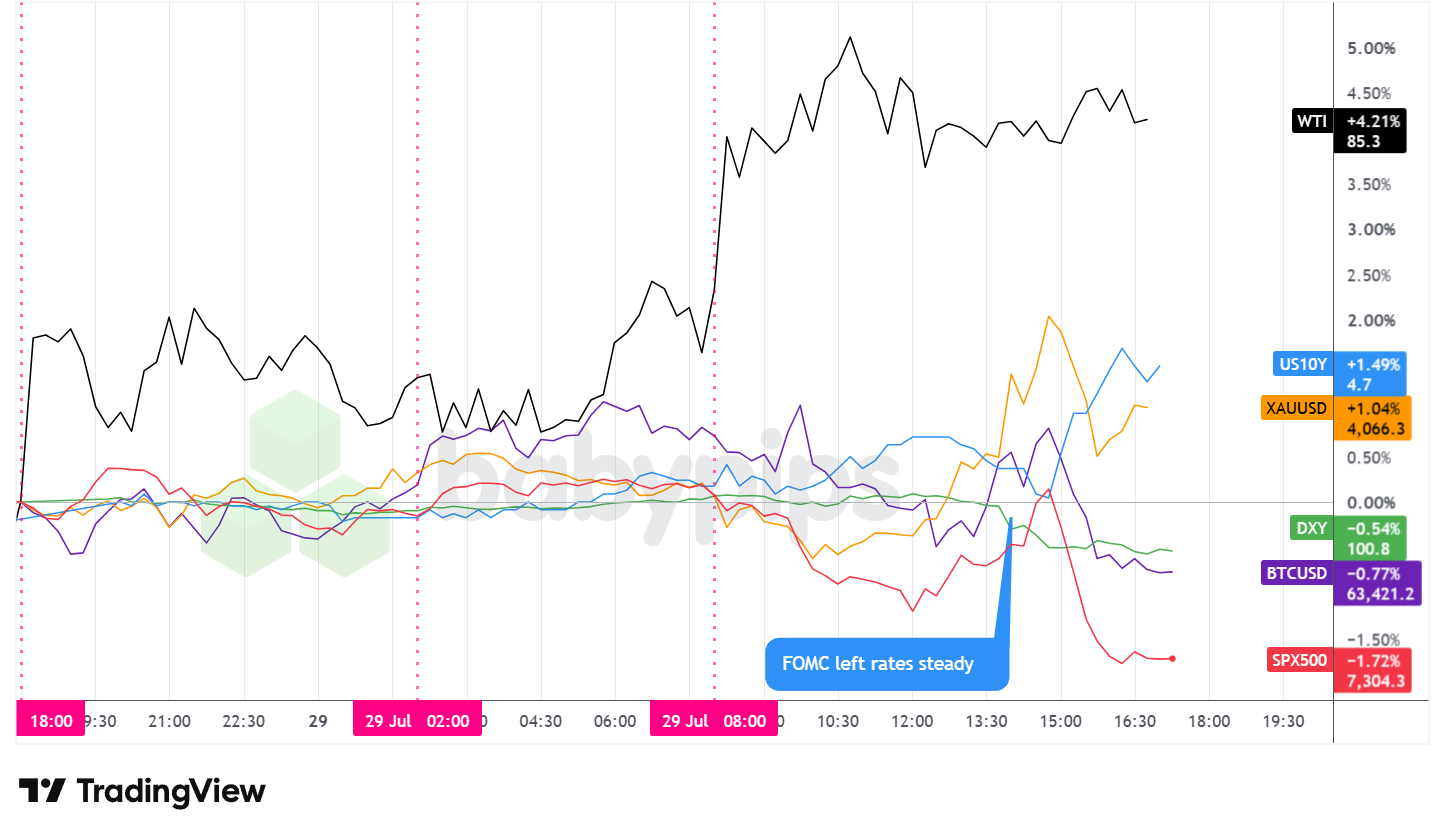
Dollar Index, Gold, Oil, S&P 500, U.S. 10-yr Yield, Bitcoin Overlay – Chart Faster With TradingView
Equity markets carried Tuesday’s nerves into Wednesday and then piled on a fresh set of their own. South Korea’s Kospi swung from a modest opening gain to an intraday drop of more than 8%, before a late rebound cut that loss about in half by the close. Trading halted for the second straight session after SK Hynix posted a record quarterly profit that still missed lofty analyst estimates. The chip-sector weakness spilled into U.S. hours and helped drag the S&P 500 down close to 1.6% on the day, with the Nasdaq 100 extending its slide from a recent record into a technical correction.
Stocks briefly pared their losses in the minutes after the Fed’s 2 p.m. statement, then gave that ground back once Chair Kevin Warsh’s press conference got underway. The Federal Open Market Committee held its benchmark rate in a range of 3.5% to 3.75% on a 9-3 vote, with Cleveland’s Beth Hammack, Minneapolis’s Neel Kashkari, and Dallas’s Lorie Logan all dissenting in favor of a quarter-point hike. Warsh framed his retreat from forward guidance as deliberate, telling reporters that “participants are learning to play the ball and not the referee.” This lack of guidance was likely the driver in the wild swings in bond yields, while the hold, paired with three hawkish dissents, arguably cost the Fed some credibility rather than building it.
Longer-dated Treasury yields climbed across the board as the 30-year touched its highest level since 2007. The 10-year followed a similar path on the charts, grinding higher through the session before its sharpest gains arrived in the afternoon window lining up with the Fed statement and press conference, and finishing the day up a little more than 1%. Two-year yields moved the other way, edging lower as the hold decision took some near-term hike risk off the table.
Crude reversed nearly all of Tuesday’s decline after Iran fired several ballistic missiles at a U.S. base in Jordan overnight, an attack the Pentagon called a surprise and that followed a U.S. strike on shipping in the Strait of Hormuz. President Trump told Fox News the U.S. would “hit them hard,” and WTI gapped higher at the open, spent the morning inside a tight range, then broke sharply higher once New York trading got underway. WTI added more than 4% on the day and touched levels near $86 a barrel intraday, while Brent, the global benchmark, pushed back above $90.
Gold spent most of the day rangebound, dipping to a session low near $3,995 during the New York morning before a sharp rally that lined up with the Fed’s afternoon announcement and press conference. The move may reflect the same inflation and rate uncertainty driving the bond market, though gold gave back a good portion of the rally into the close, finishing the day up just under half a percent.
Bitcoin held inside a fairly tight range for most of the day, drifting toward the mid-$64,000s during the London morning before slipping alongside equities in the afternoon, and ending the session down less than 1%. With no bitcoin-specific headlines behind the move, the pullback likely tracked the same higher-for-longer repricing that hit stocks after the Fed’s press conference.
Promoted: Is Your Small Account Holding Your Strategy Back?
Trading $100 isn’t the same as trading $100k. Emotional discipline & trading flexibility is easier when you have the right backing. FTMO is a global prop firm with a 4.8★ rating on 40K+ reviews, serving traders since 2015! No time limits. Free trials. Up to $200K in Demo Capital.
Start a free trial with FTMO!
Disclosure: To help support our content, we may earn a commission from our partners if you sign up through our links, at no extra cost to you.
FX Market Behavior: U.S. Dollar vs. Majors
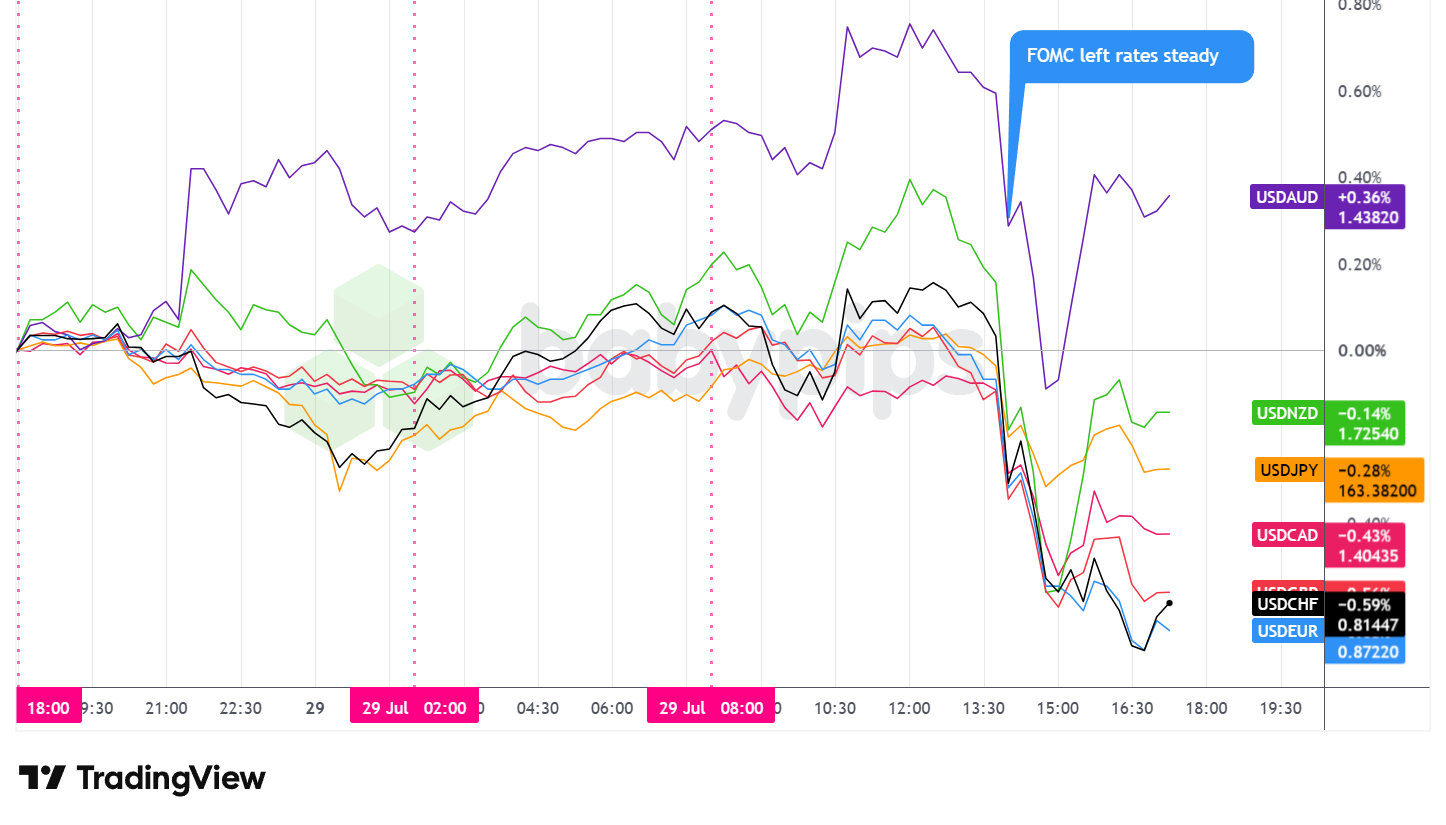
Overlay of USD vs. Majors – Chart Faster With TradingView
The U.S. Dollar Index spent Wednesday inside a roughly one-point range. It topped out a bit above 101.50 in the late morning, dropped to a session low near 100.75 in the hours following the Fed decision, then stabilized into the close down roughly four tenths of a percent, just below the 101 handle.
The session followed a three-part pattern. Volatility stayed low through the early Asian hours, then picked up mid-morning as the dollar turned net bearish heading into the London open. The dollar found its footing from there, climbing through the London morning and extending that recovery into a rebound just ahead of the London close.
That strength faded after the Wednesday U.S. open: the dollar pulled back, stabilized, and clawed out one more push higher before the afternoon session turned. The drop that followed lined up with the release window for the FOMC’s policy statement and Warsh’s press conference, and the dollar never recovered the lost ground into the close.
By the end of the day, the dollar had lost ground against every major currency but one. Losses ranged from a few tenths of a percent against the New Zealand dollar and Japanese yen to a somewhat sharper decline against the Canadian dollar, British pound, and Swiss franc, which edged out the rest of the majors as Wednesday’s best performer against the greenback. The lone exception was the Australian dollar. A June Australian inflation report that cooled more than expected gave the RBA less reason to consider another rate hike at its August meeting, and an argument could be made that this kept a lid on the Aussie through a session where most other majors gained.
Promoted: Profitable Trading Isn’t Reserved for Wall Street.
Most traders quietly wonder if consistent profitability is actually achievable for someone like them—or if it’s just a story people tell. Jack Schwager’s newest book, “Market Wizards: The Next Generation,” answers that question directly. The legendary author behind the original Market Wizards series interviews a new generation of successful traders—many self-taught—who built real wealth and income through the markets. Their common thread isn’t genius or insider access. It’s a deliberate process, disciplined risk management, and the conviction to take trading seriously as a pursuit worth mastering.
If that sounds like something worth exploring, this is a good place to start.
Get Market Wizards: The Next Generation on Amazon!
Disclosure: We may earn a commission from our partners if you sign up through our links, at no extra cost to you.
Upcoming Potential Catalysts on the Economic Calendar
-
- Australia RBA Hunter Speech at 10:40 pm GMT
- New Zealand ANZ Business Confidence for July 2026 at 1:00 am GMT
- Australia Import & Export Prices for June 30, 2026 at 1:30 am GMT
- Australia Building Permits Prel for June 2026 at 1:30 am GMT
- Japan Consumer Confidence for July 2026 at 5:00 am GMT
- Swiss KOF Leading Indicators for July 2026 at 7:00 am GMT
- Germany GDP Growth Rate Flash for June 30, 2026 at 8:00 am GMT
- Euro area GDP Growth Rate Flash for June 30, 2026 at 9:00 am GMT
- Euro area Unemployment Rate for June 2026 at 9:00 am GMT
- Bank of England Monetary Policy Report at 11:00 am GMT
- Bank of England Official Policy Rate for July 30, 2026 at 11:00 am GMT
- Germany Inflation Rate Prel for July 2026 at 12:00 pm GMT
- Canada Average Weekly Earnings for May 2026 at 12:30 pm GMT
- U.S. Initial Jobless Claims for July 25, 2026 at 12:30 pm GMT
- U.S. Personal Income & Spending for June 2026 at 12:30 pm GMT
- U.S. Core PCE Price Index for June 2026 at 12:30 pm GMT
- Bank of England Governor Bailey Speech at 1:15 pm GMT
Thursday’s session hinges on whether Wednesday’s volatility was a one-day shock or the start of a new pattern. The Fed just showed markets it won’t offer forward guidance, and Warsh’s press conference language suggests data, not central bank signaling, will drive the next leg in yields and the dollar.
That makes Thursday’s Core PCE Price Index, the Fed’s preferred inflation gauge, arguably the single most important release on the calendar, landing less than a day after officials flagged inflation as their dominant concern.
A Bank of England rate decision lands hours earlier and could add its own volatility to the pound, while the live conflict between the U.S. and Iran leaves oil exposed to further headline risk in either direction.
Stay frosty out there, forex friends!
When a central bank holds rates but surprises with dissenting votes and removes forward guidance, currencies and yields react in unexpected ways. Premium members can read our lesson:
📖 How to Trade Central Bank Decisions Using Market Expectations
Reading this helps you understand what “priced in” really means, how to read market-implied rate probabilities, and what to watch on decision day to avoid getting caught off-guard.
And if you’re not a Premium subscriber yet, consider joining now.
With Babypips Premium, you get full access to School of Pipsology lessons that help you understand how rate expectations move markets before central banks even speak, so when guidance changes, you understand exactly what’s driving price action.