


Australia’s annual inflation rate eased to 3.8% in the 12 months to June 2026, down from 4.0% in May, according to data released by the Australian Bureau of Statistics (ABS).
On a monthly basis, CPI fell 0.1% in June, in both original and seasonally adjusted terms, as a sharp drop in automotive fuel prices offset gains elsewhere in the basket.
The softer headline print came alongside a steady core inflation reading, complicating the picture for policymakers weighing the timing of future interest rate moves.
The Reserve Bank of Australia’s preferred underlying inflation gauge, the trimmed mean, held at 3.6% year-on-year, unchanged from May and signaling that price pressures beneath the surface remain more persistent than the headline figure suggests.
Key Takeaways: Australia’s June 2026 CPI
- Headline CPI: +3.8% y/y (June), down from +4.0% in May; -0.1% m/m
- Trimmed mean (core): +3.6% y/y, unchanged from May
- Housing was the largest contributor to annual inflation, rising 6.8% y/y (up from 6.5% in May)
- Food and non-alcoholic beverages rose 3.3% y/y, unchanged from May, with meals out and takeaway food (+4.0% y/y) the main driver
- Recreation and culture climbed 3.3% y/y, up from 2.4% in May, as international and domestic holiday travel costs rose
- Transport was nearly flat at +0.1% y/y, as automotive fuel prices fell 10.9% in the month on lower global oil prices, following an 11.9% drop in May
- Goods vs. services: goods inflation ran at 3.5% y/y versus services at 4.0% y/y, while non-tradables inflation (4.9%) continued to outpace tradables (1.5%), pointing to domestically generated price pressure
- The ABS confirmed the CPI weight update will now occur in January 2027, and from February 2027 the monthly CPI release will shift to the fourth Wednesday of each month
The June CPI report presents a mixed but leaning-dovish picture for the RBA. Headline inflation is trending lower, aided by cheaper fuel and unwinding base effects, but the trimmed mean’s stagnation at 3.6% shows underlying inflation is proving sticky, kept elevated in large part by housing costs, particularly electricity prices following the removal of government subsidies.
Link to official ABS Consumer Price Index (June 2026)
Services inflation continuing to run well above goods inflation reinforces that domestic cost pressures — rather than imported ones — remain the primary driver of Australia’s inflation profile.
Market Reaction
Australian Dollar vs. Major Currencies: 5-min
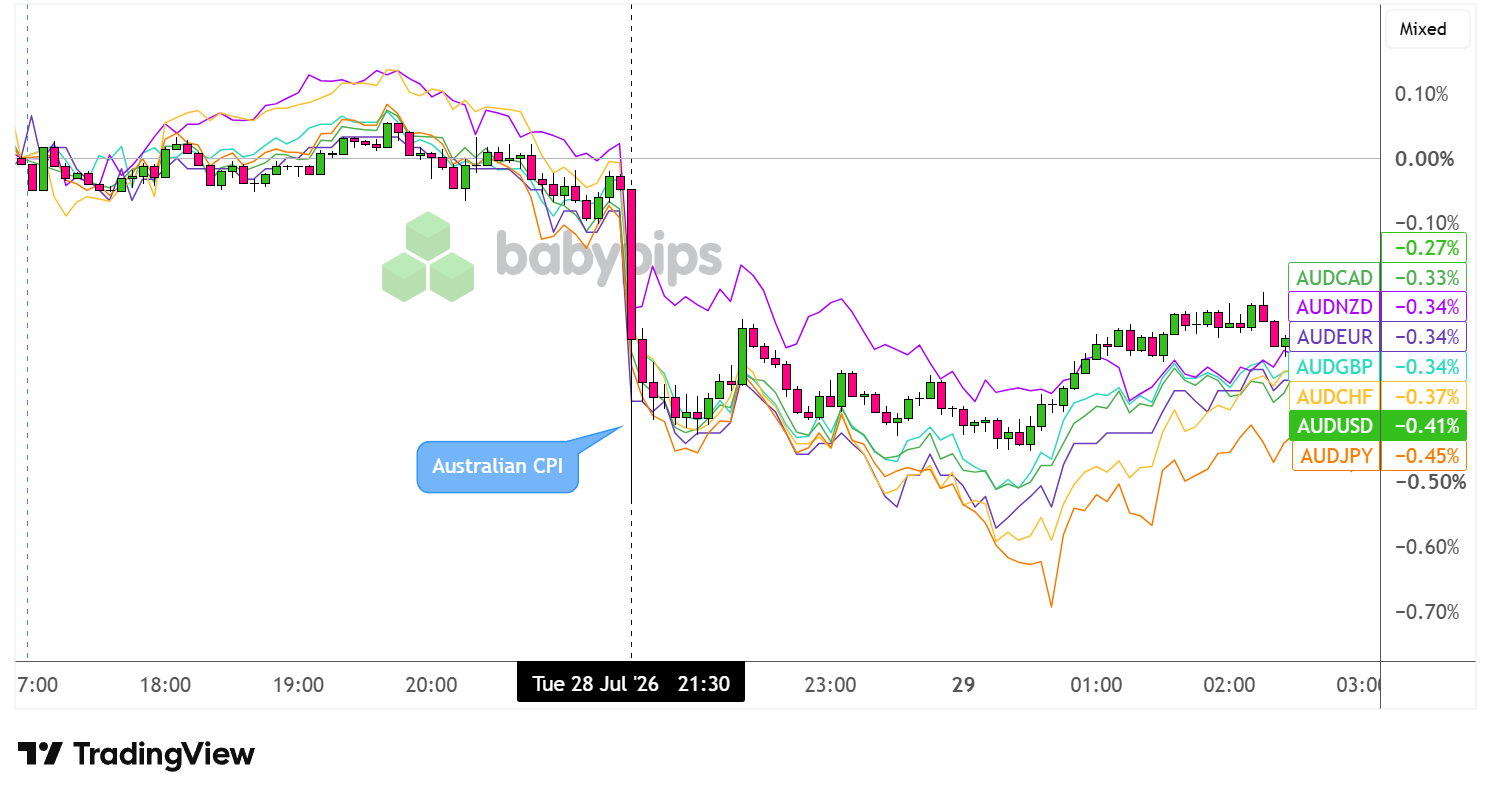
AUD vs. Major Currencies: 5-min Forex Chart Faster with TradingView
The move indicates markets read the data as leaning dovish for the Reserve Bank of Australia, as the drop in headline inflation to 3.8% likely outweighed the unchanged core reading in traders’ near-term assessment of policy risk.
In the hour following the print, AUD/USD was down roughly 0.4%, with similar or slightly larger declines against the Canadian dollar, British pound, Japanese yen, Swiss franc and euro (all in the 0.4%–0.5% range).
The Australian dollar’s decline against the New Zealand dollar was comparatively more contained, at around 0.3%, suggesting the sell-off was concentrated more broadly against the majors rather than reflecting an AUD/NZD-specific dynamic.
Australia’s June CPI showed headline inflation easing while the RBA’s trimmed mean core measure held steady, a distinction that may not be familiar to every reader. Premium members can read our lesson:
📖 Inflation: The Force That Moves Central Banks
Reading this helps you understand the difference between headline and core inflation measures like the trimmed mean, why central banks target 2% and react to deviations from it, and how sticky underlying price pressure can complicate a central bank’s rate path even as the headline number cools.
And if you’re not a Premium subscriber yet, now’s a good time to sign up.
With Babypips Premium, you get full access to School of Pipsology lessons that help you understand not just what the headline CPI number says, but what’s happening underneath it, and how that shapes where the RBA goes next.