The Federal Reserve left interest rates unchanged on Wednesday, but a hawkish set of new projections under incoming Chair Kevin Warsh pushed Treasury yields and the U.S. dollar higher while sending equities, gold, and Bitcoin lower into the close. At the same time, the advancing U.S.-Iran interim peace deal continued to weigh on energy markets as traders priced in a gradual return of crude supply.
Check out the forex news and economic updates you may have missed in the latest trading session!
Forex News Headlines & Data:
- U.S. API Crude Oil Stock Change for June 12, 2026: -8.33M (-9.12M previous)
- New Zealand Westpac Consumer Confidence for June 30, 2026: 80.4 (92.9 forecast; 94.7 previous)
- New Zealand Current Account for Q1 2026: -1.01B (-6.6B forecast; -5.98B previous)
- Japan Reuters Tankan Index for June 2026: 13.0 (9.0 forecast; 8.0 previous)
- Japan Machinery Orders for April 2026: 15.6% y/y (9.5% y/y forecast; 5.9% y/y previous); 8.7% m/m (1.0% m/m forecast; -9.4% m/m previous)
- Japan Balance of Trade for May 2026: -378.7B (-400.0B forecast; 301.9B previous)
- Australia Westpac Leading Index for May 2026: 0.0% m/m (-0.1% m/m forecast; 0.0% m/m previous)
- U.K. CPI Growth Rate for May 2026: 2.8% y/y (3.1% y/y forecast; 2.8% y/y previous)
- Euro area CPI Growth Rate Final for May 2026: 3.2% y/y (3.2% y/y forecast; 3.0% y/y previous)
- U.S. MBA 30-Year Mortgage Rate for June 12, 2026: 6.6% (6.6% previous)
- U.S. MBA Mortgage Applications for June 12, 2026: -3.8% (-0.8% m/m forecast; 10.8% m/m previous)
- Canada New Housing Price Index for May 2026: -0.3% m/m (-0.3% m/m forecast; -0.4% m/m previous)
- U.S. Retail Sales for May 2026: 6.9% y/y (4.0% y/y forecast; 4.9% y/y previous)
- U.S. Pending Home Sales for May 2026: 4.8% y/y (3.0% y/y forecast; 3.2% y/y previous)
- U.S. EIA Crude Oil Stocks Change for June 12, 2026: -8.26M (-7.23M previous)
- The FOMC held its benchmark rate at 3.50% to 3.75% on a 12-0 vote, but its updated projections leaned hawkish: nine officials saw at least one quarter-point hike this year, with six anticipating two or more, while nine expected no move or a cut. In his first meeting as Chair, Kevin Warsh reportedly declined to submit a year-end rate forecast, consistent with his stated skepticism of forward guidance.
Promoted: Capitalize on the Fed’s Hawkish Pivot with Professional Position Sizing
Incoming Fed Chair Kevin Warsh just shook up the markets with a hawkish dot plot, sending the U.S. dollar and Treasury yields soaring while triggering sharp reversals in gold, equities, and Bitcoin. When major central bank decisions ignite this level of cross-asset volatility, disciplined traders need the flexibility and liquidity to pivot fast. Don’t let a lack of capital keep you sidelined during these crucial macroeconomic shifts.
Alpha Capital Group provides access to simulated funded accounts from $5K to $200K, starting at $40, you can execute your high-conviction setups across forex and commodities with the professional position sizing they deserve. Join 250K+ traders in 180+ countries today!
Learn more about Alpha Capital Group!
Disclosure: We may earn a commission from our partners if you sign up through our links, at no extra cost to you.
Broad Market Price Action:
Dollar Index, Gold, Oil, S&P 500, U.S. 10-yr Yield, Bitcoin Overlay – Chart Faster With TradingView
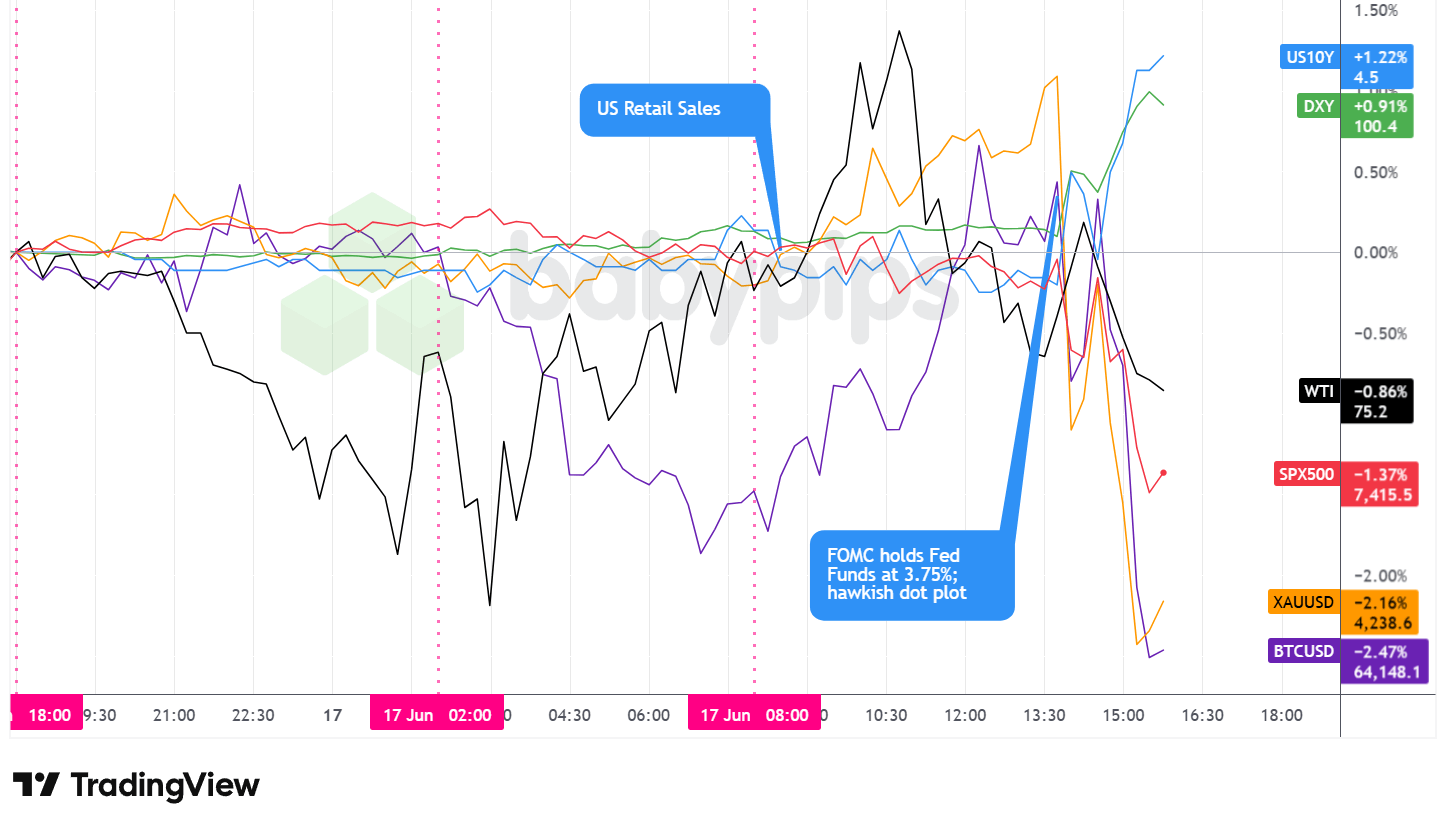
Wednesday’s session was dominated by the Federal Reserve’s policy announcement, which reset rate-hike expectations and drove a broad repricing across asset classes in the afternoon. Risk assets traded with a softening bias for much of the day before the move accelerated following the 2:00 PM ET statement.
U.S. equities declined, with the S&P 500 closing lower by approximately 1.37%, near 7,415. The index held in positive territory overnight before drifting lower through the U.S. morning, then extended its decline after the FOMC statement, reaching an intraday low in the vicinity of 7,400. The afternoon weakness appeared to correlate closely with the hawkish projections, which raised the prospect of higher borrowing costs later in the year.
The U.S. 10-year Treasury yield rose roughly 1.22% on the day, ending around 4.5%. Yields traded in a narrow range through the Asian and London sessions before jumping after the FOMC statement, a move that lined up with traders boosting their bets on a 2026 rate increase in response to the dot plot.
Gold fell sharply, declining approximately 2.16% to trade near 4,238. The precious metal had climbed to an intraday high around 4,382 in the early afternoon before reversing course. The steepest leg lower coincided directly with the FOMC statement and the accompanying rise in the dollar and yields, with the metal sliding toward 4,220 before stabilizing modestly.
Bitcoin also retreated, ending down roughly 2.47% near 64,148. The cryptocurrency chopped higher to a midday peak around 66,388 before turning lower, with the decline accelerating after the Fed announcement to a session low near 63,987. The move possibly reflected broader risk aversion following the hawkish policy signal.
WTI crude oil eased approximately 0.86% to trade around 75.2. Oil briefly spiked toward 79 during the U.S. morning before fading, and the broader bias remained to the downside as traders continued to price in returning supply tied to the advancing U.S.-Iran deal and the anticipated reopening of the Strait of Hormuz.
Promoted: Profitable Trading Isn’t Reserved for Wall Street.
Most traders quietly wonder if consistent profitability is actually achievable for someone like them—or if it’s just a story people tell. Jack Schwager’s newest book, “Market Wizards: The Next Generation,” answers that question directly. The legendary author behind the original Market Wizards series interviews a new generation of successful traders—many self-taught—who built real wealth and income through the markets. Their common thread isn’t genius or insider access. It’s a deliberate process, disciplined risk management, and the conviction to take trading seriously as a pursuit worth mastering.
If that sounds like something worth exploring, this is a good place to start.
Get Market Wizards: The Next Generation on Amazon!
Disclosure: We may earn a commission from our partners if you sign up through our links, at no extra cost to you.
FX Market Behavior: U.S. Dollar vs. Majors
Overlay of USD vs. Majors – Chart Faster With TradingView
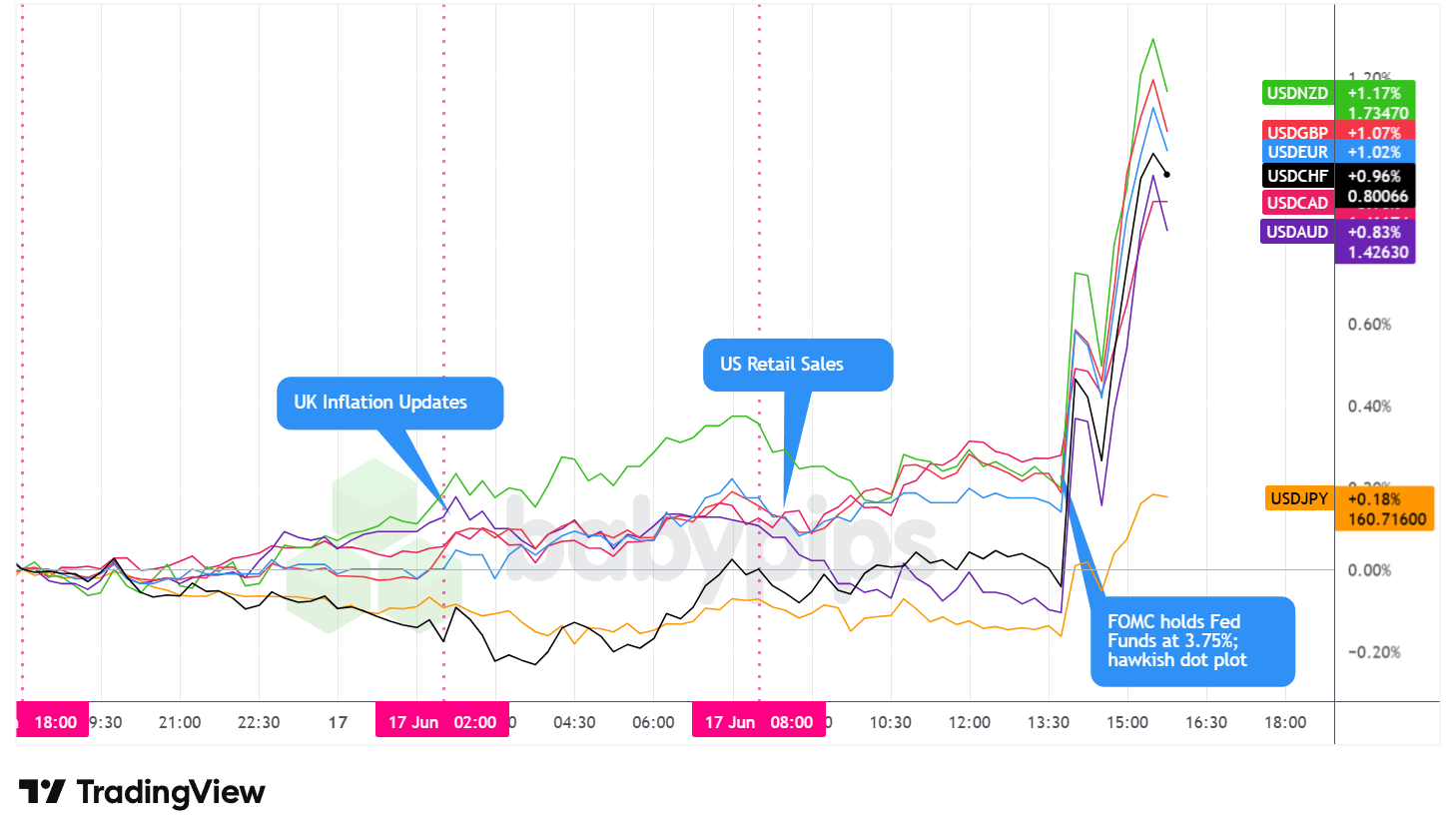
The U.S. dollar ended Wednesday as the best-performing major currency, gaining against all of its counterparts, with the decisive move arriving after the FOMC statement. The Dollar Index closed higher by roughly 0.91%, near 100.4.
During the Asian session, the dollar traded mostly sideways with low volatility, leaning slightly bearish early before shifting to a more bullish tone heading into the London open. There were no major regional catalysts driving clear directional momentum.
The London morning session saw the dollar trade mixed, carrying a bullish lean into the U.S. open. U.K. inflation data released early in the European session showed headline CPI holding at 2.8% year-over-year, below forecasts, which trimmed some near-term Bank of England rate-hike urgency and pressured sterling against the greenback. The softer headline arrived alongside a notable pickup in U.K. services inflation, a detail that may keep policymakers cautious.
After the U.S. open, the dollar pulled back on net before trading mixed heading into the FOMC decision. A stronger-than-expected U.S. retail sales report earlier in the morning, with sales rising 0.9% month-over-month against a 0.6% forecast, likely lent the dollar some underlying support ahead of the Fed.
The dollar then spiked higher against the major currencies immediately following the release of the FOMC statement and its hawkish projections. It stabilized and chopped sideways during Chair Warsh’s press conference, where he reiterated a focus on restoring price stability and signaled changes to the central bank’s communication approach, before resuming its advance into the close.
Promoted: Day traders & Scalpers have better odds of making great decisions if they see market catalysts right away. Get the real-time feed that pros use to catch the news.
Join FinancialJuice for Free to learn more!
Disclosure: We may earn a commission from our partners if you sign up through our links, at no extra cost to you.
Upcoming Potential Catalysts on the Economic Calendar
- New Zealand GDP Growth Rate for March 31, 2026 at 10:45 pm GMT
- Swiss Balance of Trade for May 2026 at 6:00 am GMT
- U.K. Employment Situation Update for April 2026 at 6:00 am GMT
- Swiss SECO Economic Forecasts at 7:00 am GMT
- Swiss National Bank Interest Rate Decision for June 18, 2026 at 7:30 am GMT
- Bank of England Official Policy Rate for June 18, 2026 at 11:00 am GMT
- ECB Lane Speech at 12:15 pm GMT
- Canada PPI for May 2026 at 12:30 pm GMT
- Philadelphia Fed Manufacturing Index for June 2026 at 12:30 pm GMT
- U.S. Initial Jobless Claims for June 13, 2026 at 12:30 pm GMT
- CB U.S. Leading Index MoM for May 2026 at 2:00 pm GMT
Thursday’s calendar carries elevated volatility potential, with back-to-back central bank decisions from the Swiss National Bank and the Bank of England. The Bank of England is widely expected to hold its Bank Rate at 3.75%, so attention will likely center on the vote split and the policy statement’s language around the jump in services inflation, both of which could shape sterling’s near-term path.
Later in the U.S. session, weekly initial jobless claims and the Philadelphia Fed Manufacturing Index could offer fresh reads on labor market and factory conditions as traders continue to digest the Fed’s hawkish tilt.
Stay frosty out there, forex friends!
Most traders see oil falling and Treasury yields popping higher, but don’t understand how those moves cascade through equities and affect every currency pair differently. Premium members can read our lesson:
📖 What Is Intermarket Analysis?
Reading this helps you understand how oil prices, bond yields, and equity market rotation move together, why a single geopolitical event can affect multiple asset classes simultaneously, and how those cross-asset correlations shape currency pair movements.
And if you’re not a Premium subscriber yet, consider joining to access the full curriculum.
With Babypips Premium, you get full access to School of Pipsology lessons that help you understand the invisible connections between commodities, bonds, equities, and currencies that move your trading pairs