The June U.S. jobs report came in as traders were already juggling Fed uncertainty, fragile risk sentiment, and yen intervention nerves.
With central bankers stepping back from clear forward guidance, one data print had the potential to punch well above its usual weight.
Here’s how our NFP watchlist held up once the numbers crossed and the dollar started moving.
Watchlists are price outlook & strategy discussions supported by both fundamental & technical analysis, a crucial step towards creating a high-quality discretionary trade idea before working on a risk & trade management plan.
If you’d like to follow our “Watchlist” picks right when they are published throughout the week, check out our BabyPips Premium subscribe page to learn more!
The Setup
What We Were Watching: U.S. Employment Report (June 2026)
- Expectation: Consensus called for 26,000 net new jobs, with unemployment expected to pull back from 4.5% to 4.4%.
- Outcome: Employment rose 40,300, and unemployment fell to 4.4% as expected, though the quality of the gain leaned part-time. Hours worked declined and underemployment edged higher
- Market environment surrounding the event: After seemingly moving on from geopolitical headlines, markets turned their attention to AI-related tech valuation concerns that triggered equity declines during the first half of the week. Strengthening Fed rate hike expectations as markets braced for a firm U.S. core PCE print also contributed to risk-off flows, though Micron’s upbeat guidance lifted chipmaker stocks during the back half of the week, along with a “buy the rumor, sell the news” reaction to the Fed’s preferred inflation print.
Event Outcome
The June U.S. jobs report badly missed expectations, with nonfarm payrolls rising by just 57,000 versus roughly 110,000 to 113,000 expected. Prior months were also revised down by 74,000 jobs, making the labor market look weaker than previously reported.
The unemployment rate fell to 4.2% from 4.3%, but that came with a lower participation rate, so it wasn’t exactly a victory lap. Fewer people looking for work helped push the jobless rate down.
Key Takeaways:
- NFP: +57,000, versus about 110,000 to 113,000 expected
- Unemployment rate: 4.2%, down from 4.3%
- Labor force participation: 61.5%, down from 61.8%
- Leisure and hospitality: 61,000 jobs lost
- Revisions: 74,000 fewer jobs across April and May
- Average hourly earnings: +0.3% month over month, +3.5% year over year
- Fed impact: July hike odds cooled, while September hike odds also dropped
The dollar was already softer before the release, then dropped again after the 8:30 a.m. ET print as traders scaled back Fed hike bets. The Greenback later recovered part of the knee-jerk move, but still ended weaker across the majors, with JPY and CHF seeing the strongest gains.
Fundamental Bias Triggered: Bearish USD
Promotion: Top-tier catalysts like the U.S. employment release can trigger emotional execution.
TradeZella’s AI powered journal turns your raw data into a high-performance playbook. Sync your broker, replay your trades bar-by-bar, and use the Playbook Designer to ensure that next time an economic data point surprises the market, you’re executing with clinical precision.
Click on the link to learn more and use code “PIPS20” to save 20% off first purchase!
Disclosure: We may earn a commission from our partners if you sign up through our links, at no extra cost to you.
Broad Market and Exogenous Drivers:
Fractured Ceasefire and Oil Whiplash (Monday-Tuesday)
The week opened with the U.S.-Iran ceasefire under real strain after four rounds of strikes over the prior weekend tied to Strait of Hormuz shipping routes. WTI crude oil, which had fallen to a four-month low near $69 as Saudi Arabia’s Ras Tanura terminal reopened, climbed back toward $70 on the renewed friction.
USD/JPY broke above 162.00 for the first time since 1986 despite official jawboning from Tokyo, then Tuesday brought a soft Conference Board consumer confidence miss, turning the focus back to U.S. data points and pre-NFP positioning.
Spotlight on Sintra (Wednesday)
The ECB’s Sintra forum put Fed Chair Kevin Warsh on stage alongside Lagarde, Bailey, and Macklem. All four central bankers stepped back from pre-announcing rate paths, meaning each new data print would now carry more weight in isolation. Warsh himself noted that inflation risks are decreasing, casting doubts on immediate rate hikes.
Equities closed out the quarter on strong footing thanks to reduced tightening expectations, with chip names driving fresh highs. The U.S. ISM Manufacturing PMI cooled to 53.3 and its employment component stayed below the growth-contraction line at 49.7, dampening NFP expectations and further weighing on hawkish policy biases.
The Jobs Miss and a Cautious Close (Thursday-Friday)
Thursday’s session, which came ahead of the long weekend Fourth of July holiday, opened quietly as traders sat on the sidelines awaiting the NFP print. A sharp, brief 100-pip yen move during the London morning, possibly an intervention signal, added to the cautious tone before the data even landed.
The payrolls miss then sent the dollar to a two-week low, lifted gold roughly 2%, and left equities chopping near flat into Friday. Holiday-thinned liquidity paved the way for a muted follow-through before week’s end.
Scenario Scorecard: How Did They Play Out?
USD/JPY: Net Bearish USD Event Outcome + Risk-Off Scenario
USD/JPY 1-hour Forex Chart Faster with TradingView
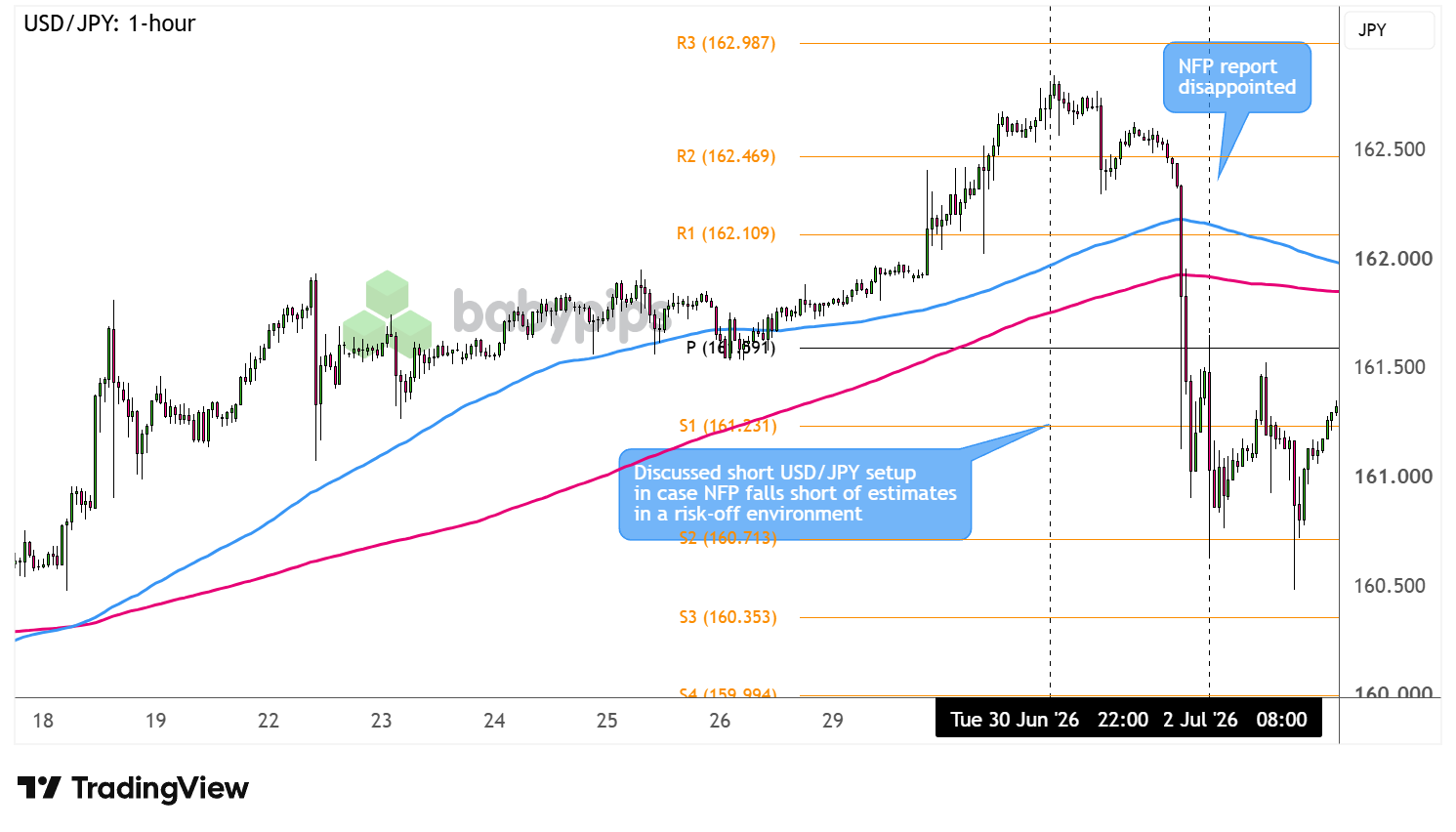
Our watchlist flagged USD/JPY as the pair to watch if a soft jobs report landed alongside a risk-averse market, the setup that would shift safe-haven demand toward the yen. The pair had been trading dangerously above previous yen intervention levels, raising the risk that officials would step into the FX market sooner or later.
The payrolls miss confirmed bearish USD fundamentals and the broader backdrop, cautious equities, unresolved Iran tension, and an already-jittery yen on intervention watch, supplied the risk-off leg this setup needed.
USD/JPY had already pushed to fresh highs near 163.00 ahead of the release, driven by yen weakness and Tokyo’s lack of actual response to the 162.00 breach. Though the original watchlist entry zone near the pivot point had already been bypassed by the time the data printed thanks to less hawkish remarks from Fed head Warsh in Sintra, USD/JPY plunged from the 162.90 area to test levels below 161 within the hour of the NFP print, brushing S1 (161.23) before stabilizing.
The move didn’t stay clean, however. USD/JPY spent Friday consolidating back toward 161.10-161.20, clawing back a portion of Thursday’s drop as holiday-thinned liquidity took over.
Traders who caught the initial post-event drop had the clearest path to a positive outcome. Those who shorted into the bounce, betting on a clean continuation toward S2 (160.71) or the 160.00 intervention zone, ran into a market that lacked the follow-through to get there before the week closed.
Promoted: Capitalize on the News Events Without Risking Your Own Funds.
In a major jobs report release, the corresponding currency can swing wildly intraday. Why risk your personal capital during extreme volatility?
Most proprietary firms terminate your evaluation account if you execute a trade during a major macroeconomic release, but FundedNext permits news trading across all models. Test your thesis with up to $300,000 in simulated capital, or take advantage of their Free Trial to experience the platform risk-free.
Explore FundedNext and Start Your Free Trial!
Disclosure: We may earn a commission from our partners if you sign up through our links.
Not Eligible to Move Beyond Watchlist – GBP/USD & Bearish USD Setups
GBP/USD: Bearish USD Event Outcome + Risk-On Scenario
GBP/USD 1-hour Forex Chart Faster with TradingView
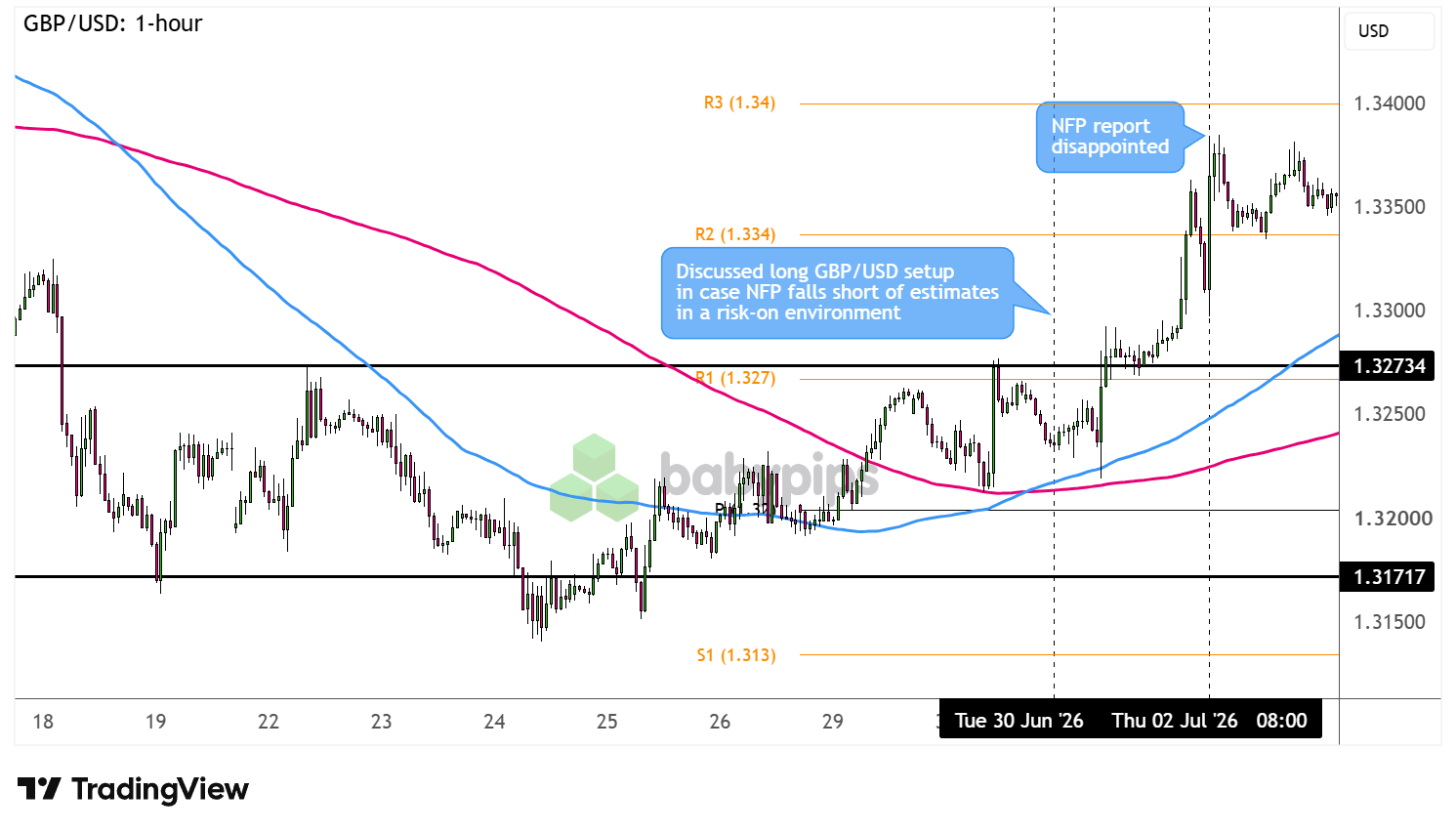
The jobs miss satisfied this setup’s economic data condition, but the required risk-on backdrop never fully materialized. Cautious positioning into the release and the Sintra speeches, not a broad appetite for risk, defined Thursday’s session, so GBP/USD didn’t exactly qualify to move beyond the watchlist stage.
That said, the pair still moved decisively. GBP/USD jumped from roughly 1.3300 to above 1.3375 within the hour of the release and held most of that gain into Friday, with 1.3500 still sitting untested overhead.
However, the rally likely owed more to broad dollar weakness and Sterling’s own tailwinds, including BOE patience and the post-Starmer leadership transition, than to any risk-on rotation. A long position would probably have worked regardless of the mismatched scenario, but the setup’s structural logic wasn’t the reason it worked.
USD/CAD: Bullish USD Event Outcome + Risk-On Scenario
USD/CAD 1-hour Forex Chart Faster with TradingView
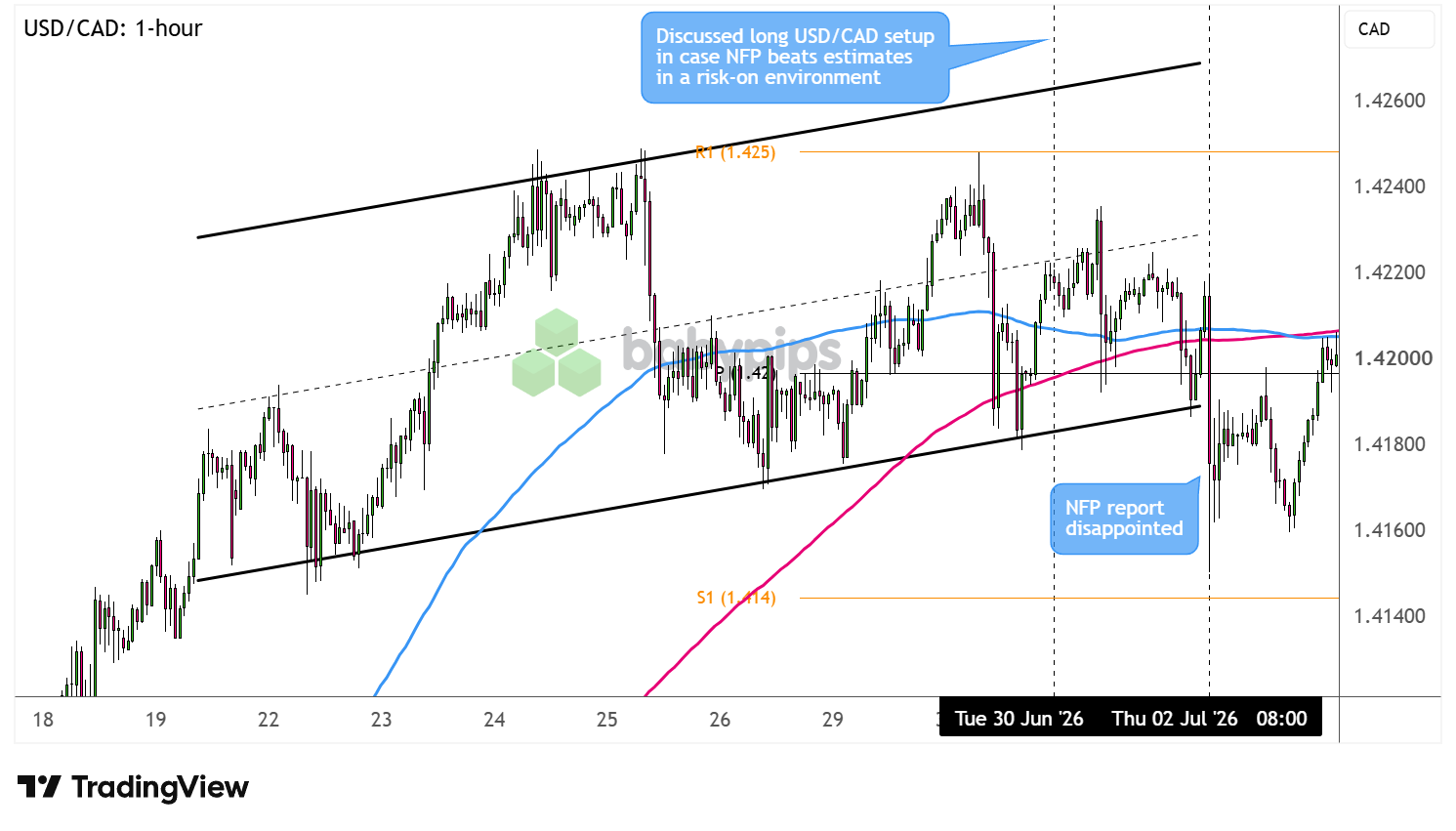
Our USD/CAD watchlist idea eyed a potential channel support bounce back to nearby resistance should an upside NFP surprise materialize in a risk-on setting. This setup required an NFP print strong enough to sustain Fed tightening expectations, and the jobs miss invalidated this fundamental thesis.
In addition, less hawkish remarks from Fed head Warsh during his Sintra testimony cast doubts on the central bank’s tightening timeline, as he acknowledged that inflation risks are subsiding, putting the pair on the back foot ahead of the target event.
USD/CAD’s reaction to the NFP report was the least clean of the four pairs, as it dropped from the mid-channel area of interest to break below the channel bottom and 1.4200 handle before recovering some of the move by Friday’s close.
Oil’s firmness offered the Loonie some support, but a softer May GDP advance read and a Bank of Canada still on hold left CAD without a strong domestic case of its own.
USD/CHF: Bearish USD Event Outcome + Risk-Off Scenario
USD/CHF 1-hour Forex Chart Faster with TradingView
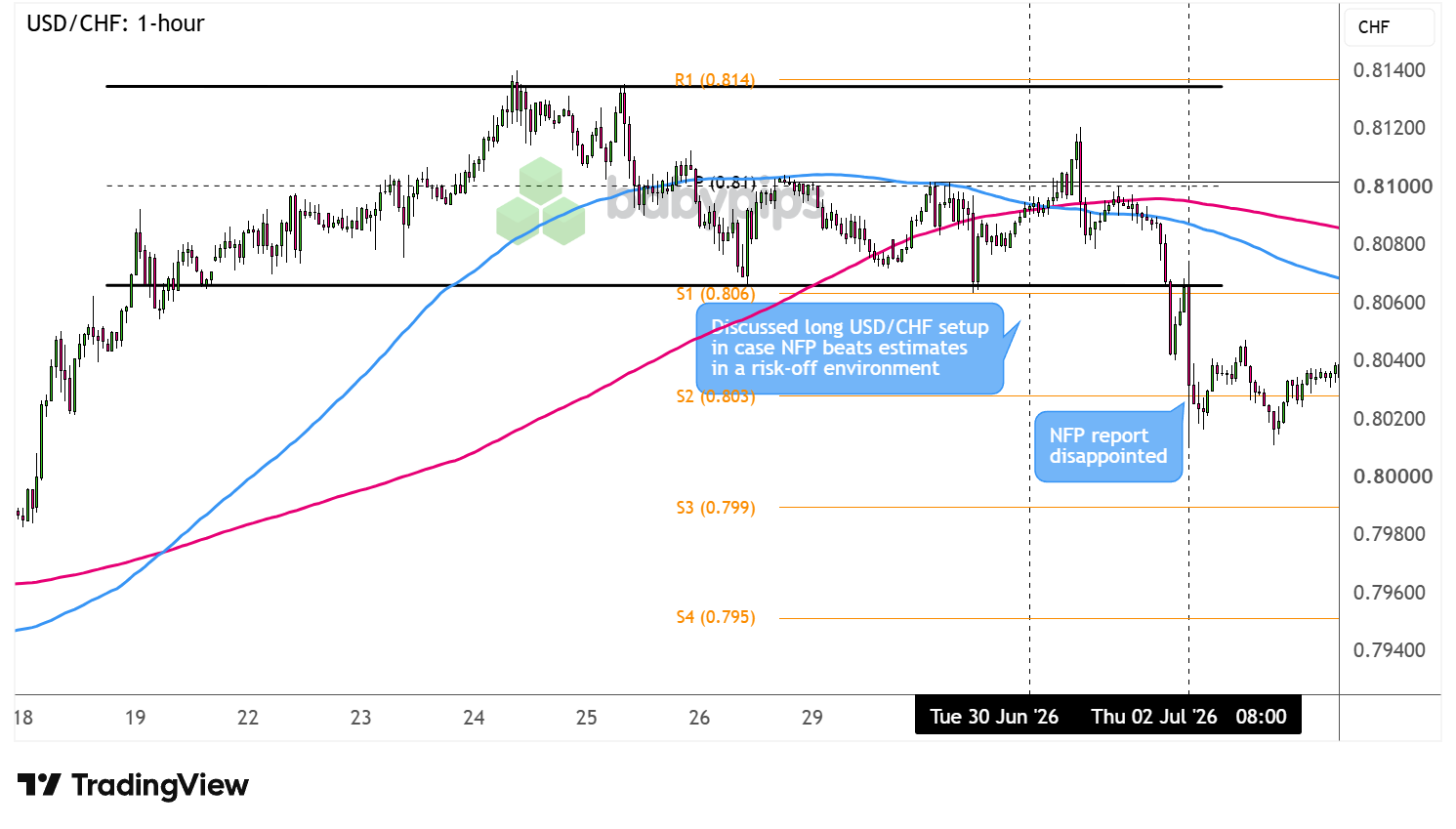
Our analysts looked at a possible range support bounce in the event that the U.S. jobs report beats estimates in a risk-off setting. This setup needed a hot NFP print to keep the Fed in higher-for-longer mode, but the 57,000 miss did the opposite, disqualifying the bullish USD thesis outright.
The pair still moved sharply, just in the other direction. Less hawkish remarks from Fed head Warsh in Sintra the previous day already brought bearish USD vibes in the mix, and USD/CHF broke down from the 0.8060 support zone to test S2 (0.8030) within the NFP release session.
Given the miss and the safe-haven bid that came with it, a reassessed short USD/CHF position had real technical footing: the breakdown was sharp, safe-haven dynamics leaned in favor of the franc, and the move held into Friday rather than round-tripping.
The Verdict
USD/JPY moved in the direction our watchlist discussion anticipated, dropping sharply once the payrolls miss confirmed the bearish USD leg and the week’s cautious risk tone supplied the rest.
The unemployment rate’s improvement offered no real cover once traders saw it was participation-driven, and combined with 74,000 in downward revisions, that was enough to pull Fed hike odds down across both the July and September meetings.
Keep in mind, though, that USD/JPY had already broken to fresh highs on yen weakness and intervention jawboning before the event, so the original technical levels weren’t there to trade cleanly by the time the data landed. The pair’s Friday recovery further muddies a straightforward directional read.
Overall, we’d rate this USD/JPY discussion as neutral-to-likely for a net positive outcome. The direction and the scenario both played out as discussed, but the pre-event price action and the choppy settling pattern afterward meant execution would likely determine the outcome.
Those who caught the initial post-event drop had a legitimate edge, though the partial Friday bounce meant timing mattered as much as direction.
Promoted: The Strategy is Half the Battle; Your Mindset is the Rest.
Most trading mistakes aren’t technical—they’re psychological. In the classic “Trading in the Zone” by Mark Douglas (⭐ 4.7★ | 10,000+ reviews on Amazon), you’ll learn how to master the probabilistic thinking and emotional discipline mentioned in today’s article. If you struggle with hesitation or breaking your rules, this is your manual for consistent execution.
Click on the link to learn more about “Trading in the Zone” by Mark Douglas!
Disclosure: To help support our content, we may earn a commission from our partners if you sign up through our links, at no extra cost to you.
Key Takeaways:
Central bank silence raises the stakes of every single print
Sintra’s four-way retreat from forward guidance meant this jobs report carried more weight than a typical NFP release. Without a pre-announced Fed path, traders had nothing to lean on except the data itself, which is part of why a 57,000 miss moved the dollar as hard as it did across every major pair.
A currency can already be primed before the “risk-off” label applies
USD/JPY didn’t need a formal risk-off catalyst to sell off. Existing intervention jitters near the 162 handle meant the pair was already sensitive to any bearish USD catalyst, jobs data included, well before the broader market environment caught up.
Disqualifications deserve a second look, pair by pair
USD/CHF and USD/CAD were both invalidated by the same jobs miss, but only one offered a clean reassessed trade. USD/CHF’s breakdown was technical and directional; USD/CAD’s was blunted by the loonie’s own soft domestic data and oil-linked support. The same invalidating event doesn’t guarantee the same replacement setup.
This NFP watchlist recap walks through how pre-built scenarios for USD/JPY, GBP/USD, USD/CAD, and USD/CHF played out once the jobs data actually printed, a process that may be new if you’ve never built a trade thesis ahead of a major release. Premium members can read our lesson:
📖 Pre-Positioning: Build Your Trade Before the Data Print
Reading this helps you understand how to build a directional bias before a catalyst like NFP even lands, how to frame trade scenarios around expected outcomes instead of reacting to the headline number, and how to manage event risk so you’re trading the outcome rather than chasing the spike.
And if you’re not a Premium subscriber yet, now’s a good time to sign up.
With Babypips Premium, you get full access to School of Pipsology lessons that help you understand not just where price ends up after a jobs report, but how to structure a scenario-based trade plan around it before the data even hits the wires.