The June 2026 jobs report landed well below expectations, and the market noticed immediately. The U.S. economy added just 57,000 nonfarm payrolls last month, roughly half the 110,000 forecast. The unemployment rate dipped to 4.2%, which sounds positive, but it came alongside fewer Americans actively looking for work — not a surge in hiring. The headline miss, a 61,000 jobs loss in leisure and hospitality, and 74,000 downward revisions to prior months all point in the same direction: the labor market is cooling faster than Wall Street expected.
June 2026 Jobs Report: Key Takeaways
- Nonfarm payrolls +57,000: About half the ~113,000 Bloomberg/Dow Jones consensus; June snapped a three-month run of above-average prints.
- Unemployment rate 4.2%: Down from 4.3%, the lowest in a year. Complication: labor force participation dropped at the same time.
- Labor force participation 61.5%: Down 0.3 pp from 61.8%; fewer Americans were actively looking for work in June.
- Leisure and hospitality -61,000: A sharp reversal after the sector drove May’s blowout print; BLS blamed “weaker than usual seasonal hiring.”
- Revisions -74,000 combined: April revised from +179,000 to +148,000; May cut from +172,000 to +129,000. Recent strength was real, just not that real.
- Average hourly earnings +0.3% MoM, +3.5% YoY: Wages rose to $37.64 per hour, still running hot enough to keep the Fed on edge.
- Long-term unemployed: 1.9 million: Up 286,000 over the past year. This is the part of the report that doesn’t make the front page but probably should.
What Did the June 2026 Jobs Numbers Show?
The short version: a big miss across nearly every important metric. Nonfarm payrolls — the broadest monthly count of U.S. jobs outside farming — came in at 57,000 for June, against a consensus of 113,000. That’s a 56,000-job gap between what markets expected and what the economy actually delivered.
Professional and business services (+36,000), social assistance (+25,000), and health care (+22,000) did most of the work. The problem is that health care is running below its own 12-month average of 38,000 per month. Even the steadiest sector in the labor market is losing speed. Meanwhile, leisure and hospitality shed 61,000 jobs in a single month, wiping out a portion of the gains that had been driving the 2026 labor story.
The 12-month average gain now sits at 36,000 per month. June matched that pace. After three months that looked like a breakout, the labor market snapped back to its baseline trend.
Why Did Payrolls Miss?
Leisure and hospitality is the headline, but the revisions are the real story for anyone trying to read the trend. May was cut from +172,000 to +129,000. April was trimmed from +179,000 to +148,000. That’s 74,000 jobs the prior reports credited to the economy that turned out not to exist.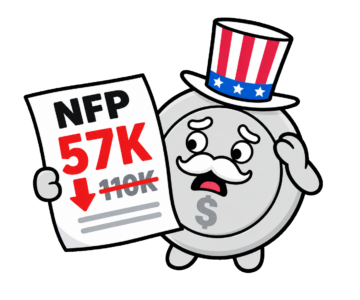 The recent strength in the labor market data was real — it was just inflated.
The leisure and hospitality reversal was always a risk. May’s 70,000-job surge in the sector came partly from World Cup hospitality demand and Memorial Day weekend timing. Those are seasonal effects that arrive loudly and unwind quietly. The BLS confirmed this, attributing June’s loss to “weaker than usual seasonal hiring.” ADP’s private-sector data, out Wednesday, flagged leisure and hospitality as a drag for the sixth month in a row in private payrolls. The original BLS reading was just catching up to what private data already showed.
Beyond leisure, job growth was narrow. Most major sectors — manufacturing, retail, construction, financial activities — showed no meaningful change. Three services subsectors did the heavy lifting while the rest of the economy sat largely flat.
Is the Falling Unemployment Rate Good News or a Warning Sign?
The unemployment rate fell from 4.3% to 4.2% — and on the surface, that looks like a win. But you need to check how it got there.
The labor force participation rate (the share of working-age Americans either employed or actively looking for work) dropped 0.3 percentage points to 61.5%. Here’s what that means for the unemployment rate: the government only counts you as unemployed if you’re actively looking for a job. When people stop looking, they stop being counted. The unemployment rate drops not because the job market improved, but because frustrated workers stepped back. In June, 477,000 Americans were classified as discouraged workers — people who gave up looking because they believed no jobs were available for them.
The employment-population ratio — a cleaner measure that simply compares total employed people to all working-age adults — edged down 0.2 percentage points to 59.0%. A genuine improvement in the labor market would push that ratio up. It went down. Long-term unemployment (people jobless for 27+ weeks) also rose to 1.9 million, up 286,000 over the past year. The headline rate dipped. The underlying picture did not improve.
What Does This Mean for the Fed’s Next Move?
This report takes a July rate hike off the table. Before the release, markets were pricing roughly a 65% probability of a September hike from the Federal Reserve. That number fell to roughly 53% post release. The Fed is currently at 3.50%–3.75%, unchanged since the June 17 FOMC meeting, where nine policymakers projected at least one additional hike for 2026 and the median projection moved to 3.8%.
Today’s data likely makes it difficult to envision a path toward a July Fed hike even if there is upside in the inflation data yet to be realized as the miss probably takes some of the pressure off as the markets figure out how new Fed Chairman Kevin Warsh will respond to conflicting data.
Here’s the catch: inflation hasn’t cooperated. Core PCE (Personal Consumption Expenditures — the Fed’s preferred inflation gauge) came in at 3.4% year-over-year in May, well above the 2% target. One soft jobs print does not overwrite that. Cuts are off the table. Hikes are less likely near-term. The Fed is stuck watching data at the July 29 meeting, and the next CPI release will matter more for policy direction than today’s payrolls did.
Promoted: Profitable Trading Isn’t Reserved for Wall Street.
Most traders quietly wonder if consistent profitability is actually achievable for someone like them — or if it’s just a story people tell. Jack Schwager’s newest book, “Market Wizards: The Next Generation,” answers that question directly. The legendary author behind the original Market Wizards series interviews a new generation of successful traders — many self-taught — who built real wealth and income through the markets. Their common thread isn’t genius or insider access. It’s a deliberate process, disciplined risk management, and the conviction to take trading seriously as a pursuit worth mastering.
If that sounds like something worth exploring, this is a good place to start.
Get Market Wizards: The Next Generation on Amazon!
Disclosure: We may earn a commission from our partners if you sign up through our links, at no extra cost to you.
Frequently Asked Questions About the June 2026 Jobs Report
What do nonfarm payrolls measure?
Nonfarm payrolls count the net monthly change in paid U.S. workers outside agriculture. The Bureau of Labor Statistics derives the figure from surveys of roughly 145,000 businesses and government agencies. The same release also includes the unemployment rate, average hourly earnings, and hours worked, giving traders a wide view of labor market conditions in a single report.
Why do nonfarm payrolls matter for forex traders?
Strong job growth signals a stronger economy, which typically leads to higher interest rates. Higher U.S. rates attract foreign capital, which strengthens the dollar. A miss like June’s does the reverse: it reduces rate-hike expectations, sends Treasury yields lower, and weakens USD. This report moves markets because it directly shapes what traders expect the Fed to do next.
What happened in the June 2026 jobs report?
The economy added 57,000 nonfarm payrolls in June, missing the ~113,000 consensus forecast. The unemployment rate fell to 4.2%, but labor force participation also dropped — a red flag for the health of that decline. Leisure and hospitality lost 61,000 jobs. Prior months were revised down 74,000 combined. Long-term unemployment continued its year-long rise.
What does the weak jobs report mean for the Federal Reserve?
It reduces near-term pressure to hike. The Fed holds at 3.50%–3.75%, with the next decision at the July 29 FOMC meeting. Core PCE inflation at 3.4% keeps rate cuts off the table as well. The Fed is watching and waiting — and so is the market.
What is the outlook for U.S. employment in H2 2026?
The trend is softening. The 12-month average gain is 36,000 per month, and June matched that pace after a few months that looked stronger than they turned out to be. Labor force participation is falling, long-term unemployment is rising, and leisure/hospitality reversed a key sector of prior strength. Whether the second half recovers depends on the Iran-U.S. situation, energy prices, and whether consumers keep spending as inflation eats into real wages.
A weak jobs report doesn’t just change the headline. It shifts what traders expect the Fed to do next, and that’s what moves your USD pairs. Premium members can read our lesson:
📖 How to Trade Central Bank Decisions Using Market Expectations
Reading this helps you understand how to read market-implied probabilities for rate decisions, what scenarios traders must prepare for when data is conflicting, and how a single economic miss reshapes the odds the market is pricing in.
And if you’re not a Premium subscriber yet, consider joining to access these lessons anytime.
With Babypips Premium, you get full access to School of Pipsology lessons that help you understand not just which data releases move markets, but how the Fed weighs conflicting signals and where rate expectations are headed.