


The RBNZ delivered its first rate hike in three years, lifting the Official Cash Rate 25 basis points to 2.50%. On the surface, markets saw it coming. Rate pricing had leaned toward a hike for weeks after May’s split vote and Governor Breman’s hawkish warnings.
Underneath, the call was messier than the pricing suggested. The NZIER shadow board called it a line-ball decision, several major banks still expected a hold right up to the announcement, and the guidance that came with the hike stopped short of promising a fast follow-through. Add a mid-week collapse of the U.S.-Iran ceasefire and hawkish-leaning FOMC minutes on the same day, and Kiwi traders had plenty of chances to get shaken out of a directionally correct idea.
Let’s look at which setup from our watchlist ideas had a path to a clean trade.
Watchlists are price outlook & strategy discussions supported by both fundamental & technical analysis, a crucial step towards creating a high-quality discretionary trade idea before working on a risk & trade management plan.
If you’d like to follow our “Watchlist” picks right when they are published throughout the week, check out our BabyPips Premium subscribe page to learn more!
The Setup
What We Were Watching: RBNZ Monetary Policy Statement (July 2026)
- Expectation: A 25 basis point hike from 2.25% to 2.50%, with the bigger market mover likely coming from the statement’s tone and Governor Breman’s press conference an hour later. Because the hike looked priced in, we flagged the risk of a pop-and-fade on the announcement itself and pointed to the presser as the cleaner entry window.
- Market environment surrounding the event: Cautiously positive risk sentiment heading in, with markets repricing lower Fed tightening odds after Warsh’s less hawkish Sintra remarks and a dismal NFP print. The FOMC minutes landing in the late U.S. session of the same day threatened to muddy post-event price action, and Middle East headlines stayed a live risk-off wildcard.
Event Outcome
The RBNZ raised its Official Cash Rate 25 basis points to 2.50% on July 8, its first hike since mid-2023. The committee reached the decision by consensus, a sharp contrast to May’s three-three split that Governor Breman had to break herself. The statement flagged that further increases “appear likely at upcoming meetings” without pinning down a date, and Breman framed the move as removing stimulus and moving toward neutral rather than the start of an aggressive campaign.
Key Takeaways:
- Official Cash Rate: 2.50% vs. 2.25% previous — a 25bp hike, the first in three years, decided by consensus with no casting vote needed. Two members flagged upside inflation risks; four, including Breman, called risks balanced.
- Guidance: further hikes “appear likely,” timing unspecified — analysts pencil in the OCR near 3.00% by year-end, and rate pricing implies roughly a 60% chance of another hike at the September 2 meeting.
- Inflation outlook: 3.9% peak in the June quarter, seen easing to 3.3% by September and 2% by mid-2027 — the partial reopening of the Strait of Hormuz knocked oil prices lower since May and took the sharpest edge off the RBNZ’s inflation worries.
- Growth: momentum faded in the June quarter — softer card spending and weaker survey readings, though the RBNZ expects a bounce from September as fuel costs ease.
- NZD reaction: up roughly 0.4% against the dollar to trade near $0.5699 shortly after the announcement, clawing back an overnight dip tied to fresh Iran headlines.
The rate-path read leaned hawkish enough to keep Kiwi bulls in charge. A consensus hike plus a “further hikes appear likely” signal beat the hold that the NZIER shadow board and several banks had called for, and Thursday’s blowout BusinessNZ PMI at 59.7, a five-year high against a 49.0 forecast, gave the tightening case a fresh data point the next day.
Fundamental Bias Triggered: Bullish NZD
Promotion: Top-tier catalysts like the RBNZ rate decision can trigger emotional execution.
TradeZella’s AI powered journal turns your raw data into a high-performance playbook. Sync your broker, replay your trades bar-by-bar, and use the Playbook Designer to ensure that next time a central bank surprises the market, you’re executing with clinical precision.
Click on the link to learn more and use code “PIPS20” to save 20% off first purchase!
Disclosure: We may earn a commission from our partners if you sign up through our links, at no extra cost to you.
Broad Market and Exogenous Drivers:
Post-Holiday Dollar Bid and Hormuz Flare-Up (Monday–Tuesday)
The greenback firmed through Monday’s Asian and London hours as traders returned from the July 4 break, with the Dollar Index climbing from around 100.83 toward 101.15 before New York sellers knocked it back near flat. ISM services held at 54.0 with a jump in the employment component, and Fed Governor Waller noted risks had shifted toward inflation. Equities leaned constructive, with chipmakers leading the S&P 500 toward the 7,550 area.
Tuesday turned uglier. Reports of Iranian missiles striking commercial vessels in the Strait of Hormuz set a risk-off tone through Asia, and the U.S. Treasury’s revocation of Iran’s oil waiver spiked crude during the New York session. The dollar closed with a firm net bullish lean, the oil-linked Loonie outperformed, and the Kiwi drifted lower across most of the board with the NZIER shadow board’s line-ball call capping any pre-event rally attempts.
RBNZ Hike, Ceasefire “Over,” and Hawkish-Leaning Minutes (Wednesday)
The Kiwi surged after the RBNZ’s 25bp hike during the Asian session and extended gains into early London. Then the geopolitical overlay hit: fresh U.S. strikes on Iran and Trump’s declaration that the ceasefire was “over” sparked a broad risk-off pullback that trimmed RBNZ-driven gains mid-session and pushed WTI to the week’s high around $75.70. Risk appetite firmed again through U.S. hours once Trump signaled he did not expect a full-scale war.
The June FOMC minutes, released that afternoon, revealed a few officials had seen a case for hiking and that inflation concern was building. The read leaned hawkish, yet the dollar still slipped into the close against everything but the yen, taking its cue from the broad risk backdrop rather than the rate outlook. The Kiwi closed as the day’s strongest major.
AI Chip Rally and a Fading War Premium (Thursday–Friday)
Risk-on took over. New Zealand’s June BusinessNZ PMI printed a five-year high at 59.7, chipmakers rallied across Asia, and SK Hynix’s blockbuster U.S. debut fed the AI theme, carrying the S&P 500 to a fresh weekly high above 7,570. Crude bled its war premium despite a second day of airstrikes as traders noted vessels rerouting around Hormuz, drifting back toward the low-$71 zone by Friday afternoon. The yen caught a Friday bid on Japan’s pension-repatriation story and pulled safe-haven flows that might otherwise have gone to the franc, while SNB Chairman Schlegel’s mid-week reminder about FX intervention and possible negative rates kept the franc among the week’s softer majors. The Kiwi closed as the best performing major currency on the week.
Scenario Scorecard: How Did They Play Out?
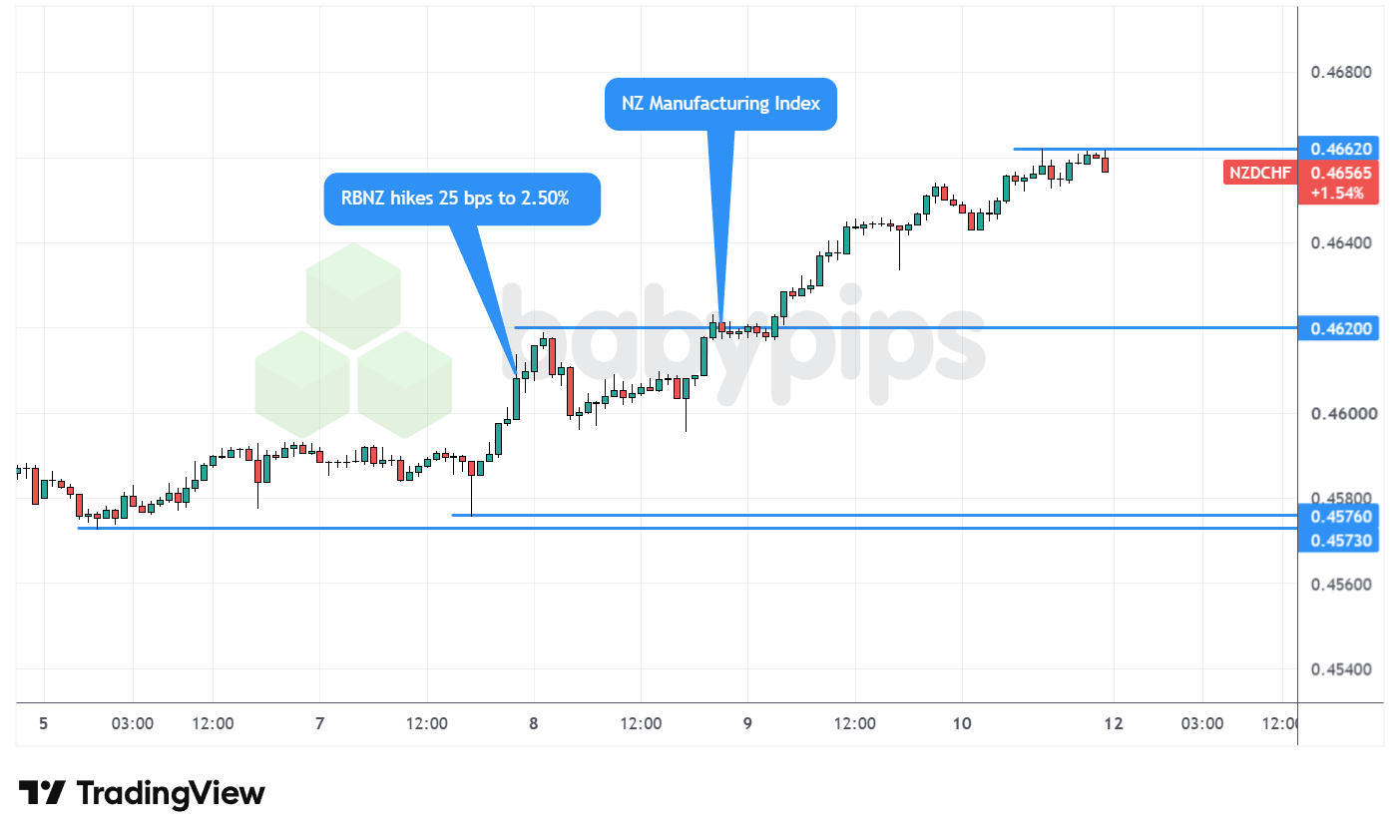
NZD/CHF: Bullish NZD Event Outcome + Risk-On Scenario = Arguably good odds of a net positive outcome
NZD/CHF 1-hour Forex Chart Faster with TradingView
The watchlist called for a hawkish RBNZ decision to spur a break above the descending trend line that had capped the pair for a month, with the .4600 major psychological resistance as the first hurdle and bullish targets at R1 (.4610) then R2 (.4630). We also warned that a dip on profit-taking could follow the actual hike before an upbeat presser extended the climb.
This setup was best-positioned to move beyond the watchlist stage: the RBNZ delivered the hike with tightening-friendly guidance, and the risk environment resolved net risk-on as equities rallied and the franc stayed on the back foot.
Price action followed the script closely, including the warning label. NZD/CHF popped through the trend line and above .4600 on the announcement, tagged the .4618 area, then gave back a chunk of that move in the profit-taking dip we flagged, a pullback that Wednesday’s ceasefire headlines likely deepened. Traders who waited for the presser-driven momentum, or who bought the post-hike dip against the broken trend line, arguably had the cleaner entry. From there the pair ground higher for two days, clearing R1 and R2 and closing the week near .4657, up roughly 1.6%. Both watchlist targets got hit with room to spare, helped by Schlegel’s intervention talk keeping the franc heavy and Thursday’s PMI blowout extending Kiwi demand. Active management mattered mainly around the mid-week Iran headlines, which briefly put safe-haven flows back under the franc.
Promoted: Capitalize on the News Events Without Risking Your Own Funds.
In a major central bank rate decision, the corresponding currency can swing wildly intraday. Why risk your personal capital during extreme volatility?
Most proprietary firms terminate your evaluation account if you execute a trade during a major macroeconomic release, but FundedNext permits news trading across all models. Test your thesis with up to $300,000 in simulated capital, or take advantage of their Free Trial to experience the platform risk-free.
Explore FundedNext and Start Your Free Trial!
Disclosure: We may earn a commission from our partners if you sign up through our links.
Not Eligible to Move Beyond Watchlist – AUD/NZD, GBP/NZD & NZD/USD Setups
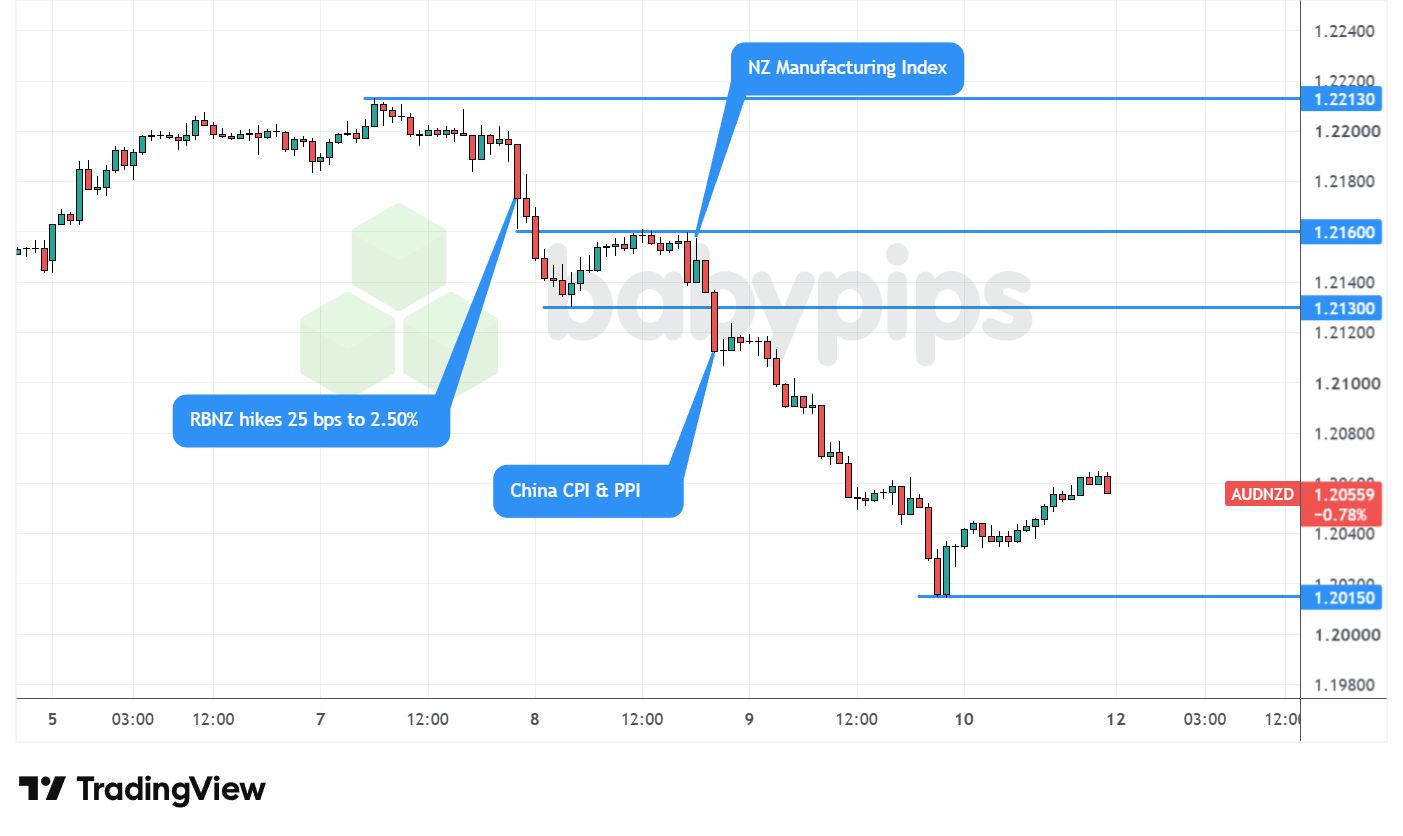
AUD/NZD: Bullish NZD Event Outcome + Risk-Off Scenario
AUD/NZD 1-hour Forex Chart Faster with TradingView
The watchlist called for the selloff to resume from the resistance zone where the 61.8% Fibonacci level lined up with R1 (1.2200) and a major psychological ceiling, targeting the pivot point (1.2170) and possibly the swing low around 1.2140 if Breman hinted at back-to-back hikes.
The event condition was met, but the risk environment resolved risk-on rather than risk-off, so this setup did not satisfy both required conditions to move beyond the watchlist stage.
Here’s the uncomfortable part for the framework: the pair fell anyway, and hard. AUD/NZD rejected the 1.2200 resistance zone, sliced through the 1.2170 pivot and the 1.2140 swing low on Wednesday, and kept bleeding through Thursday to a Friday low near 1.2015 before a bounce into the 1.2050s. Rate divergence dominated the cross regardless of risk tone, since both Antipodeans ride the same sentiment wave and the RBNZ-RBA policy gap did the steering. A trader who re-read the driver and shorted on the hawkish outcome alone plausibly captured a 150-pip move. That was an adapted trade, though. The original thesis conditioned the short on a risk-off backdrop that never arrived, and taking it as written meant standing aside.
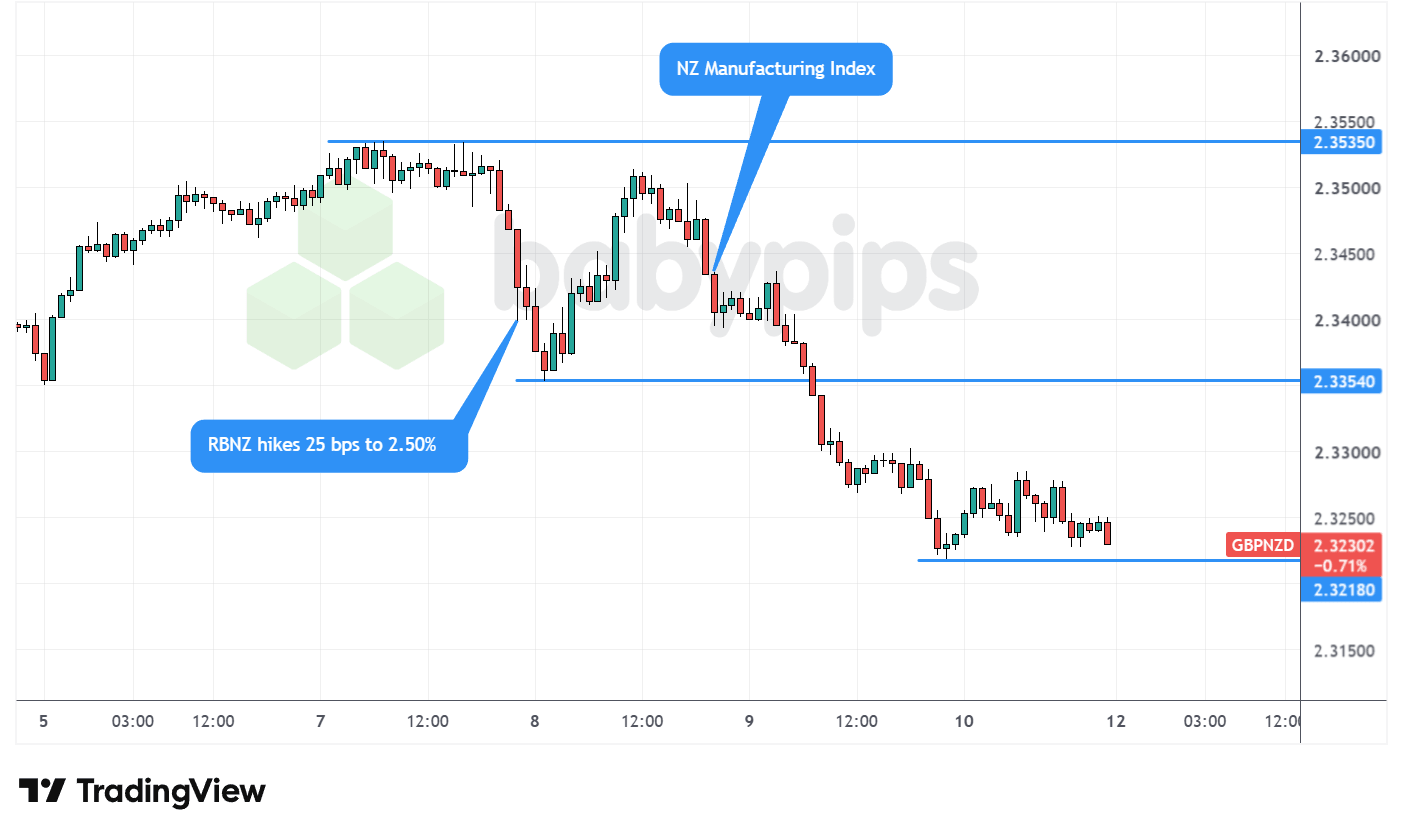
GBP/NZD: Bearish NZD Event Outcome + Risk-On Scenario
GBP/NZD 1-hour Forex Chart Faster with TradingView
The watchlist called for a Kiwi-bearish RBNZ event to power a run from the 2.3500 psychological level and R1 Pivot Point (2.3472) toward R2 near 2.3569, if not the 2.3600 area, with the 2.3450 mid-channel zone and 2.3400 near the 100 and 200 SMAs as pullback support.
The event outcome came in bullish NZD rather than bearish, so this setup did not satisfy both required conditions to move beyond the watchlist stage.
The pair topped out near 2.3535 before the decision and never threatened R2. The hike knocked GBP/NZD below the 2.3394 pivot on Wednesday, the ascending channel gave way, and Thursday’s PMI-fueled Kiwi strength drove the pair through S1 (2.3297) to a Friday low near the S2 area around 2.3220, a drop of roughly 300 pips from the pre-event highs. Sterling had nothing domestic to fight back with beyond a house-price beat and a steady-as-she-goes BOE stability report. An adapted short on the bullish-Kiwi outcome had plenty of room to work, but that trade reversed the watchlist thesis outright rather than adjusting it, and we’d score it as a different idea entirely.
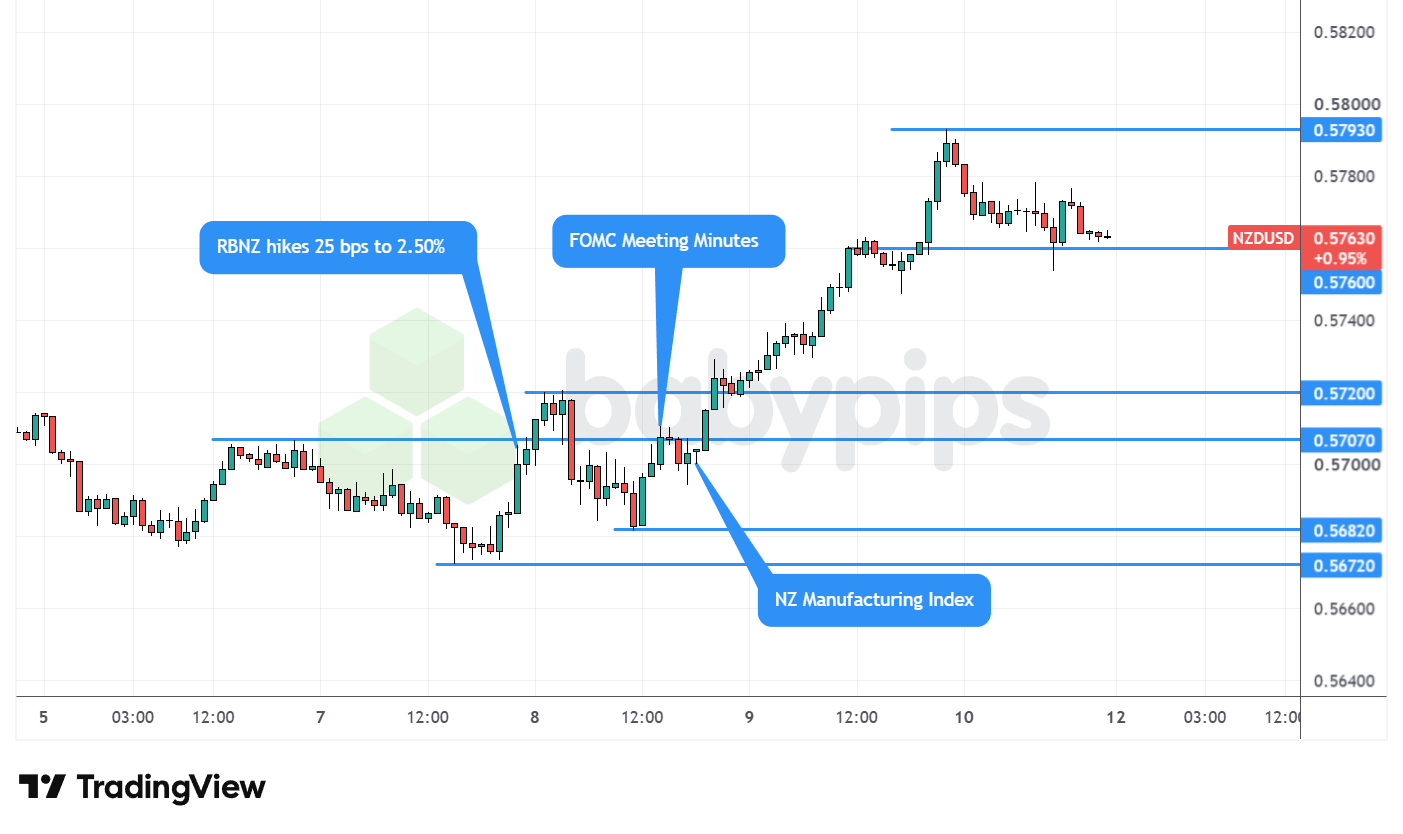
NZD/USD: Bearish NZD Event Outcome + Risk-Off Scenario
NZD/USD 1-hour Forex Chart Faster with TradingView
The watchlist called for a resumption of the June downswing toward the .5640 previous lows, with stronger bearish momentum possibly dragging the pair below .5620, while noting the flip side: a climb toward the R1 Pivot Point at .5742 near the 50% Fibonacci retracement if NZD caught a bid.
Neither condition held. The event outcome printed bullish NZD and the risk environment leaned risk-on, so this setup did not satisfy both required conditions to move beyond the watchlist stage.
The .5640-and-below downside targets never came close. NZD/USD chopped around the .5690 pivot into the decision, popped on the hike, and then climbed in near-textbook fashion once the risk-on chip rally weighed on the dollar, clearing the .5742 R1 flip-side level on Thursday and stretching to R2 near .5786 with a Friday high around .5793 before settling near .5763. The watchlist’s own flip-side note mapped the first leg of that move, so a trader who flipped bullish on the outcome had marked levels to work with. Credit where due, but the flip side is a contingency note, and the setup as constructed was a short that the event invalidated within minutes.
The Verdict
The week split one-and-three on the strict framework. NZD/CHF was the only setup where both the event outcome and the risk environment aligned, and it paid its targets and more, with the pre-flagged post-hike dip serving as the main execution test. AUD/NZD fell to its targets despite the risk-environment condition failing, a reminder that policy divergence can drive an Antipodean cross harder than risk tone. The two bearish-Kiwi setups on GBP/NZD and NZD/USD were invalidated at the moment of release and stayed invalidated as Kiwi finished the week as the strongest major.
Overall assessment: Likely supportive of a net positive outcome, since the qualifying setup ran through both targets on a clean directional read, though the mid-week Iran headlines and the same-day FOMC minutes demanded disciplined timing around the entry.
Key Takeaways:
A Priced-In Hike Can Still Pay if the Guidance Does the Work
The hike itself was the consensus lean, and the initial pop did partially fade, exactly the pop-and-dip pattern the Event Guide sketched out. The lasting move came from the guidance layer: “further hikes appear likely,” a consensus vote replacing May’s split, and a five-year-high PMI the next day that made the tightening path credible. The market repriced the path, not the print.
Application: When an outcome is fully priced, build your trade plan around the forward guidance and the presser, and treat the announcement pop as a liquidity event. Set your entries where a post-announcement retrace would find structure, like a broken trend line, rather than chasing the first spike.
Crosses Can Rescue a Thesis That the Risk Environment Abandons
The AUD/NZD short “worked” while its risk-off condition failed, because both legs of the cross share the same risk sensitivity and the policy gap was the only live differential. Meanwhile the dollar pairs needed the risk environment to cooperate, and NZD/USD’s path depended as much on the chip-rally dollar softness as on the RBNZ.
Application: When your conviction is about one central bank rather than about global risk appetite, express it in a cross that neutralizes the risk factor, and size dollar-pair versions of the same idea smaller or skip them when a same-day U.S. catalyst like FOMC minutes is on the calendar.
Exogenous Shocks Interrupt Trends More Often Than They End Them
Wednesday’s ceasefire-over headlines trimmed the Kiwi’s RBNZ gains within hours and put a temporary bid under the franc, and a trader stopped out in that window watched the trend resume without them. The Event Guide’s warning that global developments tend to overwhelm domestic policy within 24 to 48 hours cut both ways this week: the headlines interrupted the move, and then the risk-on recovery extended it.
Application: When trading a domestic catalyst against a live geopolitical backdrop, widen stops to structure-based levels or reduce size rather than running tight stops into headline risk, and predefine which specific developments would actually invalidate your fundamental read versus merely delay it.
The RBNZ hike was the headline, but the Kiwi’s real moves came from multiple asset classes competing at once. Stocks rallied, geopolitics flared up, and risk sentiment shifted. Premium members can read our lesson:
📖 What Is Intermarket Analysis?
Reading this helps you understand how stocks, bonds, commodities, and risk sentiment all drive currency moves, so a priced-in central bank decision doesn’t feel like a surprise when equities or geopolitics shift the follow-through.
And if you’re not a Premium subscriber yet, now’s a good time to sign up.
With Babypips Premium, you get full access to School of Pipsology lessons that help you understand not just what the chart is showing, but the interconnected forces from multiple markets driving the move.