Japan may have finally drawn a line in the sand for the yen.
USD/JPY plunged roughly 3% in a matter of minutes on Thursday, July 30, despite no major data release or headline out of Tokyo, quickly raising suspicions that Japanese authorities had stepped into the currency market.
A second suspected intervention followed before Friday’s Bank of Japan (BOJ) decision, helping push the pair from above 163 at Thursday’s open to around 157 by the end of Governor Kazuo Ueda’s press conference.
The big question now is whether those moves were enough to change the yen’s direction, or simply bought Tokyo some time.
What Did the Suspected Interventions Actually Look Like?
USD/JPY had nearly reached 164.00 the week before, its weakest yen level since November 1986, before settling near 163 through Wednesday and Thursday morning. Then the first suspected intervention hit.
At 9:55 a.m. New York time on Thursday, the yen surged roughly 2% to 3% across the major crosses within minutes, with no obvious news catalyst. A lack of a fundamental trigger immediately raised suspicions of official buying, since normal market flows rarely move nearly every yen pair that quickly at the same time.
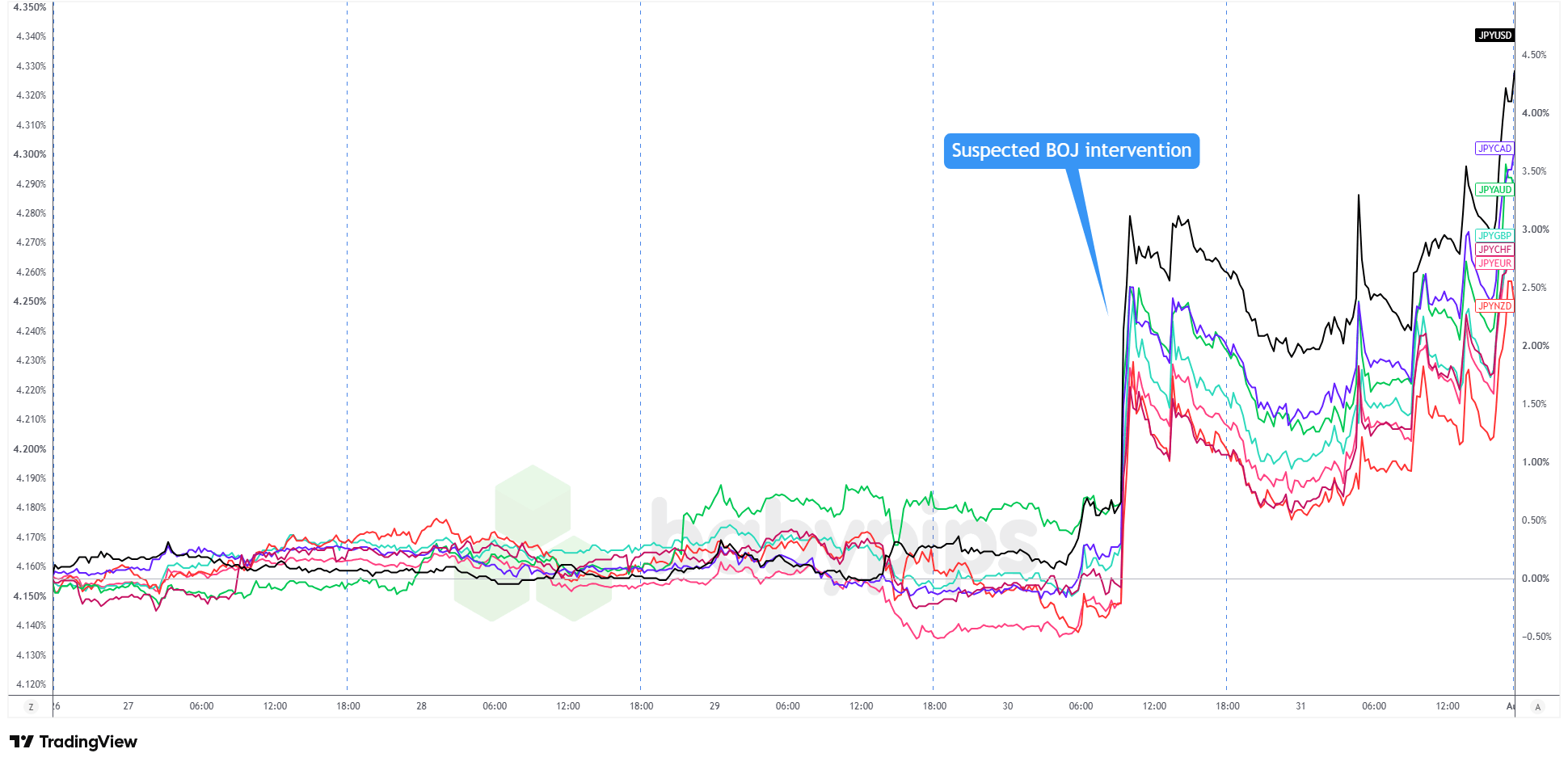
Overlay of JPY vs. Major Currencies – Chart Faster with TradingView
What made the episode especially unusual was reported U.S. involvement. U.S. authorities reportedly conducted a “rate check” with major currency dealers ahead of the move, a step often viewed as a warning that intervention may be coming. Treasury Secretary Scott Bessent also called the yen “very undervalued” that day, while the Treasury reportedly sold euros as part of the coordinated action.
This would mark the first joint U.S. and Japan currency operation since 2011. Nikkei later reported government and BOJ activity in the market, while Bloomberg’s analysis of central bank accounts estimated Thursday’s operation at roughly $53 billion.
The timing also had tailwinds. The U.S. Q2 GDP came in at just 1.5% annualized against the 2.1% forecast, putting independent pressure on the dollar and giving the intervention more bang for its buck.
USD/JPY recovered toward 160 overnight before another suspected operation hit around 4:30 a.m. ET on Friday, shortly before the BOJ policy statement. The move abruptly cut into the dollar’s recovery, although buyers later returned. No official estimate is available for the size of Friday’s operation.
Together, the two suspected interventions bracketed the BOJ meeting, giving the yen direct support on both sides of the central bank’s policy decision.
Promoted: When Markets Move Fast, Discipline Matters
Sudden yen intervention can turn a quiet market into chaos in minutes. Mark Douglas’ “Trading in the Zone” explores the mindset and discipline traders need to stay focused on their process instead of getting swept up in every market move.
Click on the link to learn more about “Trading in the Zone” by Mark Douglas!
Disclosure: We may earn a commission from our partners if you sign up through our links, at no extra cost to you.
Why Doesn’t Intervention Hold on Its Own?
Japan’s Ministry of Finance (MOF) directs currency intervention, using the country’s foreign exchange reserves to buy yen while the BOJ executes the trades. That can move the currency sharply, but it doesn’t fix the bigger force weighing on the yen.
That force is the carry trade, where traders borrow in low-interest-rate currencies like the yen and invest in higher-yielding ones to earn the difference. With Japan’s policy rate at 1.00% and the Fed’s at 3.50% to 3.75%, the yen remains one of the cheapest major currencies to borrow.
That 250-275 basis point gap creates steady pressure on the yen. Intervention can overwhelm the market temporarily by creating a burst of demand, but it doesn’t change the interest rate math. Once the official buying stops, carry traders have an incentive to return.
Why Did Ueda’s Words Do More Than the Reserves?
Carry traders react to where interest rates are going, not just where they are today. So when Ueda said Friday that core inflation was likely to rise “clearly above” 2% from the second half of fiscal 2026 and that the BOJ would keep raising rates, he gave traders a reason to believe Japan’s rate gap with the U.S. could start narrowing.
This meant that traders don’t have to wait for an actual rate hike to unwind yen-funded positions. If they expect borrowing yen to become less attractive, they can start cutting those trades early, creating yen demand without Japan spending another cent on intervention.
BOJ dissenter Hajime Takata’s call for an immediate hike to 1.25% also showed just how hawkish part of the committee has become, while Bessent’s comments about an undervalued yen reinforced the message from the U.S. side.
Japan saw a similar dynamic in August 2024, when a 15 basis point BOJ hike and hawkish guidance triggered a broader unwind in leveraged carry trades and helped fuel a multiweek yen rally. The shift in expectations ultimately mattered more than the size of the rate move itself.
What Does JPY Direction Depend on Now?
Japan still has plenty of firepower, with roughly $1.2 trillion in foreign exchange reserves. But intervention has political and diplomatic limits, and U.S. coordination is unlikely to be available every time the yen comes under pressure. Two operations in one week showed that Tokyo is willing to act aggressively, but the underlying carry trade pressure remains in place.
This puts the BOJ’s rate path back in focus. A Bloomberg survey of 52 economists found 40% expect a hike to 1.25% in October and 50% in December, while a Reuters poll of 87 economists showed 86% expect another move by the end of 2026.
Until then, credible signs that the BOJ is moving closer to another hike could matter more for the yen than any single round of intervention.
Quick Takeaways
- Japan ran two suspected yen-buying operations last week: Thursday July 30 around 9:55 a.m. New York time and Friday July 31 around 4:30 a.m. ET ahead of the BOJ decision.
- The US participated for the first time since 2011, with a reported rate check, euro sales by the US Treasury, and public comments from Treasury Secretary Bessent on yen undervaluation.
- The carry trade (borrowing cheap yen to invest in higher-yielding currencies) is the structural force that limits how long intervention holds. Japan’s 1.00% rate against the Fed’s 3.50%–3.75% keeps that pressure active.
- Carry traders unwind on the expectation of rate hikes, not on their delivery. Ueda’s hawkish press conference moved the yen further than the operations did because it shifted forward rate expectations.
- The BOJ’s next hike, priced by most economists for October or December 2026, is the more consequential event for sustained JPY direction.
Watch For
Japan’s July CPI lands August 21 and will be the first major inflation reading ahead of the September 19 BOJ meeting. A print above 2% could strengthen the case for an October hike and move USD/JPY well before the actual decision.
On the U.S. side, this week’s payrolls report could add another layer of pressure. A weak number would weigh on the dollar and could recreate last week’s squeeze on USD/JPY, this time without any official intervention.
This article covers a suspected coordinated U.S.-Japan currency intervention, and readers unfamiliar with how official FX operations work may want to check our lesson:
📖 Currency Intervention: When Central Banks Enter the Market
Reading this helps you understand how central banks enter the currency market, why intervention-driven moves often reverse once official buying stops, and how to manage risk around suspected central bank activity.
And if you’re not a Premium subscriber yet, now’s a good time to sign up.
With Babypips Premium, you get full access to School of Pipsology lessons that help you understand not just what the price is doing, but the central bank mechanics and policy dynamics driving the move.