


The Reserve Bank of New Zealand (RBNZ) raised interest rates on Wednesday, and most traders in the market had already priced it in. Yet the New Zealand dollar dropped anyway.
That’s forex doing one of its favorite tricks: selling the news. NZD/USD fell around 0.6% to 0.5860 after the decision. The pair slid as much as 1.7% from peak to trough on the day.
The interest rate went up, but the currency went down. Let’s break down why.
What Actually Happened?
The RBNZ raised its Official Cash Rate (OCR) by 25 basis points to 2.75%. The OCR represents the base cost of borrowing that ripples through mortgages, business loans, and savings accounts across the country.
This marked the second consecutive hike and the second increase this year, following a 25bp move in July. Before that, the RBNZ had held rates steady at 2.25% through February, April, and May. So the bank spent most of 2026 on pause, then hit the accelerator twice in a row.
Back in July, that committee split 3-3 on whether to hike at all. This time, the decision was reached by consensus, with no vote required.
The RBNZ’s job, like most central banks, is to keep inflation inside a target band while the economy stays healthy. New Zealand’s target sits at 1% to 3%, with 2% as the sweet spot. Right now the country is running hot.
Why Did the RBNZ Raise Rates Again?
Inflation is the central reason. Annual consumer-price inflation rose to 4.1% in the June quarter, driven largely by higher fuel prices tied to the Middle East conflict.
Oil shocks travel fast. Pump prices climb, transport costs climb, and that shows up in the price of nearly everything else within weeks.
Strip out fuel, though, and the picture cools off. The RBNZ said inflation excluding vehicle fuels had eased to 2.9%, with most measures of underlying inflation sitting within the 1%-3% target range.
That gap matters because it suggests the headline number is being pushed up by an energy shock rather than a broad, self-sustaining wage-price spiral. The RBNZ expects that gap to close over time: its central forecast keeps headline inflation near 3.9% through the end of 2026, before it falls to 3.7% in Q1 2027, 2.6% in Q2, and 2.1% by Q4.Growth was a secondary factor. The RBNZ noted growth in New Zealand was lacklustre in the second quarter but likely resumed in the third, supported by strong demand from trading partners and resilient export prices. A recovering economy gives a central bank more room to raise rates without choking off activity, but a fragile one doesn’t.
The committee left its options open going forward. The RBNZ said the OCR “may need to increase further,” while also stressing that “the future OCR path is not pre-determined”.
Translation: more hikes are possible, but nothing is locked in.
Promoted: Stay Connected When Markets Move Fast.
When the RBNZ hikes rates as expected but the Kiwi surprisingly drops, losing your connection can be costly. ForexVPS provides low latency trading servers that keep your platform and automated strategies running around the clock, even when your home internet doesn’t cooperate.
Explore VPS plans at ForexVPS!
Disclosure: To help support our free daily content, we may earn a commission from our partners if you sign up through our links, at no extra cost to you.
Why Should Traders Care?
Here’s the part that trips up new traders: A rate hike is supposed to be currency-positive. Higher rates tend to attract yield-seeking capital, which tends to lift the currency. This time, the opposite happened.
First, note that the move was fully expected. Markets had the 25bp hike to 2.75% almost completely priced in before the announcement, which meant the real action was going to come from the RBNZ’s forward guidance, not the headline number itself.
To top it off, the guidance leaned cautious. The bank framed the move as “gradually removing monetary stimulus,” language markets read as more dovish than the tightening pace they’d been pricing. When a hike arrives exactly as scripted, there’s nothing left to buy. When the accompanying tone disappoints, there’s plenty to sell.
Even though the RBNZ hike narrowed the gap with US Fed rates, which sit between 3.50% and 3.75%, NZD/USD still slumped to its lowest level since August 13. The rate differential between New Zealand and the US still favors the dollar, and that differential often matters more to currency traders than any single decision.
The Kiwi’s weakness showed up against other currencies, too. AUD/NZD pushed up to 1.2200, its highest level since July 8, as stronger Australian growth data combined with a muted reaction to the RBNZ’s move. Australia’s economy is currently outperforming, and that contrast is doing a lot of work in the cross rate.
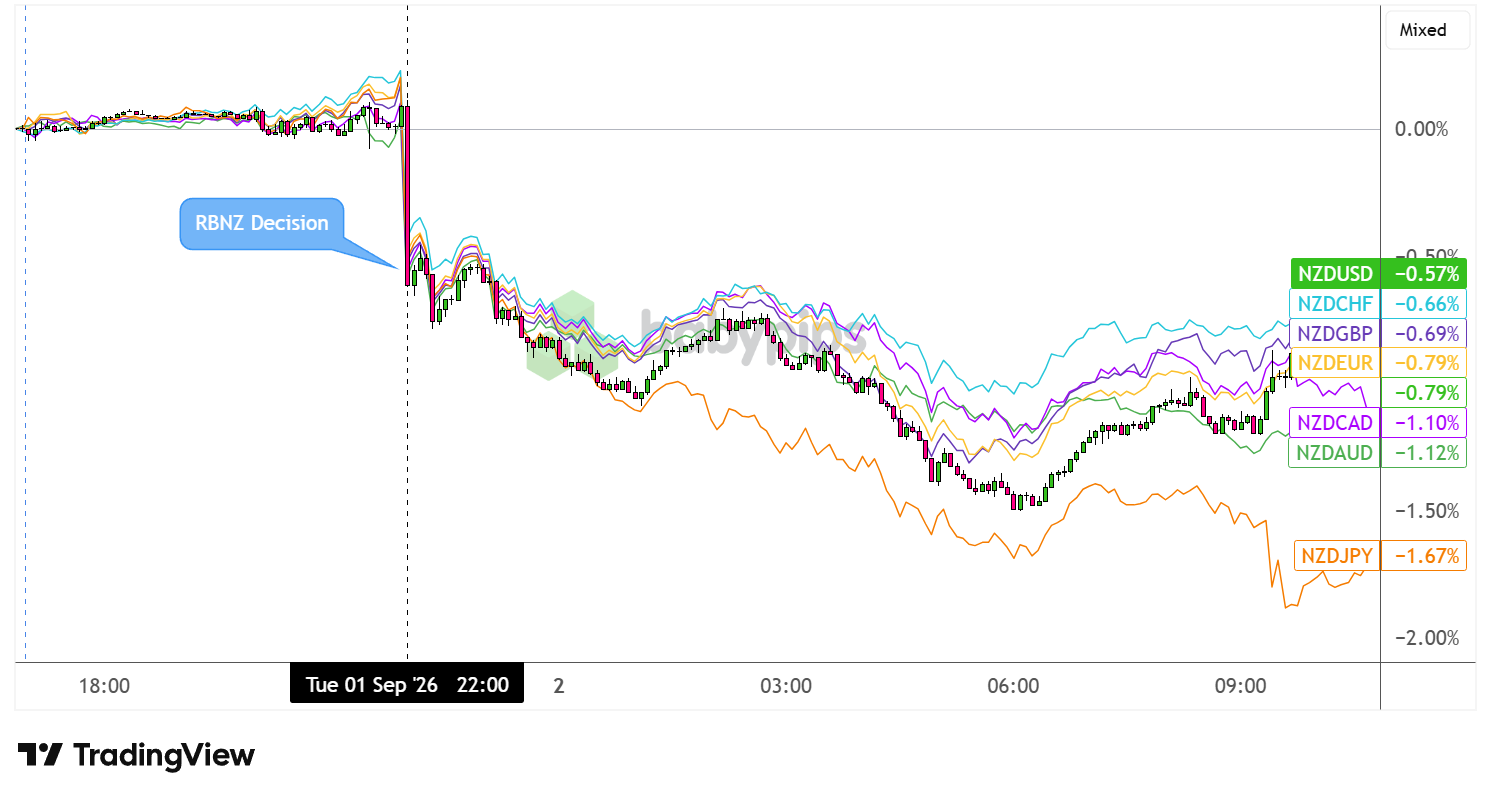
Overlay of NZD vs. Major Currencies – Chart Faster with TradingView
Looking ahead, most desks now expect the RBNZ to pause at its next meeting before resuming hikes. The RBNZ’s own OCR forecasts point to a pause in October and a further 25bp hike to 3% in December, a path little changed from the bank’s May projections.
The RBNZ’s estimate of the neutral rate, the level that neither stimulates nor restricts the economy, remains unchanged at 3% to 3.5%. That’s worth remembering: at 2.75%, the RBNZ isn’t far from home.
The Bottom Line
- A rate hike that’s already priced in often produces a “sell the news” reaction, especially if the forward guidance disappoints relative to expectations.
- Headline inflation and core inflation can tell very different stories. New Zealand’s 4.1% headline figure was largely an energy story, not a broad price spiral, with core measures much closer to target.
- Currency direction depends on more than the decision itself. The rate differential against major peers like the US, and relative growth against neighbors like Australia, often carries just as much weight as the local headline.
- Central bank language matters as much as central bank action. Phrases like “gradually removing stimulus” versus “not pre-determined” shape trader expectations for months.
- New traders may find it useful to watch the reaction in the minutes after a decision, not just the decision itself, since that’s usually where the real signal shows up.
What to Watch Next
The next data point on deck is the US employment report, due out Friday. A strong US jobs number could reinforce dollar strength and add further pressure to NZD/USD.
From there, attention shifts to the RBNZ’s October 28 meeting, where a pause is the current base case, followed by a possible hike to 3% at the December 9 meeting.
The RBNZ hiked rates on Wednesday and the Kiwi fell anyway, which confuses a lot of traders who assume a rate hike always lifts a currency. Premium members can read our lesson:
📖 Market Expectations: Why Good News Can Tank a Currency
Reading this helps you understand why currencies move on the deviation from expectations rather than the headline number, why a fully priced in hike leaves nothing left to buy, and how to read a central bank reaction the way the market actually reads it instead of taking the decision at face value.
And if you’re not a Premium subscriber yet, now’s a good time to sign up.
With Babypips Premium, you get full access to School of Pipsology lessons that help you understand not just whether a central bank hiked or held, but why the market’s reaction can run the opposite direction from what the headline decision suggests.