


When the 10-year U.S. Treasury yield climbed to its highest level since 2002 last week, gold rose about 1.3% while Bitcoin fell about 4.5%.
Both assets pay no interest, so both felt the squeeze from a stronger dollar.
Gold appears to have had extra buyers in its corner, though, while Bitcoin ran short of them.
What Happened to Gold and Bitcoin Prices?
Let’s start with the shared headwind. The 10-year Treasury yield, which is the interest rate the U.S. government pays to borrow money, touched about 5.34% midweek.
When government bonds yield more than 5%, holding gold or Bitcoin means giving up that potential income. Traders call that the opportunity cost (a.k.a. what you give up by choosing one asset over another).
The U.S. Dollar Index (DXY) also gained about 0.3%, and a firmer dollar tends to weigh on anything priced in dollars.
As a result, gold sank to a two-month low around $4,070 last Wednesday morning as the dollar and yields peaked ahead of the Federal Reserve meeting minutes. Buyers then pushed it back to about $4,195 by Friday, ending a two-week losing streak.
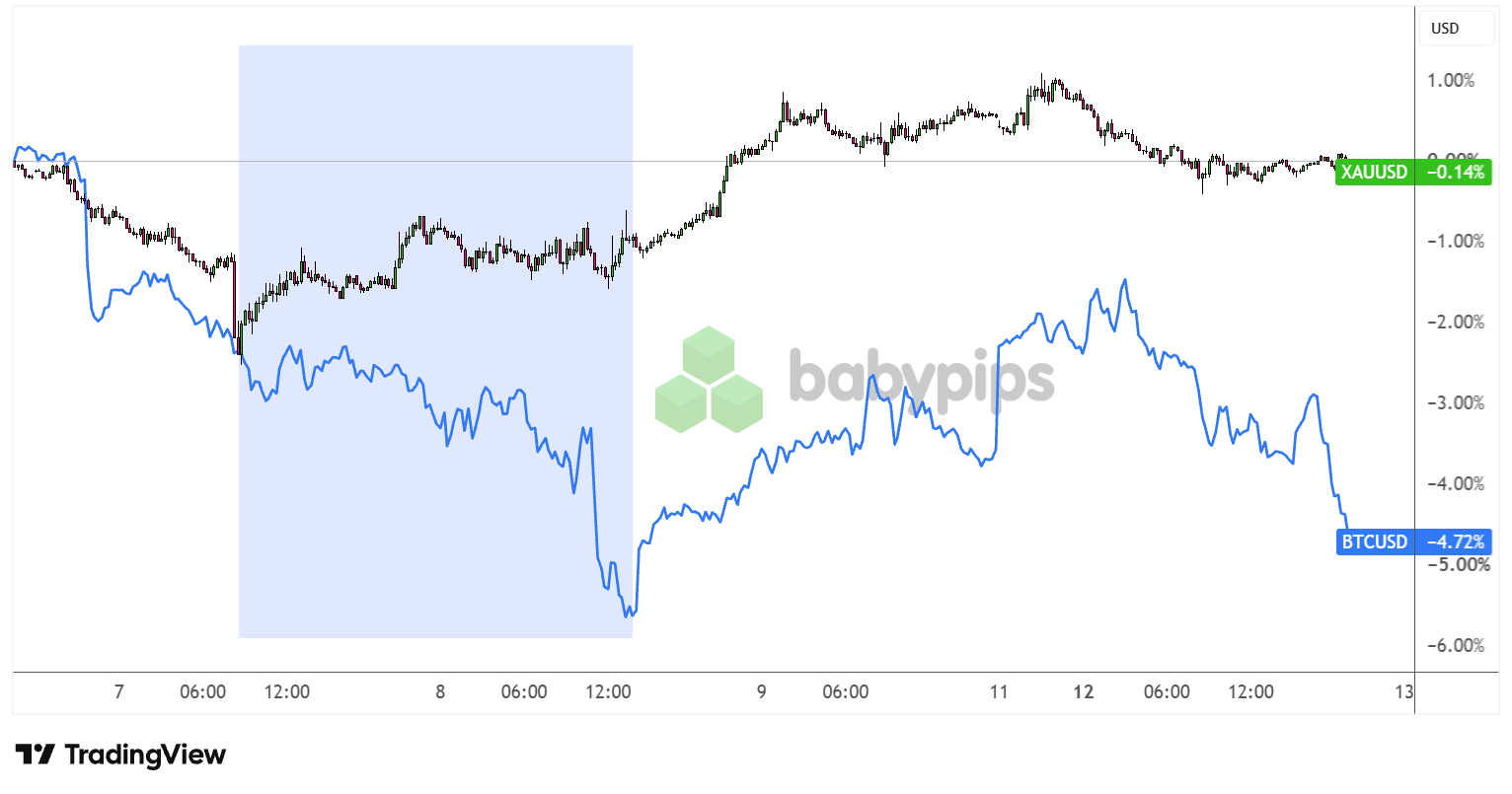
Bitcoin (BTC/USD) vs. Gold (XAU/USD) 1-hour Chart Faster with TradingView
On the other hand, bitcoin never found its footing. It dropped hard late Tuesday in New York as yields and the dollar firmed, and more than $400 million in leveraged long liquidations (exchanges force-closing bullish bets made with borrowed money) may have deepened the fall. It slid again on Thursday and bottomed near $80,450.
Picture two cars on the same icy road. Only one had snow tires.
Promoted: Scale Your Strategy With The5ers
When gold and bitcoin move in different directions despite a common driver, traders need more than conviction. They need disciplined risk management and enough capital to give a well tested strategy room to work.
The5ers has spent 10 years building funding and scaling programs for traders. With a 4.7★ rating from more than 32,000 reviews and over 1.6 million traders worldwide, it offers experienced backing in a market where signals can change quickly.
Learn more about The5ers and available discounts
Disclosure: We may earn a commission from our partners if you sign up through our links, at no extra cost to you.
Why Did Gold Rise While Bitcoin Fell?
Both assets reacted to yields and the dollar. The split likely came from everything else.
Gold had a second set of buyers
Gold doubles as a safe haven or an asset investors buy when they feel anxious. On Thursday, reports said the Pentagon told U.S. Central Command to prepare for more strikes on Iran, and gold climbed through the Asian session. A chipmaker-led stock selloff later that day weakened the dollar, which may have helped gold bounce off its lows.
Bitcoin traded like a tech stock
Bitcoin got none of that safety bid. It fell alongside chipmakers on Thursday, which suggests many traders still treat it as a risk asset or something you buy when you feel confident and sell when you don’t.
Investors also pulled cash. U.S.-listed spot Bitcoin ETFs saw $681 million in outflows last week, the largest weekly withdrawal since June. Crypto-specific worries piled on when two senior Ethereum researchers warned that AI-driven mathematics could weaken wallet cryptography sooner than expected, and Ledger-related theft headlines added a minor overhang.In short, no single factor explains the gap. The yield story probably set the direction for both, while safe-haven demand, ETF flows, and leverage likely decided how far each one traveled.
Is the Gold and Bitcoin Divergence Still in Play this Week?
Partly. So far, gold has stopped rising, and bitcoin suffered another wave lower.
Elevated yields, a stronger dollar, and uncertainty ahead of the U.S. midterm elections seem to be influencing broader sentiment this week. Gold slipped about 0.6% on Monday, but Bitcoin once again fell harder as it inched back below $83,000.
Both assets face pressure into Wednesday’s inflation report. Gold is struggling, while bitcoin looks more vulnerable.
What Does the Gold and Bitcoin Divergence Mean for Traders?
The main lesson: two markets can answer to the same driver and still land in different places. As noted in our Fundies Cheat Sheet for this week, bitcoin appeared to track the dollar and yields more closely than stocks last week.
Wednesday’s Consumer Price Index (CPI) report could test the pattern in either direction:
- A hot CPI could push yields higher and pressure both assets. Gold’s haven demand may cushion it more than bitcoin.
- A cool CPI could ease yields and lift both. Bitcoin tends to swing harder than gold, so a relief bounce could favor crypto for a day or two.
Last week showed that soft data can lift gold and bitcoin for a few hours, then fade once yields recover.
Quick Takeaways
- Shared driver, separate outcomes. Higher yields and a firmer dollar weighed on both gold and Bitcoin, but each asset carried its own set of buyers and sellers.
- Gold has more than one job. Safe-haven demand and strong ETF inflows appear to have offset part of the yield pressure.
- Bitcoin still trades with risk appetite. It fell with chipmakers, lost $681 million in ETF money, and leverage likely amplified the drop.
- Check correlations before you lump assets together. An “anti-dollar” label can hide two different sets of drivers.
What to Watch Next
- U.S. CPI: Wednesday, October 14, 8:30 a.m. ET (12:30 GMT). Forecasts call for headline CPI at +0.6% for the month and 3.6% for the year. Forecasters see core CPI (which strips out food and energy) at +0.2% for the month. Year-over-year core estimates vary from 2.4% to 2.5%.
- U.S. PPI and retail sales: Thursday, October 15, 8:30 a.m. ET.
- Fed Chair Kevin Warsh: speaks with IMF Managing Director Kristalina Georgieva on Thursday at 11:30 p.m. ET (Friday 03:30 GMT).
- Spot Bitcoin ETF flows and the 10-year yield at each daily close.
Gold and Bitcoin both felt pressure from rising Treasury yields and a firmer dollar last week, but if you’re not sure what it means when these two assets split in opposite directions, it helps to know how traders read them as liquidity signals. Premium members can read our lesson:
📖 Gold and Bitcoin: Your Liquidity Confirmation Signals
Reading this helps you understand how gold and Bitcoin act as confirmation signals for global liquidity, the patterns that tell you whether conditions favor an aggressive or defensive stance, and how to interpret divergences like last week’s gold bounce and Bitcoin slide.
And if you’re not a Premium subscriber yet, now’s a good time to sign up.
With Babypips Premium, you get full access to School of Pipsology lessons that help you understand not just how gold and Bitcoin reacted to yields and the dollar, but what their divergence says about liquidity and risk appetite.