Tuesday started simple. The dollar dropped the moment June’s inflation report hit the wire. Then it climbed most of the way back before lunch.
Nothing reversed course by accident. New traders often watch a number, watch the market move, and assume the story is over. It rarely is.
A data release landing close to a scheduled speech from a top central bank official produced a two-stage event: one reaction to the data, a second reaction to the speaker, sometimes a third once traders decide which one they believe.
What Actually Happened?
At 12:30 GMT on Tuesday, the U.S. Bureau of Labor Statistics released June’s Consumer Price Index. Headline inflation cooled to 3.5% year-over-year, well below the 3.9% economists had forecast, and consumer prices fell 0.4% on the month, the first monthly decline in six years.
Core inflation (CPI excluding food and energy, which swing around too much to show the underlying trend) eased to 2.6% year-over-year against a 2.9% forecast.
Markets interpreted that as a factor likely discouraging the Federal Reserve from raising rates in July, so the U.S. Dollar Index slid to the bottom of the majors within minutes of the print.
A little over an hour later, new Fed Chair Kevin Warsh began his testimony before Congress. He leaned against the market’s dovish read, reminding lawmakers that the committee has little patience for elevated inflation.
The dollar clawed back part of its losses over the next few hours but never fully erased them.
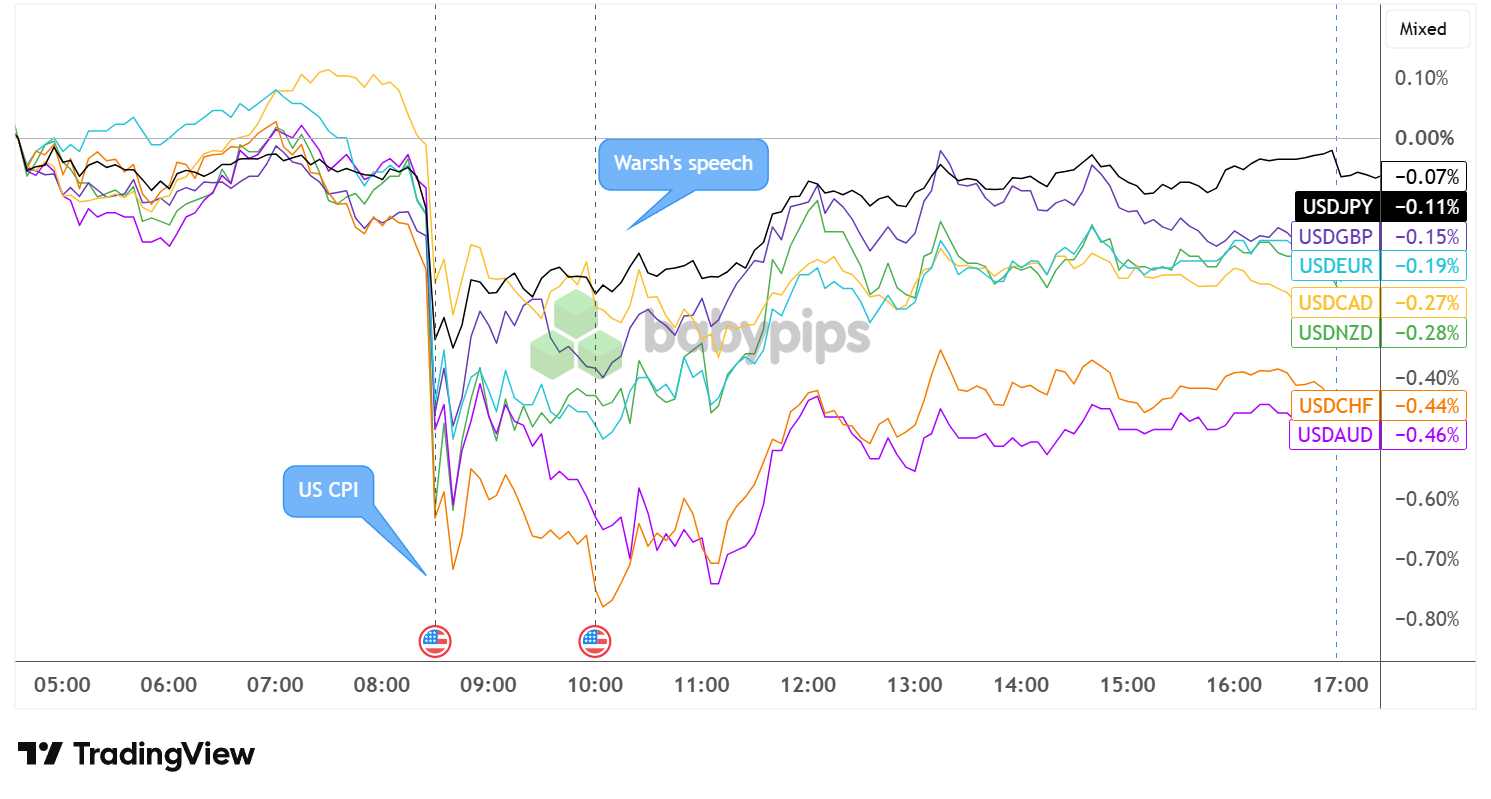
Overlay of USD vs. Major Currencies Forex Chart Faster with TradingView
Breaking Down the Move
Markets tend to react to data releases relative to what everyone already expected, and then they price in what those numbers mean for the people who set interest rates. That second part is where Fed Chair testimony comes in.
A cooler-than-expected CPI print suggests inflation is easing faster than the Fed assumed, which reduces the odds traders assign to a near-term rate hike. Lower hike odds usually make a currency less attractive to yield-seeking investors, so the dollar sold off hard and fast in the minutes after the CPI dropped. That’s the classic “data surprise” reaction, and it’s often the fastest, most mechanical part of the move.
The testimony that followed complicated the picture. Warsh’s comments appear to have reminded traders that one soft month doesn’t necessarily change the Fed’s broader stance, especially with energy prices climbing on a separate escalation in the Middle East. His remarks likely gave some traders a reason to unwind part of their dollar-selling moves, which helped explain the partial rebound.
This is why seasoned traders usually treat scheduled speeches as their own event, separate from the data release that precedes them, even on the same day. A Fed chair, an ECB president, or a Bank of England governor can reinforce a market’s reaction to data, push back against it, or ignore it entirely, and market players often can’t tell which path is unfolding until the remarks are well underway.
Promotion: Central bank testimonies can ripple through inflation data before traders have time to sort out what actually moved their positions.
TradeZella’s new AI trading partner can break down your trades, spot recurring mistakes, and help build a clearer game plan, so you can spend less time digging through old charts and more time preparing for the next market move.
Start Your Trading Journey with TradeZella & use code “PIPS20” for 20% off your first purchase!
Disclosure: To help support our free daily content, we may earn a commission from our partners if you sign up through our links, at no extra cost to you.
What Does This Mean for Markets?
The immediate lesson: the first move after a big data release is not always the market’s final answer. Tuesday’s dollar sell-off looked decisive for about ninety minutes. Then it wasn’t – at least not entirely.
For newer traders, this raises a practical question: if the first reaction can reverse, when do you trust a move?
There’s no perfect answer, but many traders in this framework watch whether a currency, index, or commodity manages a decisive close by the end of the trading day, rather than reacting to the first candle after a headline. A fast intraday spike and an established daily trend are different things, and confusing the two is one of the more common ways new traders get shaken out of otherwise reasonable positions.
Beyond the dollar, the same two-stage dynamic likely helped shape moves in stocks, gold, and bitcoin on Tuesday – all of which closed higher as risk appetite improved on the cooler inflation read, even as Warsh’s later comments introduced some hesitation.
The CPI print, the testimony, ongoing tension in the Middle East affecting oil prices, and the start of second-quarter bank earnings all likely played a role. No single catalyst explains the entire session, which is often the case in weeks stacked with scheduled top-tier events.
The Bottom Line
- A market’s first reaction to economic data can reverse once a related scheduled event, like a central bank speech, adds new information.
- CPI and similar reports move markets based on the gap between the actual number and what was forecast, not the number in isolation.
- Fed testimony and similar speeches can reinforce, soften, or reverse the initial data reaction, and traders often won’t know which until the speaker is partway through.
- Waiting to see how a session closes can offer more signal than reacting to the first few minutes after a release.
- Weeks with stacked catalysts (data plus speeches plus other developments) tend to produce choppier, multi-stage price action than isolated single-event days.
Wednesday brings another potential two-stage session: June’s Producer Price Index at 12:30 GMT, followed by Warsh’s second day of testimony at 14:00 GMT and a Bank of Canada rate decision at 13:45 GMT. Given this week’s pattern, a repeat whipsaw is plausible, though not guaranteed.
Tuesday’s dollar sell-off after the CPI print didn’t hold, and Fed Chair Warsh’s testimony an hour later is a big reason why. Premium members can read our lesson:
📖 From Data to Price Action: What Happens When Big News Hits
Reading this helps you understand why the first spike after a release is often just the algorithmic reaction, how a second, more analytical move can follow once traders digest the context, and why waiting for a scheduled event like a Fed speech to play out can matter more than reacting to the initial headline.
And if you’re not a Premium subscriber yet, now’s a good time to sign up.
With Babypips Premium, you get full access to School of Pipsology lessons that help you understand not just the first candle after a headline, but the full sequence of catalysts, from the data print to the scheduled speech that follows it, that actually decides where a currency ends up by the close.