

On July 30, the Bank of England held interest rates at 3.75%, but three policymakers wanted a hike instead.
When a central bank’s own committee can’t agree, the economy sits at a genuine crossroads.
Here’s how the hawkish split could matter more than most rate decisions get credit for.
What Actually Happened?
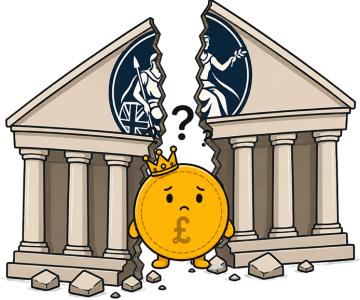
The Bank of England’s Monetary Policy Committee (MPC), the nine-person group that sets U.K. interest rates, voted 6-3 on July 30 to hold the Bank Rate at 3.75%.
Governor Andrew Bailey led the majority, joined by Sarah Breeden, Swati Dhingra, Clare Lombardelli, Dave Ramsden, and Alan Taylor. Three members, Megan Greene, Catherine Mann, and Huw Pill, voted against the hold. They wanted a 0.25 percentage point increase to 4.00%.
The backdrop: UK CPI fell to 2.6% in June, according to the BOE’s July Monetary Policy Report. That drop came in bigger than economists expected, and it gave the majority room to pause rather than tighten further.
Inflation still sits above the BOE’s 2% target. It has stayed above target for more than five years, which is exactly the fact the dissenters kept coming back to.
Promoted: Markets move on surprises, not just headlines.
When central bank decisions hit, FinancialJuice helps traders track the data, commentary, and market expectations shaping price action in real time.
Join FinancialJuice for Free to learn more!
Disclosure: We may earn a commission from our partners if you sign up through our links, at no extra cost to you.
So Why Is the Vote Split?
It all traces mainly back to one event: the Middle East conflict and what it’s done to energy prices. Crude oil and refined fuel prices have stayed volatile and elevated since the conflict began.
The BOE said plainly that monetary policy can’t touch energy prices. What it can do is manage how the rest of the economy absorbs that shock.That’s where “second-round effects” come in. It’s central-bank jargon for a specific chain reaction: a business pays more for fuel, so it raises its prices.
Workers see their grocery bills climb, so they push for bigger raises. Those higher wages then feed back into prices again. One shock becomes two, then three, and inflation that should have been temporary turns sticky.
The six-member majority argued this chain hasn’t shown up yet. Bailey pointed to a labor market that keeps loosening, soft demand across the economy, and financial conditions that have already tightened since the conflict started, partly through higher borrowing costs the market imposed on its own.
 The underlying disinflation trend that was running before the conflict, he argued, looks intact. There’s little evidence of second-round effects so far, though the majority was careful to say it’s too early to relax about that.
The three dissenters saw the same data and drew the opposite conclusion. Greene, Mann, and Pill weren’t reassured by the lack of second-round effects yet; they worried those effects could still show up and be significant.
Their logic borrowed from risk management: raise rates now as insurance, and course-correct later if the inflation threat fades. Waiting and being wrong, they argued, costs more than acting early and being wrong.
Both sides agree on the risk. They disagree on how to insure against it.
What Does This Mean for Sterling?
Even with the hawkish surprise, what’s worth noting is that Sterling barely moved on the news.
The Federal Reserve had held its own rate steady just one day earlier, on July 29, in a 9-3 vote with three hawkish dissents as well. Fed Chair Kevin Warsh also dropped forward guidance entirely in his press conference. That decision, and the confusion around it, dominated forex trading that session far more than anything out of London.
The BOE’s hold was also largely priced in before it happened. June’s larger-than-expected CPI drop had already told the market a pause was likely, so GBP/USD’s reaction stayed contained rather than sharp.
What didn’t get priced out: expectations for future hikes. Markets are still pricing in at least one 25 basis point increase later in 2026, and the MPC’s own minutes flagged a higher likelihood of two rate increases by the third quarter of 2027.
In other words, markets read this hold as a pause, not a pivot. The BOE bought itself time to watch how the energy shock plays out. It didn’t declare the inflation fight over.
For GBP crosses, this keeps the pound’s near-term path tied less to what the BOE says and more to two outside forces: oil prices out of the Middle East, and whatever the Fed does next with a dollar that’s currently driving most of the volatility in G10 currency pairs.
The Bottom Line
- The BOE held Bank Rate at 3.75% on a 6-3 vote, with three members wanting a hike to 4% instead.
- A bigger-than-expected fall in June CPI, to 2.6%, gave the majority room to wait rather than tighten.
- The entire debate centers on second-round effects: whether an energy-price shock from the Middle East conflict starts a longer inflation cycle through wages and pricing decisions.
- Markets still expect the BOE to hike later in 2026 or in 2027. This hold looks like a pause, not the end of the tightening story.
- GBP/USD’s muted reaction shows how central bank decisions that land in the same week as a Fed meeting can get overshadowed, even when the domestic story is genuinely split.
What to Watch Next
The next BOE decision lands September 17, 2026. Between now and then, watch UK CPI data for August and September, any fresh developments in Middle East energy markets, and the Fed’s own rate path, since a dollar move can swamp a sterling story just as easily as it did this week.
The BOE’s 6-3 vote split shows how a central bank committee can read the same data and land in completely different places. Premium members can read our lesson:
📖 Hawkish vs. Dovish: How to Read Central Bank Language
Reading this helps you understand how to identify hawkish and dovish positioning within a committee, why a split vote like this one signals where policy could head next, and how to weigh dissenting votes against the majority stance when trading GBP crosses.
And if you’re not a Premium subscriber yet, now’s a good time to sign up.
With Babypips Premium, you get full access to School of Pipsology lessons that help you understand not just what a rate decision was, but what the language behind a split vote reveals about where a central bank is headed next.