



Before funding a forex or CFD account with an entity authorised in a UAE financial free zone, compare brokers on four things: the exact legal entity you contract with, the scope of that entity’s regulatory permissions, where your money is actually held, and the true cost of trading on the account type you plan to use. A licence number on a homepage is a starting point, not an answer. What follows is a practical way to turn that number into evidence, for entities licensed in the Dubai International Financial Centre or the Abu Dhabi Global Market specifically.
One publisher that focuses on exactly this kind of broker research is compareforexbrokers.ae, a UAE-facing comparison site covering broker reviews, regulator and entity evidence, and cost and account guides. The approach below follows the same order of checks: verify the entity first, then compare costs, rather than trusting a brand.
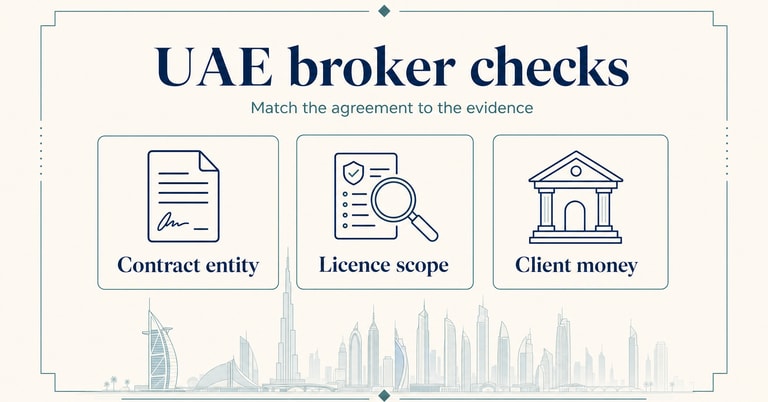
Why the Brand and the Entity Are Different Things
A broker’s marketing name, its Dubai office address and its logo tell you almost nothing about which company you are contracting with. Many groups operate several entities under one brand. One entity might be authorised in a UAE financial free zone, another might sit offshore, and the website may not make the distinction obvious.
So the first job is not to judge the brand. It is to identify the contracting entity named in the client agreement, then check that entity against the relevant public register. Do not assume that arranging services automatically means offshore custody, or that dealing services automatically mean UAE custody. The account agreement and the broker’s separate disclosures establish where money sits, not the label on the service.
The Two Free-Zone Registers Worth Checking
The UAE hosts distinct financial jurisdictions, and this matters for your checks. The Dubai Financial Services Authority, or DFSA, authorises financial services in and from the Dubai International Financial Centre, and it maintains a public firm register at the DFSA firms register. The Financial Services Regulatory Authority, or FSRA, regulates the Abu Dhabi Global Market, and its public register shows entity activity permissions, accessible via the ADGM financial services regulator.
Note the limits of those sentences. The DFSA covers the DIFC, not Dubai as a whole and not the wider UAE. The FSRA covers ADGM. A broker with a Dubai office is not necessarily DFSA authorised, because that office may sit outside the DIFC or belong to a different entity in the group. The register, not the address, settles the question.
These two registers do not exhaust the UAE’s licensing jurisdictions. If the contracting entity sits outside the DIFC and ADGM, checking it requires its relevant official regulator or register, which is outside the scope of this article. An entity absent from the DFSA or FSRA registers is not for that reason unregulated.
The Five-Field Evidence Sheet
Before opening an account, build a short evidence sheet with five fields. The sheet records what you have verified and what remains unknown.
Field one, the contracting entity. Get the full legal name from the account agreement or the broker’s legal documents page, including the jurisdiction of incorporation. This is the company that owes you obligations.
Field two, register status and activity scope. Search that entity on the DFSA or FSRA register as applicable. Record whether it is authorised, what financial activities it is permitted to conduct, and whether retail clients fall within that scope. An entity can be licensed for a narrow set of activities that does not include the service you are being sold.
Field three, custody of funds. Record who holds client money and under which jurisdiction, based on the account agreement and disclosures. This is where you confirm or reject assumptions about where your deposit actually sits.
Field four, pricing basis. Record the account’s spread and commission structure, the account currency options, and any stated administration fees. Keep this separate from marketing claims about “zero spreads”, because a zero starting spread is not a guaranteed average.
Field five, the dispute route. Record which complaints process and which authority would handle a dispute with that specific entity. This follows directly from fields one and two.
Making Cost Comparison Concrete
Once the entity checks out, compare account costs on a like-for-like basis. Here is an explicitly hypothetical example, not a quote from any broker. Suppose account A charges a spread of 0.2 pips on EUR/USD plus a round-turn commission of USD 7 per standard lot, where round-turn means the commission covers both opening and closing the position. With EUR/USD, one pip on one standard lot of 100,000 EUR is worth USD 10 in a USD-denominated account, since a pip is 0.0001 USD per EUR. Account A therefore costs roughly USD 9 per round turn, being USD 2 of spread plus USD 7 of commission.
Now suppose account B charges a 1.0 pip spread with zero commission, which is USD 10 per round turn. Over 20 round turns of one lot each, account A costs about USD 180 against USD 200 for account B, before swaps, slippage and any currency conversion. Slippage may improve or worsen execution in either case, and an ordinary stop-loss does not guarantee your exit price. The comparison assumes the same pair, the same size and the same period, with no double counting of spread. These are illustrative figures only, and this trade size is not a recommendation. If you traded 0.10 lots instead, the same assumptions scale every figure down by one tenth.
The point of the exercise is the method. Two pricing structures that look different on a pricing page can be compared arithmetically once you convert both into cost per round turn.
Swap-Free Accounts and Other Terms Questions
If a swap-free account matters to you, treat it as a terms question rather than a certification. Ask which instruments are eligible, whether holding periods are limited, and whether an administration fee applies after a set number of days. Do not expect a broker, a comparison site or an article like this one to certify Sharia compliance. That is a question for your own advisers, and the broker’s written terms are the only reliable source of the mechanics.
Borrowed Lessons From Other Jurisdictions
Two pieces of BabyPips analysis sharpen the same habits. One is the article on What FCA Regulation Means for UK Forex Traders, which walks through how a national regulator’s permissions translate into practical protections for traders in that jurisdiction. Its relevance here is as a contrast: UK protections apply to UK-authorised entities, and nothing about them transfers to a UAE or offshore entity. Reading it helps you understand what jurisdiction-specific protection looks like, so you do not accidentally assume UK-style safeguards apply to your UAE account.
The other is the piece on Advertised Spreads vs Tested Spreads in Australia, which explains why a broker’s advertised spread can differ from what traders experience, and how to distinguish a floor, an average and a test window. The methodology transfers even though the Australian data does not. When you see a spread claim on a UAE-facing site, ask which of those three things it is, and over what period.
A Note on Perspective
Noam Korbl, co-founder and COO of CompareForexBrokers, put the underlying philosophy plainly in his published profile: “A trader who can read a broker’s own published terms and check a public register is better protected than one relying on a ranking.” Treat that as an educational opinion rather than a guarantee of safety. A licence does not guarantee profits, and it does not guarantee recovery of funds if something goes wrong. What governs in practice are the entity’s actual permissions, the client category you fall into, and whether your particular dispute is eligible for the complaints process: a licence does not mean every activity or every client category is allowed, nor that every complaint is accepted. A verified licence does, however, give you a register to check, a defined scope of permissions and a dispute route, which is more than an unregulated arrangement offers.
Your Next Steps
Start with the evidence sheet. Pull the contracting entity from the account agreement, verify it on the DFSA or FSRA register as applicable, record the custody arrangements, then run your own cost arithmetic on the account type you would actually use. Do that for two or three brokers and the comparison writes itself. If the contracting entity sits outside the DIFC or ADGM, this article’s checks do not cover it, and you will need its relevant official regulator or register instead.
Forex and CFDs involve substantial risk, and leverage magnifies losses. This article is general education, not personalised investment advice.