


AUD/USD is sliding lower again after its recent rebound attempt lost momentum, putting nearby lows back in focus.
The pullback is starting to look stretched in the short term, so sellers need follow-through to confirm continuation, while buyers need to step in quickly and spark a corrective bounce to prevent the weakness from extending.
Welcome to “TA Alert of the Day.” Each day after the market close, MarketMilk scans for popular technical indicator alerts. We use these alerts as the basis for a mini-lesson, breaking down what each alert means, why it matters, and how traders might interpret it. The goal is to help beginner traders not only spot these alerts but also understand the logic behind them and how they can inform trading decisions.
What MarketMilk Has Detected
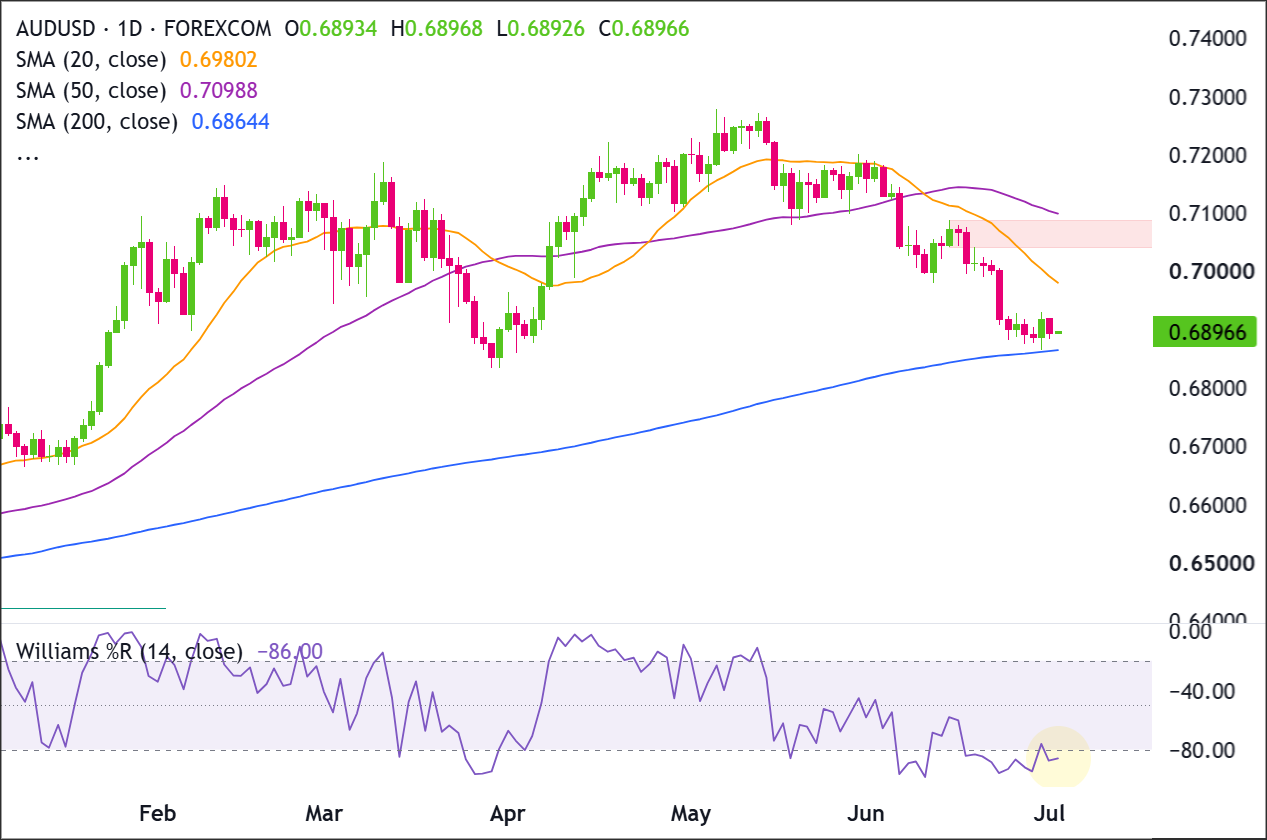
Williams %R (14) has reached oversold territory, dropping to -87.39 after crossing below the -80.00 threshold.
This occurred as AUD/USD closed at 0.6893, continuing the pullback from the mid-June rebound attempt.Recently, the pair has repeatedly probed lower levels around 0.6880–0.6910.
What This Signals
Traditionally, an oversold Williams %R reading suggests that downside momentum has become stretched versus the last 14 sessions.
If the move is sustained and price stabilizes above nearby support, this can attract dip-buying interest and often marks conditions where a bounce or mean-reversion move becomes possible, especially when the market is already near a recognized floor like 0.6880–0.6910.
However, this same pattern can also represent trend continuation rather than a reversal. Oversold momentum can persist in strong downtrends, where prices briefly pause and then push to new lows.In that scenario, the oversold reading is less a “buy signal” and more a reflection that sellers remain in control, with risk of another leg down toward 0.6865 or lower if support fails decisively.
Alternatively, the signal can resolve into a range outcome: momentum resets (Williams %R lifts back above -80) without a major price recovery, producing choppy back-and-forth trade.
This is especially common when AUD/USD is caught between nearby support and overhead resistance zones, and when follow-through from the next 1–3 daily closes is mixed.
The outcome will depend on follow-through: whether AUD/USD can hold above the 0.6880–0.6910 area, whether sellers can force a decisive break below recent lows, or whether buyers can reclaim nearby levels like 0.7000 to improve the rebound case.
How It Works
Williams %R is a momentum oscillator that measures where the current close sits relative to the highest high and lowest low over a lookback period (here, 14 days).
It ranges from 0 (close near the period high) to -100 (close near the period low). Readings below -80 are typically labeled oversold momentum, meaning price has been closing near the lower end of its recent range.
Because it is range-based, Williams %R is most useful for spotting momentum extremes and potential inflection points, especially when paired with support/resistance.
Oversold conditions can persist if price keeps making lower lows within the lookback window.
Important: Oversold is not the same as “must bounce.” Reliability often improves when the oscillator exits oversold (moves back above -80) and price confirms with a higher low, a reclaim of a key level, or a shift in market structure.
What to Look For Before Acting
Do not assume the oversold reading means an immediate reversal. Consider these factors:
✅ A daily close holding above the 0.6880–0.6910 support zone (reduced acceptance below support)
✅ Williams %R (14) moving back above -80 (an “exit” from oversold)
✅ Evidence of seller exhaustion (smaller real bodies, long lower wicks, or failed pushes to new lows)
✅ A break above the near-term pivot area around 0.7000, which would suggest improved upside traction
✅ Resistance checks: watch reactions near 0.7040–0.7055 and then 0.7070–0.7095 if a bounce develops
✅ Trend context on the Weekly chart (to see whether this is a pullback within a broader uptrend or part of a larger downswing)
✅ Confirmation from related FX context (broad USD tone and risk sentiment; AUD often responds to shifts in risk appetite)
✅ Event risk: upcoming RBA and Fed communications/data that can override short-term oscillator signals
Risk Considerations
⚠️ Oversold can stay oversold during persistent selloffs, leading to premature entries
⚠️ A clean break and close below 0.6880 increases the odds the move is continuation rather than rebound
⚠️ “Snap-back” bounces can be sharp but short-lived, creating whipsaw if resistance (e.g., 0.7000) caps price
⚠️ FX can reprice quickly on macro headlines (rates, inflation, jobs), reducing the usefulness of oscillator-only setups
Potential Next Steps
Add AUD/USD to a watchlist and monitor whether price can stabilize above 0.6880–0.6910 while Williams %R begins to recover out of oversold.
Recent price action show sellers driving AUD/USD below 0.7000, with price now pausing right above the 200-day SMA support area at 0.6860-0.6890.
Williams %R is oversold near -86.00, which supports the possibility of a short-term rebound, but buyers still need to reclaim the 20-day SMA area around 0.6980-0.7000 to prove the bounce has strength.
Until that happens, the short-term structure remains vulnerable below the declining 20-day SMA.
Trade Idea: Bullish Continuation Scenario
Setup
The bullish setup depends on AUD/USD continuing to defend the 200-day SMA area around 0.6860-0.6890. As long as price holds that zone, buyers have a chance to build a recovery attempt from oversold conditions.
The key upside test is 0.6980-0.7000, where the 20-day SMA and prior breakdown area sit. A daily close above 0.7000 would show price reclaiming the 20-day SMA zone and could open the door for a move back toward the 50-day SMA resistance area around 0.7080-0.7100.
Entry
Consider entering long on a daily close above 0.7000, confirming that buyers are breaking out of the recent structure.
Alternatively, enter on a controlled pullback into 0.6860-0.6890 if price stabilizes there and turns back higher.
If price loses that support zone and closes decisively below 0.6860, stand aside and wait for either deeper support to form or a cleaner breakout later.
Stop Loss
For breakout entries: stop on a daily close back below 0.6980. That would invalidate the breakout by showing price could not stay above the former ceiling and the 20-day SMA area.
For pullback entries: stop on a daily close below 0.6860. That would invalidate the support-hold idea and show buyers are no longer defending the 200-day SMA zone.
Take Profit
Target 0.7080-0.7100, because that is the next clear upside area on the chart, aligns with the 50-day SMA region, and is the most natural place for price to retest if the current recovery continues.
Bottom Line
The bullish case is only valid if AUD/USD continues to hold 0.6860-0.6890 and then reclaims 0.7000 on a daily closing basis. That would suggest the recent downside move is losing momentum and buyers are stepping back in from the 200-day SMA area.
Above 0.7000, the next upside target is 0.7080-0.7100, where the 50-day SMA and prior resistance zone come into focus. A daily close below 0.6860 would invalidate the bullish setup and suggest the 200-day SMA support base has failed.
Trade Idea: Bearish Pullback Scenario
Setup
The bearish setup remains active while AUD/USD trades below 0.6980-0.7000 and fails to reclaim the declining 20-day SMA area.
Sellers have already pushed price below 0.7000, and the next confirmation would be a daily close below 0.6860, which would break the 200-day SMA support zone and signal that the pullback is extending.
The 50-day SMA near 0.7099 also keeps the broader structure capped unless buyers can reclaim 0.7080-0.7100.
Entry
Consider entering short on a daily close below 0.6860, confirming that the support zone has failed.
Alternatively, if price pushes into 0.6980-0.7000 and prints a clear bearish rejection candle, enter short on the next daily close back below 0.6980.
If price instead breaks and closes decisively above 0.7000, stand aside, as that would invalidate the bearish pullback idea.
Stop Loss
For breakdown entries: stop on a daily close back above 0.6890. That would invalidate the breakdown by showing price has reclaimed the 200-day SMA support zone.
For rejection entries near resistance: stop on a daily close above 0.7000. That would invalidate the bearish idea by confirming buyers have pushed through the 20-day SMA resistance area.
Take Profit
Target 0.6800, because that is the next major support area below the current structure and the most likely place where buyers would try to step back in.
Bottom Line
The bearish case stays in play while AUD/USD remains below 0.6980-0.7000 and the 20-day SMA continues to act as overhead resistance. A failed bounce into that zone would suggest sellers are still controlling the short-term structure.
A daily close below 0.6860 would confirm a breakdown of the 200-day SMA support area and expose 0.6800 as the next downside target.
A daily close above 0.7000 would weaken the bearish setup and shift focus back toward 0.7080-0.7100.
This content is strictly for informational purposes only and does not constitute as investment advice. Trading any financial market involves risk. Please read our Risk Disclosure to make sure you understand the risks involved.