





Most UK brokers offer both spread betting and contracts for difference (CFDs), which can make the choice confusing at first. On the surface, they work in a similar way, you’re trading on price movements, using leverage, and you don’t own the underlying asset.

But there are some important differences, especially when it comes to tax, costs, and how trades are structured. So what actually separates spread betting from CFDs, and which one makes more sense for UK traders?
The Basics
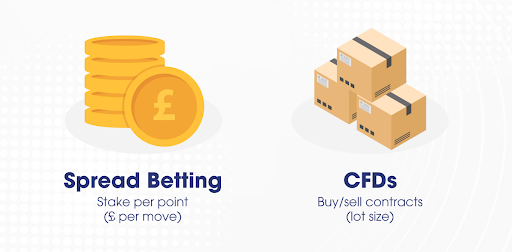
A CFD (or contract for difference) is an agreement between you and your broker to settle the difference in an asset’s price from when you open a trade to when you close it. You can go long or short, apply leverage and access a wide range of markets. Your profit or loss is calculated in the currency of the underlying asset.
Spread betting works on the same principle, but the sizing works differently. Instead of buying contracts, you stake a pound amount per point of movement. If you bet £5 per point on the FTSE 100 and it moves 100 points your way, you make £500.
The maths is simple once you’ve worked through a few examples, and most brokers display your notional exposure before you confirm a trade as well.
The Tax Position
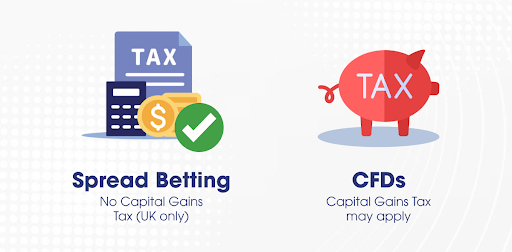
This is where the two products start to differ, and where it gets more interesting for UK traders. Spread betting profits are generally exempt from capital gains tax (CGT) and stamp duty in the UK. HMRC treats it as gambling rather than investing, which is why those profits are usually tax-free. For most retail traders, that means the profits are theirs to keep.
CFD profits don’t get that type of treatment. They are subject to CGT, but CFDs do not attract stamp duty. Over a full year of trading, that difference can add up quickly.
Justin Grossbard, co-founder of spread-bet.co.uk, explains: “When you look beyond trade execution and focus on net profitability, the tax treatment becomes a major factor. For UK-based traders, spread betting can offer a clear advantage once you account for capital gains tax on CFD profits.”
With that said, there is one exception worth mentioning. If spread betting is your primary source of income, HMRC may treat it as a trade and apply income tax instead. This doesn’t affect most people who trade casually alongside their day to day job, but it’s worth knowing if you plan on spread betting full time as your main source of income.
Costs and Overnight Financing
Both spread betting and CFDs are mainly priced through the spread. This is the difference between the buy (ask) and sell (bid) price, and it’s one of the main ways brokers make money. Most spread betting accounts are commission-free, while CFD accounts may either be spread-only or charge a separate commission, particularly on share trades.
Overnight financing applies to both products. If you hold a leveraged position past the daily rollover, you’ll pay interest on the full position size, not just your margin. This can add up over time, which is why both spread betting and CFDs are generally used for shorter-term trading.
One key point for UK traders is that neither spread betting nor CFDs are subject to stamp duty. However, spread betting profits are generally tax-free, while CFD profits are typically subject to CGT.
Currency Settlement
Spread betting accounts always settle in British pounds (GBP), no matter what market you’re trading. If you’re trading US stocks or European indices, your profit and loss comes back in pounds without any currency conversion.
CFD accounts typically calculate P&L in the currency of the underlying market, which is then converted back to your account’s base currency. On smaller trades you won’t notice it, but it does add up on larger (or more frequent) positions.
Market Access
The range of markets is somewhat similar across both products at most UK brokers. You’ll find forex, indices, commodities, shares, and bonds under either product type. The differences tend to appear in minimum stake sizes rather than in what markets are available, so it’s worth checking those numbers if you’re starting with a smaller account.
Where CFDs Make Sense
There are some situations where CFDs are the more practical choice. If you’re trading through a limited company, the CGT exemption on spread betting doesn’t apply, so the tax advantage disappears. CFDs are also better supported by third-party platforms and automated trading tools. This matters if you’re running an algo strategy or using external software to generate signals.
Spread betting is a UK-specific product too. If you spend extended periods abroad, check how your residency status affects the tax treatment before assuming the exemption applies to you.
Which One Should You Use?
For most UK retail traders, spread betting tends to be the more efficient option from both a cost and tax perspective. The mechanics take a little getting used to, but most traders pick it up quickly.
Before opening a spread bet account, it’s worth comparing spreads, overnight rates, and trading platform quality across different providers. Comparison sites like Spread-Bet make it easier to find FCA regulated brokers with spread betting services, so you’re not starting from scratch. Once you’ve chosen who you are going to spread bet with, you can focus on managing your trading strategy and risk.
