


GBP/NZD is hitting a major resistance zone just as BOE head honcho Bailey hinted at patience on interest rate hikes!
Will this keep GBP/NZD stuck inside its range? Or will bulls extend June’s uptrend and force a bullish breakout?
Here’s what we’re watching on the daily time frame:
GBP/NZD: Daily
GBP/NZD Daily Forex Chart Faster With TradingView
Bank of England (BOE) Governor Bailey struck a patient tone in Sintra on Tuesday, hinting that the central bank isn’t in a hurry to react to the latest oil-related inflation pickup. He still expects inflation to return to the 2% target, just later than he’d like, which could keep Sterling capped even as Chief Economist Pill keeps pushing for a hike.
Meanwhile, Kiwi got a quick lift after New Zealand’s ANZ Business Confidence jumped to 36.6, its strongest reading in years. But with the RBNZ not meeting again until July 8 and Thursday’s U.S. jobs report coming up, NZD follow-through may stay limited as traders keep their powder dry.
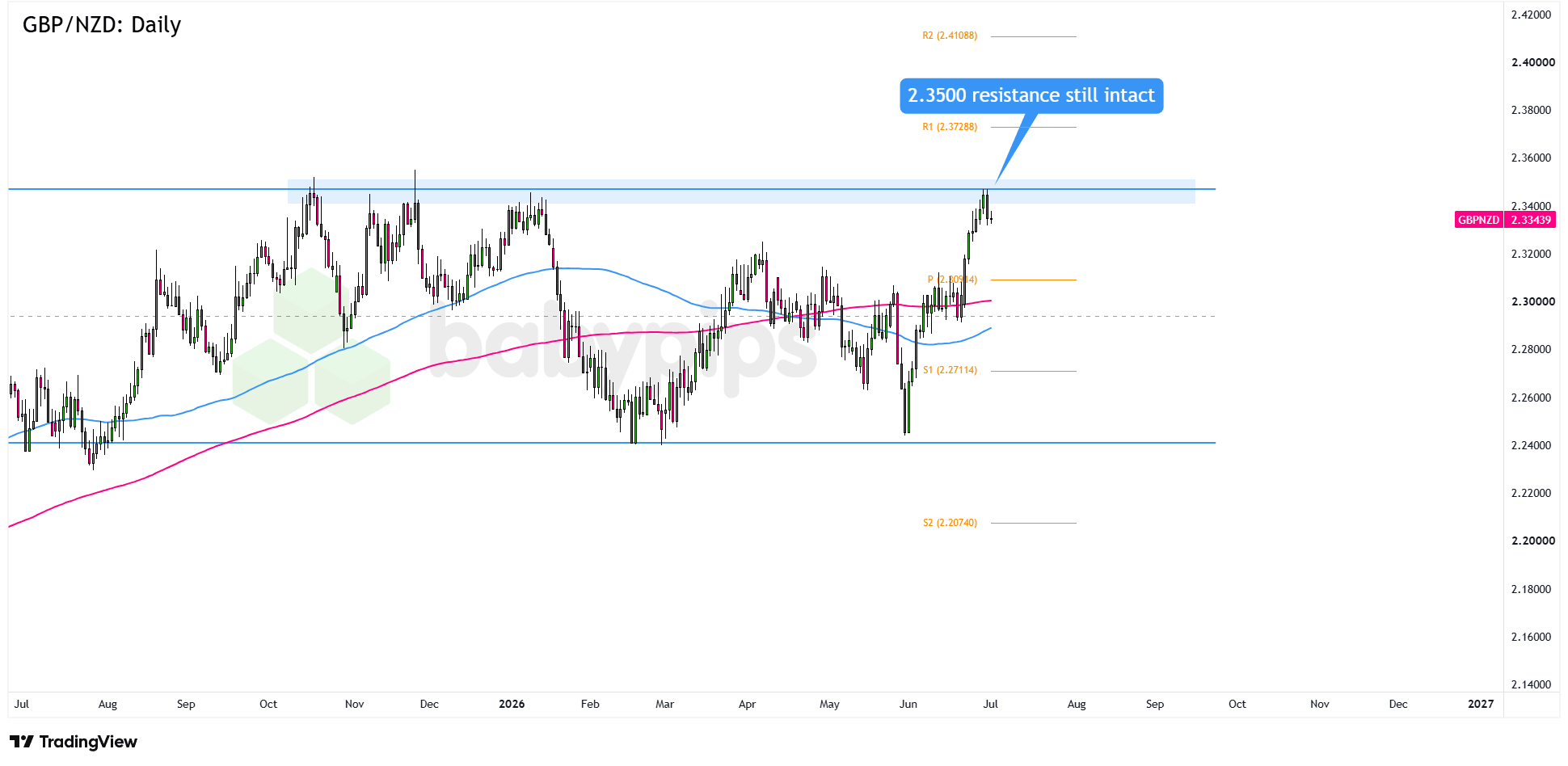
As you can see, GBP/NZD has been stuck between 2.2400 and 2.3500 since mid 2025. The latest bounce from June’s low near 2.2400 has carried price right back toward the top of that range, with the pair now around 2.3344.Remember that directional biases and volatility conditions in market price are typically driven by fundamentals. If you haven’t yet done your homework on the British pound and the New Zealand dollar, then it’s time to check out the economic calendar and stay updated on daily fundamental news!
The moving averages are starting to curl higher near the 2.2800 to 2.3000 area, while the Pivot Point at 2.3091 gives bulls a nearby pullback zone to defend. A daily close above 2.3500 would suggest buyers are finally forcing a breakout, opening the door toward the R1 Pivot Point at 2.3729.
But if Bailey’s patient tone keeps Sterling capped and the Kiwi manages to find some pre-NFP demand, GBP/NZD could slip back toward the Pivot Point at 2.3091. A deeper pullback could then bring the S1 Pivot Point at 2.2711 into view, with S2 sitting farther down at 2.2074.
Whichever bias you end up trading, don’t forget to practice proper risk management and stay aware of top-tier catalysts that could influence overall market sentiment.
Related lesson: Hawkish vs. Dovish: How to Read Central Bank Language
This article’s fundamental thesis rests on reading BOE Governor Bailey’s tone at Sintra as dovish and what that means for sterling, so understanding how to decode central bank language is key here. Premium members can read our lesson:
📖 Hawkish vs. Dovish: How to Read Central Bank Language
Reading this helps you understand the hawkish and dovish policy spectrum, how to interpret a central bank’s tone versus its formal rate decision, and why a single speech can cap or lift a currency like GBP.
And if you’re not a Premium subscriber yet, now’s a good time to sign up.
With Babypips Premium, you get full access to School of Pipsology lessons that help you understand not just the technical levels on the chart, but the central bank signals that determine whether price can break through them.