


AUD/USD looks ready to stretch its weeks-long uptrend!
Will Aussie keep piling on pips against the U.S. dollar in the next few trading sessions?
Here’s what we’re seeing on the 4-hour time frame:
AUD/USD: 4-hour
AUD/USD 4-hour Forex Chart Faster with TradingView
The Australian dollar was one of last week’s strongest major currencies, backed by hawkish RBA expectations, upbeat China PMI reports, and optimism around U.S.-Iran negotiations.
The Greenback wasn’t as lucky, as improved risk sentiment chipped away at safe-haven demand with every positive headline.
That could change in the next few days as Uncle Sam drops the U.S. CPI report while Australia releases its annual budget and quarterly wage report.
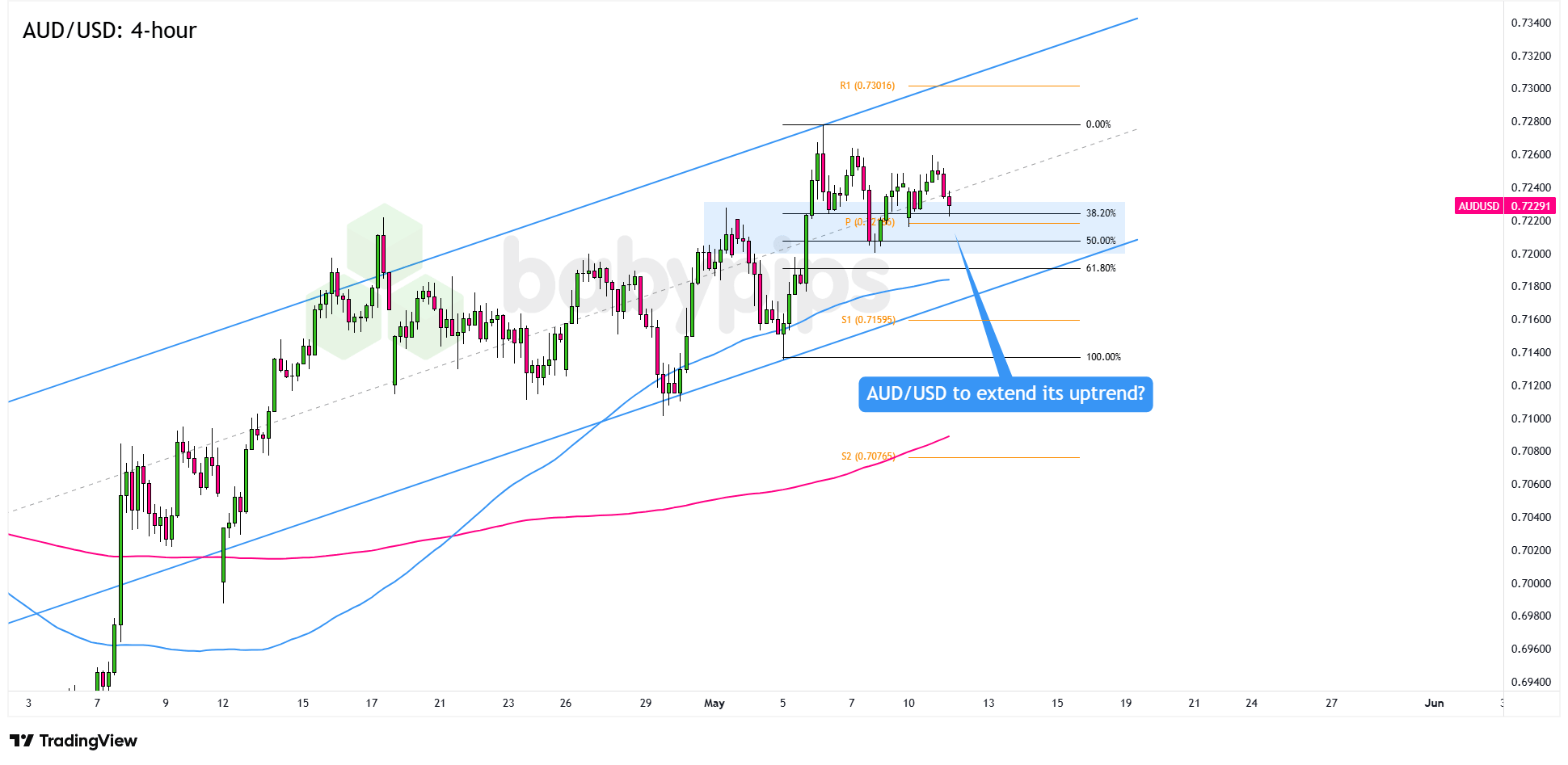
AUD/USD has been trending higher since mid-April, but the pair hit a ceiling near the .7280 zone before settling into a tight 60 pip range.Remember that directional biases and volatility conditions in market price are typically driven by fundamentals. If you haven’t yet done your fundie homework on the Australian dollar and the U.S. dollar, then it’s time to check out the economic calendar and stay updated on daily fundamental news!
What makes today’s setup interesting is that current support lines up with the Pivot Point (.7219) line and the 50% Fibonacci retracement of last week’s upswing.
Sustained trading above the .7200 zone could bring in more bullish pressure and push AUD/USD back toward its .7260 previous highs, if not fresh highs above .7300.
On the flip side, continued selling around the .7260 resistance could weaken AUD/USD’s bullish momentum and bring the bears back into play.
In that scenario, watch for sustained trading below .7200, which could open the door to a dip toward the 100 SMA near .7180 or the .7150 previous area of interest.
Whichever bias you end up trading, don’t forget to practice proper risk management and stay aware of top-tier catalysts that could influence overall market sentiment.
This article touches on what’s driving AUD/USD, including hawkish RBA expectations, China PMI data, and upcoming Australian economic releases, and if you’re not familiar with how those factors shape the Aussie, Premium members can read our lesson:
Reading this helps you understand how the RBA’s monetary policy stance moves the Australian dollar, why Chinese economic data matters for AUD pairs, and what key indicators to watch ahead of Australian data releases.
And if you’re not a Premium subscriber yet, now’s a good time to sign up.
With Babypips Premium, you get full access to School of Pipsology lessons that help you understand not just what AUD/USD is doing on the chart, but the economic and central bank forces behind every move.