



Before buying a challenge, traders should check reviews, payout proof, hidden rules, platform transparency, and time risk.
Prop firm challenges are easier to compare than ever. In minutes, a trader can check account sizes, prices, payout splits, targets, platforms, and discounts.
But choosing a prop firm is not only a checkout decision. It is also a time decision.
A trader may spend weeks or months trying to pass an evaluation. If that trader later reaches the payout stage and discovers unclear rules, vague consistency requirements, or a subjective review process, the real cost is not only the challenge fee. It is the time already invested.
Before buying, traders should ask one practical question:
Do I trust this firm enough to spend my trading time with it?
Quick Answer
A trader should not choose a challenge only by price.
Before buying, traders should check reviews, Trustpilot warnings, payout proof, company history, consistency rules, payout conditions, and whether the platform shows drawdown limits, account status, and challenge progress.
The cheapest challenge is not always the best one. A discount reduces the fee, but unclear rules, weak trust signals, hidden conditions, or payout uncertainty may cost far more.
1. Start With Independent Reviews
The first thing traders should check is not the discount page. It is public reputation.
A prop firm’s website will usually show its strongest points. That is normal marketing. But traders should look outside the company website.
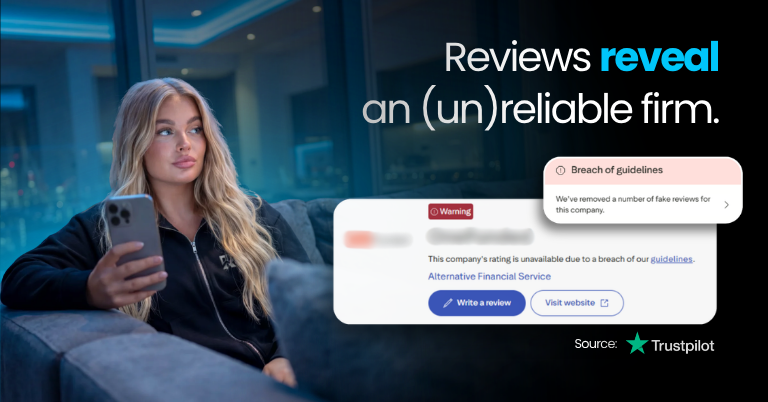
Trustpilot is useful, but traders should not rely only on the overall star rating. The review pattern matters more.
Traders should check whether the company has a Trustpilot warning, whether reviews were flagged or removed, whether negative reviews repeat the same issues, and whether traders mention successful payouts.
A small number of reviews does not automatically make a firm bad. But limited independent feedback or review warnings are strong reasons to slow down before committing serious time.
2. Look for Real Trader Proof
A serious prop firm should have more than landing pages and polished banners.
Traders should look for signs that real people are using the firm, passing challenges, receiving payouts, and sharing their experience.
Useful trust signals include trader interviews, payout stories, case studies, educational articles, social media comments, community discussions, and repeated payout posts.
Generic testimonials are weaker than detailed trader stories because they show less context around risk, mistakes, pressure, and payouts.
For example, RebelsFunding publishes trader interviews and educational stories about mistakes, discipline, risk management, and decision-making.
Real trust is not built only by showing wins. It is also built by showing how traders handle pressure, mistakes, risk, and recovery.
3. Be Careful When Discounts Become the Main Product
Discounts are common in prop trading. A discount itself is not a problem. The issue starts when the discount becomes the reason to buy.
If a firm constantly promotes huge discounts, urgent countdowns, 80–90% offers, BOGO campaigns, or aggressive “last chance” deals, traders should pause and check the actual conditions.
The key question is:
Would this challenge still look attractive without the discount?
Before buying because of price, traders should check rule clarity, payout conditions, payout proof, payout complaints, and public trust.
A cheap challenge is not automatically bad. But a very cheap challenge with vague rules, weak reputation, limited payout proof, aggressive urgency, and little history should be treated carefully.
The problem is not the discount itself. The problem is when it distracts traders from the real cost.

4. Calculate the Time Risk
Many traders think the challenge fee is the main risk. In many cases, time becomes the larger cost.
A trader may need weeks or months to pass while trading selectively, reducing size after losses, and avoiding overtrading.
But if the trader later reaches the payout stage and discovers unclear payout conditions or vague consistency reviews, the problem becomes much bigger than the initial fee.
Before starting, traders should ask what happens after they pass, when they are eligible for payout, what can delay or deny a payout, and whether consistency rules are objective or subjective.
A challenge that takes months to pass should not depend on unclear conditions at the final stage.
5. Read Consistency Rules Carefully
Consistency rules are not automatically bad. A well-defined consistency rule can help discourage gambling behavior, one-trade luck, extreme lot-size jumps, and unrealistic trading patterns.
The problem is vague consistency.
Traders should be cautious when rules use broad terms without clear definitions, such as abusive trading, toxic trading behavior, unrealistic trading, gambling behavior, inconsistent trading, suspicious strategy, or trading against the spirit of the rules.
These terms may have valid uses, but traders should know how they are applied.
Before buying, traders should check whether consistency rules exist, how they are measured, whether one large trade can affect payout eligibility, and whether the rule applies during the challenge, funded stage, or both.
Sometimes a rule is technically written somewhere, but the wording is so broad that traders cannot know how it will be applied. That is still a transparency issue.
6. Check the Payout Process, Not Just the Payout Split
A high payout split can look attractive. But payout split is only one part of the payout question.
A 90% payout split means less if the payout process is unclear, slow, subjective, or surrounded by extra conditions that traders only discover after becoming profitable.
Useful questions include:
- When can the first payout be requested?
- What can delay or deny a payout?
- Are payout rules easy to find?
- Are payout examples visible publicly?
- Do independent reviews mention successful payouts?
A transparent payout process does not mean every payout is automatic. Firms may verify accounts and check rule compliance. But the process should be understandable before the trader begins.
7. Make Sure the Platform Shows What Prop Traders Need
The trading platform is not just a place to open and close trades. In a prop firm challenge, it should also help traders understand where they stand inside the evaluation.
A trader needs visibility into balance, equity, profit target progress, daily drawdown, maximum drawdown, remaining drawdown buffer, account phase, challenge progress, and payout eligibility progress.
This matters because a trader may be profitable overall but still close to a daily loss limit, or have open floating losses that affect account status.
The less a trader has to calculate manually, the better.
For example, RebelsFunding uses RF-Trader, its own platform designed specifically for prop trading. The platform helps traders monitor account status, challenge progress, drawdown-related limits, and key account information directly inside the trading environment.
If the evaluation depends on drawdown limits, rule compliance, and account progress, those details should be easy to see.
What a More Transparent Prop Firm Structure Can Look Like
No prop firm structure removes the difficulty of trading. Traders still need discipline, risk management, patience, and a strategy that fits the rules.
But transparency reduces unnecessary uncertainty.
RebelsFunding is one example of a prop trading firm that addresses some of these transparency questions through clear rules, trader education, and RF-Trader, its own platform designed specifically for prop trading.
RF-Trader helps traders monitor account status, challenge progress, and drawdown-related limits directly inside the trading environment. The firm also publishes trader interviews and gives traders ways to explore the environment before choosing a paid program.
Another important point is disclosure. RebelsFunding communicates that its funded-style trading accounts operate in a simulated trading environment, which matters when “funded account” wording can be unclear.
The broader point is simple:
Traders should look for firms that explain the structure clearly before asking for payment.
Final Takeaway
The cheapest prop firm challenge is not always the best one.
Before buying, traders should check independent reviews, Trustpilot warnings, payout proof, real trader stories, rule clarity, consistency requirements, payout conditions, and platform transparency.
A prop firm challenge is not just a checkout decision. It is a time commitment.
The better question is not:
“How cheap is this challenge?”
It is:
“Do I trust this firm with my trading time?”
Explore the Trading Environment Before You Decide
Traders who want to evaluate these transparency points in practice can review how RebelsFunding structures its rules, trader education, and RF-Trader platform before choosing a paid program.
The goal is not to rush into a challenge, but to understand the environment first.
Learn more at RebelsFunding.