


After six weeks of war between the United States and Iran and a fragile two-week ceasefire, negotiators from both countries sat down in Islamabad, Pakistan, on Saturday for peace talks. It was the highest-level face-to-face engagement between Washington and Tehran since the 1979 Iranian Revolution.
However, after a marathon 21-hour round of negotiations, discussions ended without a deal. Vice President JD Vance who led the US delegation told reporters that Iran had “chosen not to accept our terms.”
Key Takeaways
- Nuclear commitments and Strait of Hormuz control were the core sticking points
- Iranian Ministry of Foreign Affairs spokesman Esmaeil Baghaei noted that the two sides discussed a range of issues, including the “Strait of Hormuz, the nuclear issue, war reparations, the lifting of sanctions, and the complete end of the war against Iran.”
- Iran’s chief negotiator, Mohammad Bagher Ghalibaf that his delegation raised “forward-looking” initiatives but that the U.S. failed to gain their trust and cited “excessive demands” from Washington as the critical obstacle
- U.S. Central Command (CENTCOM) confirmed the navy blockade will apply to all maritime traffic entering or departing Iranian ports on the Arabian Gulf and Gulf of Oman, beginning Monday at 10 a.m. ET
- Pakistan’s Foreign Minister Ishaq Dar urged both sides to uphold their ceasefire commitments despite peace talks falling through, and Islamabad pledged to continue facilitating dialogue
- Israel-Lebanon fighting continues. Israel struck over 200 Hezbollah targets over the weekend, complicating the broader regional picture
U.S. President Trump characterized the breakdown on Truth Social, writing that “the only point that really mattered, NUCLEAR, was not” agreed upon. Vance described the U.S. position as a “final and best offer,” and left open the possibility that Iran could still accept Washington’s terms.
Iran’s side framed the outcome differently. Chief negotiator Mohammad Bagher Ghalibaf, speaker of Iran’s parliament, said the U.S. “failed to gain the trust of the Iranian delegation.”
Tehran has consistently maintained its nuclear program is for civilian purposes and that it has the right to enrich uranium, a position that appears irreconcilable, at least for now, with Washington’s demand for complete nuclear disarmament.
Promotion: Master your trading psychology with AI-powered insights! TradeZella helps you track, backtest, and eliminate bad habits automatically! Click on the link and use code “PIPS20” to save 20%!
Disclosure: To help support our free daily content, we may earn a commission from our partners if you sign up through our links, at no extra cost to you.
Following the collapse of talks, President Trump announced the blockade on Truth Social on Sunday. CENTCOM subsequently issued a formal statement narrowing the scope of Trump’s initial announcement. The blockade, which began at 10 a.m. ET on Monday, applies specifically to all maritime traffic entering or departing Iranian ports and coastal areas, including Iranian ports on both the Arabian Gulf and the Gulf of Oman.
With the U.S. blockade now formalizing what had been an effective Iranian shutdown of Iranian port access, the risk of prolonged energy market disruption remains elevated. Trump is also reportedly considering limited further strikes on Iran, according to the Wall Street Journal, which would mark a material escalation from the ceasefire posture.
Market Reaction
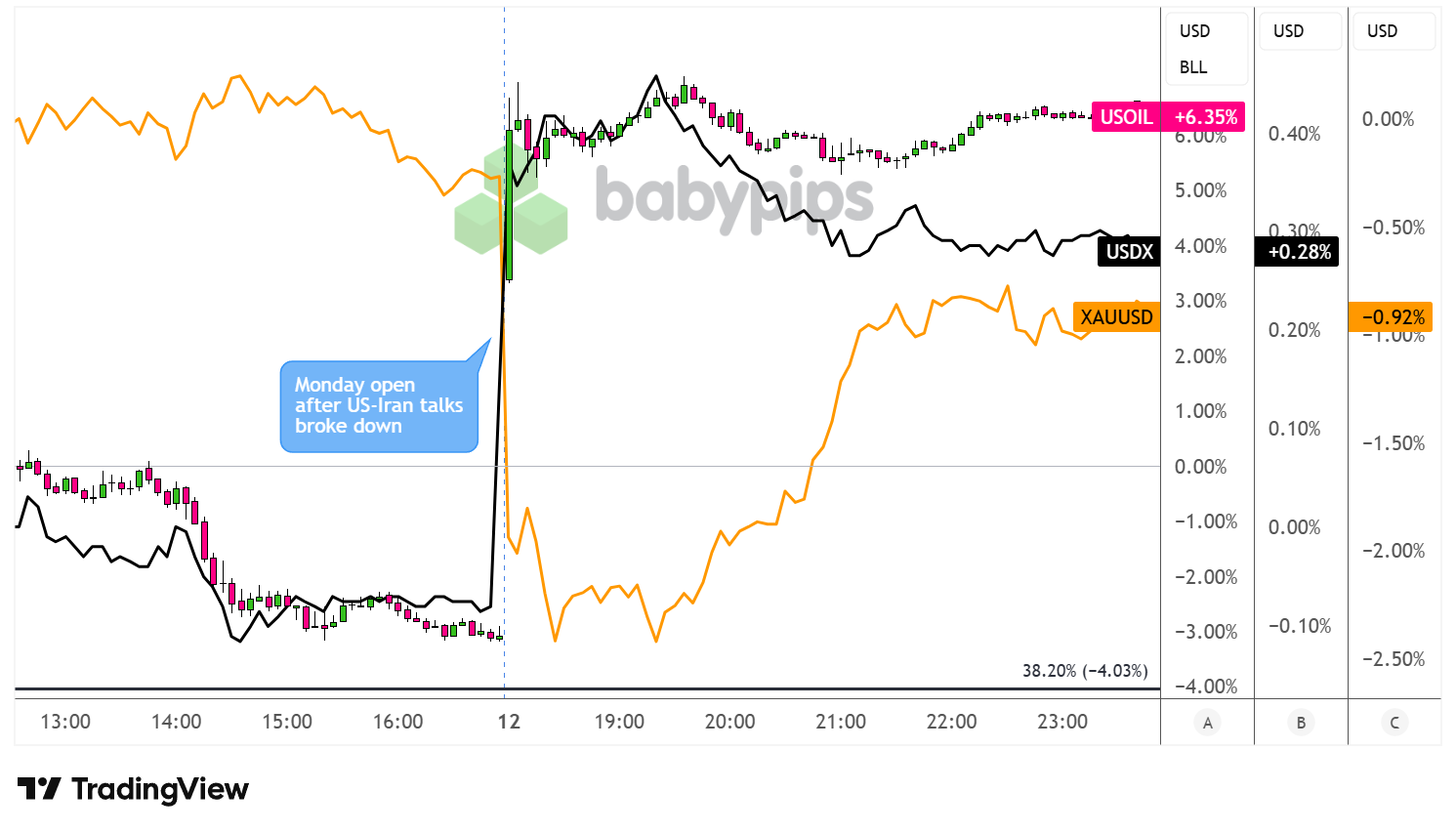
Overlay of WTI Crude Oil, USDX, and Gold: 5-min
Overlay of WTI Crude Oil, USDX, and Gold: 5-min Chart Faster with TradingView
WTI crude oil, which had been cruising slightly lower on “cautious optimism” during Friday’s U.S. session as US-Iran peace talks kicked off, gapped higher during Monday market open as traders adjusted positions to weekend developments.
The energy commodity is holding on to more than 6% in gains as of this writing while global supply concerns resurfaced on the U.S. military blockade likely stoking tensions in the Strait of Hormuz and the Middle East region.
The dollar index (USDX) also gapped up on increased safe-haven flows spurred by prolonged geopolitical uncertainty, with the current ceasefire still looking shaky amid Israel attacks on Lebanon. Some gains have since been faded as the session progressed, though USDX is still 0.28% in the black.
Gold (XAU/USD), on the other hand, dipped sharply likely in reaction to dollar strength. The precious metal appears to have found a bottom quickly, taking advantage of risk-off moves to pare initial losses but is still 0.92% lower by midday Asian session.
Promoted: Capitalize on Geopolitical Headlines Without Risking Your Own Funds
As the latest US-Iran talks collapse showed, markets can shift gears in an instant. When fundamental drivers and geopolitical news create this kind of massive volatility, trading the swings requires deep focus—and enough capital to make your edge count.
If you have the right trading bias but a restrictive personal account size, Funded Trading Plus can help. They offer evaluation packages starting at just $89.00. Prove your skills with simple, fair rules, and you can double your account every 10% up to $2,500,000.
Learn more about Funded Trading Plus!
Disclosure: To help support our content, we may earn a commission from our partners if you sign up through our links, at no extra cost to you.