


The Swiss franc weakened on Thursday after the Swiss National Bank (SNB) kept its policy rate at 0%.
The franc likely slid because the SNB sounded relaxed about its currency and gave no hint of a rate hike.
Still, the SNB’s biggest move of the day arguably came down to removing a single adjective.
What Did the SNB Decide This Week?
The SNB held its policy rate at 0% for a fifth straight meeting, as widely expected. It nudged its inflation forecasts up to 0.7% for 2026 and 0.8% for both 2027 and 2028. It also lifted its 2026 growth forecast to 1.5% to 2%.
The change that moved markets sat in one sentence about the currency. Since March, the SNB had signaled an increased willingness to fight a strong franc because of the Middle East conflict.
On Thursday, the SNB softened that warning, saying it was “willing to be active in the foreign exchange market as necessary.” This refers to currency intervention, which is when a central bank buys or sells its own currency to influence its value.
How Did the Swiss Franc React to the SNB Decision?
The franc firmed in the hours before the announcement, gaining about 0.2% against most majors and more than 0.4% against the Japanese yen. The run-up suggests some traders had positioned for a hawkish SNB, one leaning toward higher interest rates.
That move faded within minutes of the release, as the franc erased its gains and fell against most majors shortly after the London session open. By then it traded roughly 0.4% to 0.5% below Wednesday evening’s levels.
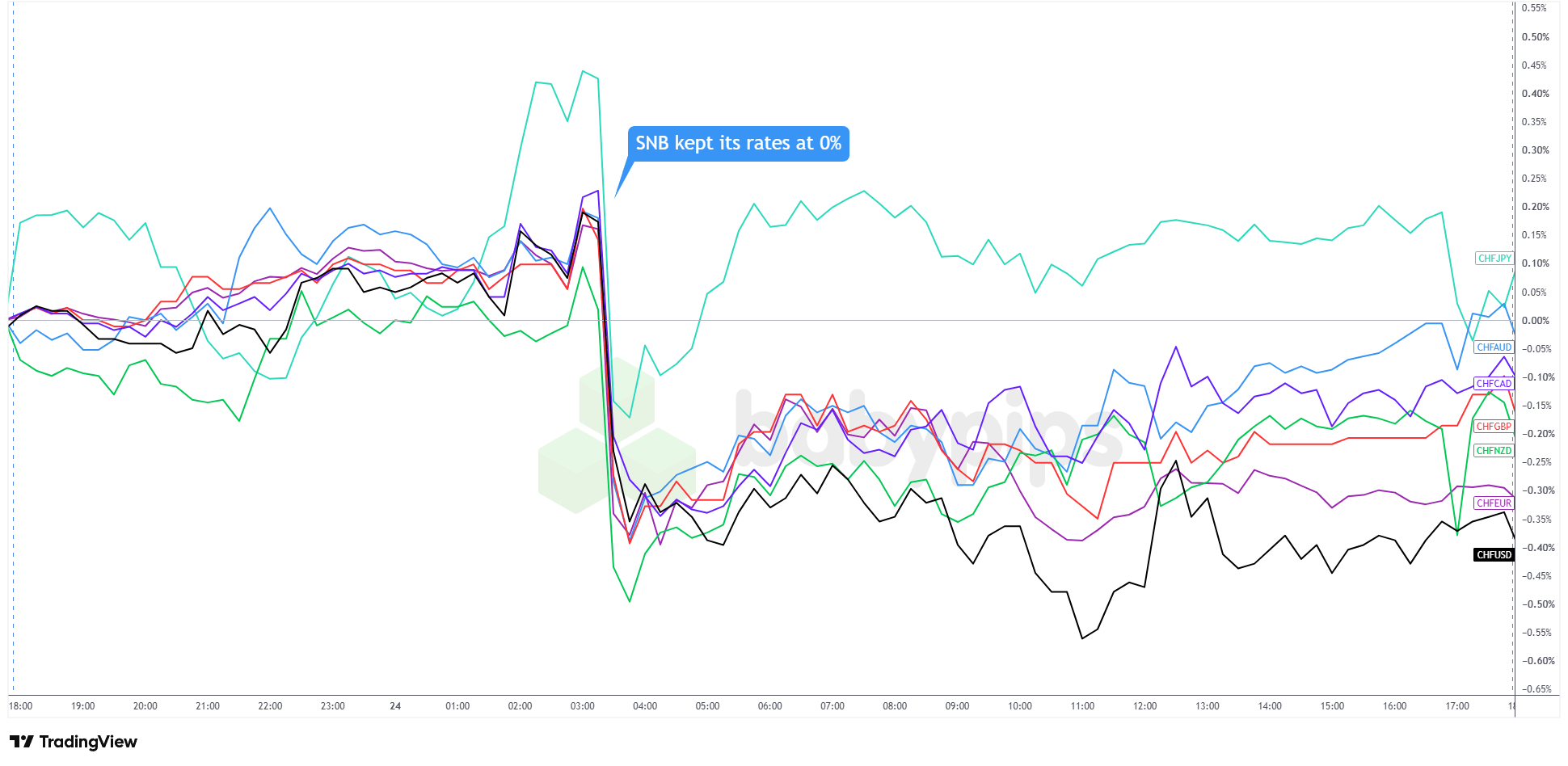
CHF 15-minute Forex – Chart Faster with TradingView
Once traders had priced in the SNB news, each pair tracked the currency on the other side more closely.
The franc recovered some ground in the European morning before the pairs split farther apart during the U.S. session. Its biggest loss came against the U.S. dollar, while it finished about 0.3% lower against the euro. It recovered most of its losses against the Australian and Canadian dollars and ended slightly higher against the yen.
Promoted: Carry Trades Build Slowly but Can Unwind Fast
The Swiss franc’s reaction is a reminder that calm markets can shift quickly when central bank signals change. Whether you’re following currencies or exploring digital assets, Crypto.com offers a convenient platform for tracking markets and managing your crypto portfolio.
Learn more here at Crypto.com!
Disclosure: We may earn a commission from our partners if you sign up through our links, at no extra cost to you.
Why Did the SNB Decision Reinforce the Franc’s Carry Trade Role?
A carry trade involves borrowing a currency with a low interest rate to buy one with a higher yield and pocket the difference. The franc is a natural funding currency because the SNB’s 0% rate is the lowest among major central banks. By comparison, the Federal Reserve’s target range is 3.75% to 4.00%, while Norway’s central bank raised its rate to 4.50% on the same day the SNB held.
Borrowing and selling francs to buy dollars or other higher-yielding currencies creates steady pressure on the franc. SNB Chairman Martin Schlegel said its recent decline partly reflected widening interest rate differences between Switzerland and other economies.
These carry trades tend to build gradually while markets remain calm, which may help explain the franc’s slide against the dollar over the past several weeks.
What Could Flip the Swiss Franc Back?
The franc could quickly return to its traditional role as a safe haven currency, which investors often buy during a crisis. In 2025, demand for safe havens helped it gain more than 12% against the dollar.A sharp escalation in the Middle East or a major stock market selloff could revive that demand and trigger a rapid unwinding of carry trades, forcing traders to buy back borrowed francs.
Interest rate expectations could also support a recovery. Money markets still priced roughly even odds of a December SNB hike after the decision, though the SNB’s own forecasts assume rates stay at 0% through 2028. Hotter Swiss inflation could strengthen hike bets and give the franc a fresh lift.
The Bottom Line
The SNB’s quiet meeting still moved the Swiss franc. By dropping its extra intervention warning and holding at 0%, the SNB appears to have signaled comfort with a softer currency.
Pre-meeting positioning shaped the size of the drop. The franc’s early run-up gave traders more to unwind once the SNB stayed calm, which likely made the fall sharper.
The franc’s safe-haven role keeps two-way risk alive. A shock that sends investors running for safety, or a December SNB hike, could reverse the move faster than it formed.
If the SNB’s language shift surprised you, you may not be familiar with how central banks use wording to signal their policy stance. Premium members can read our lesson:
📖 Hawkish vs. Dovish: How to Read Central Bank Language
Reading this helps you understand how to identify where a central bank sits on the hawkish-dovish spectrum, why tone and wording often move currencies more than the rate decision itself, and how to spot when a subtle language change signals a meaningful policy shift.
And if you’re not a Premium subscriber yet, now’s a good time to sign up.
With Babypips Premium, you get full access to School of Pipsology lessons that help you understand not just what the SNB decided, but how to read what any central bank is really signaling through its language choices.