

If you thought the era of “higher-for-longer” interest rates was a relic of 2023, the headlines of 2026 have a surprise for you.
Across the globe, from the marble halls of the Federal Reserve in Washington to the Reserve Bank of Australia and the Monetary Authority of Singapore, central banks are dusting off their hawkish playbooks.
For the uninitiated, “tightening” or “hiking” sounds like something you do to a pair of boots before a trail.
In the financial world, it’s arguably more grueling. It refers to a hiking cycle or a period where central banks systematically raise interest rates to cool down an overheating economy.
But why is everyone doing it at the exact same time?
First: What Is a Hiking Cycle?
Think of the global economy as a house party, with a central bank as the responsible host.
When the party is too quiet (a recession), the host spikes the “punch bowl” with low interest rates, making it cheap to borrow money and encouraging everyone to dance (spend and invest).
However, when the party gets too rowdy (prices start skyrocketing, and the “inflation dragon” wakes up), the host has to take the punch bowl away. They do this by raising interest rates.
The goal is something called a soft landing — raising rates just enough to kill inflation without tipping the economy into recession.
Central bankers like to make it sound clinical. In practice, it’s like landing a 747 on a postage stamp. During a hurricane. Yipes!
The Great Inflation “Afterparty”
You might wonder: “Didn’t we already deal with inflation?” While 2024 and 2025 saw a brief lull, 2026 has brought a “second wave” of price pressures.
Several factors fueled the inflation fire:
 Geopolitical Friction: Ongoing conflicts in the Middle East and Eastern Europe have kept energy and food prices volatile. When a barrel of oil gets expensive, everything—from your commute to the plastic in your toothbrush—gets pricier.
The Return of Tariffs: As global trade becomes more “protectionist,” many countries are slapping taxes on imports. While this might protect local jobs, it makes goods more expensive for the end consumer.
Government Spending: Even as central banks try to cool things down, many governments are still spending heavily on infrastructure and defense. This keeps a lot of cash circulating in the economy, forcing central banks to hike rates even higher to offset that “fiscal” heat.
Why Everyone Is Moving Together
Central banks aren’t moving together because they’re all huddled in some secret back room. It’s happening because global markets are tightly linked, and the Fed is still the main conductor.
Since the U.S. dollar is the world’s reserve currency, Fed policy ripples everywhere.
When the Fed keeps rates high and another central bank cuts, investors tend to chase the better return in dollars. A weaker currency makes imports (like oil, which is priced in dollars) much more expensive.
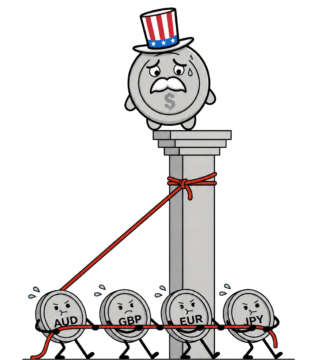
To prevent their currency from crashing and “importing” more inflation, other central banks are forced to hike rates in tandem with the U.S.
Promoted: Trade the Return of Rate Hike Volatility Without Overstretching Your Own Account.
Global central banks are back in tightening mode, and every rate decision can shake up currency trends.
If your macro read is solid but your personal account size is holding you back, Funded Trading Plus offers evaluation packages starting at just $89.00. Prove your skills with straightforward rules, and you can double your account every 10% up to $2,500,000.
Learn more about Funded Trading Plus!
Disclosure: We may earn a commission from our partners if you sign up through our links, at no extra cost to you.
A Country-by-Country Snapshot
Here’s what major central banks around the world are doing now:
- Australia (RBA): CPI hit 4.6% in March. The RBA hiked in February 2026 for the first time since 2023, then twice more, bringing the cash rate to 4.10% with markets pricing a 70–75% chance of another hike in May.
- Japan (BOJ): Raised rates to 0.75% in December 2025 — the highest since 1995 — after inflation exceeded its 2% target for 44 consecutive months. Paused in April amid Middle East uncertainty, but raised its inflation forecast to 2.8% for fiscal year 2026. Most economists expect the next hike by July.
- UK (BOE): CPI reached 3.3% in March, with the MPC warning of material second-round effects on prices and wages. Held at 3.75% in April, but one member voted to hike immediately. June is live.
- Eurozone (ECB): Inflation hit 3% even as GDP growth slowed to 0.8% in Q1 — a combination economists are calling stagflation. Held at 2.15%, but markets expect hikes at the June and July meetings.
- Canada (BOC): The most nuanced position of the group. CPI climbed to 2.4% in March and is expected to approach 3% in April, but core inflation has been easing, and long-term inflation expectations remain anchored. Held at 2.25% and is currently “looking through” the oil-driven spike, though Governor Macklem warned that if energy prices stay elevated for longer, rate hikes will follow. Markets are pricing a possible hike by October.
- United States (Fed): The odd one out. The Fed held at 3.50–3.75% in April, frozen in wait-and-see mode as oil-driven inflation collides with slowing growth and tariff uncertainty. April was also Jerome Powell’s final press conference, with Kevin Warsh now on track to take the chair. Until his policy instincts become clear, the Fed’s path is genuinely hard to read. With the dollar quietly losing its yield advantage against actively hiking peers, that uncertainty matters.
What This Means for Your Trading
The core principle is straightforward: currencies backed by hiking central banks tend to rise against those that are cutting or holding. The Australian dollar strengthened after the RBA’s February announcement, as higher rates attract capital flows. The Fed, meanwhile, is frozen in wait-and-see mode at 3.50–3.75% — meaning the dollar is quietly losing its yield advantage against peers that are actively tightening.
One concept worth adding to your toolkit is the real interest rate — the nominal rate minus inflation. If a central bank’s rate is 4% but inflation is running at 5%, the real rate is actually negative. The bank isn’t truly tightening yet; the value of debt is still shrinking faster than interest is growing. It’s why central banks sometimes keep hiking even when rates already look high on paper.
For a “newbie” analyst or a casual observer, the hiking cycle has two very different faces.
The Good News (For Savers): If you have money sitting in a high-yield savings account or certificates of deposit (CDs), you’re finally being rewarded. Higher central bank rates usually mean your bank pays you more to keep your money with them.
The Bad News (For Borrowers): If you have a variable-rate mortgage or a credit card balance, your monthly payments are likely going up. The “cost of carry” is rising.
The Bottom Line
The return of the global hiking cycle in 2026 is a reminder that the global economy is a complex, interconnected machine. While higher rates feel like a “tax” on growth, the alternative of runaway inflation is far worse for the average person’s purchasing power.
The era of free money is over (again), and the world is learning to live within its means.
Watch the RBA on May 5, the ECB on June 11, and the Bank of England on June 18 — each meeting has the potential to reset its currency’s direction.
Keep an eye on those central bank meeting minutes, as the “host” is still watching the punch bowl very closely.
BabyPips Premium Annual Members have exclusive access to our highest-tier partnership deal: 30% off your first purchase of a TradeZella annual subscription! To level up the rate of progress towards mastering your performance and psychology, TradeZella’s AI-powered journaling and backtesting tools are the industry gold standard.
This discount effectively covers a large portion of an annual Babypips Premium subscription!To Claim the Exclusive 30% off, email us at [email protected] to verify membership status and receive the promo code. Please reference “TradeZella Annual Plan Promo Code” in your email subject line.