


U.S. employers cut 23,000 jobs in July 2026, far short of the 80,000 gain economists forecast, the Bureau of Labor Statistics reported Friday. The unemployment rate slipped to 4.1%, but that drop came as more workers left the labor force. The BLS also cut its May and June payroll estimates, down a combined 103,000 jobs from what it first reported.
July 2026 U.S. Jobs Report: Key Takeaways
- Payrolls fell 23,000: A sharp miss versus the forecast for an 80,000 gain, and well below the 34,000 average monthly gain of the prior 12 months.
- Unemployment rate: 4.1%: Down from 4.2% in June, but the drop came alongside a falling labor force participation rate.
- Prior months revised down 103,000: May’s gain shrank from 129,000 to 63,000, and June’s fell from 57,000 to 20,000.
- Wages grew 3.2% year-over-year: Average hourly earnings hit $37.62, missing the 3.5% economists expected.
- Job losses concentrated in two sectors: Local government education cut 50,000 positions and retail trade cut 19,000, while health care kept adding jobs (+22,000).
- Fed rate hike odds dropped: Traders cut the odds of a September rate hike from 57% to 44% within hours of the report.
- Read the official BLS Employment Situation Summary for July 2026.
What Were the July 2026 Jobs Report Results?
The economy lost 23,000 jobs in July, a reversal after 12 months that averaged a 34,000 monthly gain. Wall Street had expected payrolls to grow by 80,000, with forecasts ranging from 10,000 to 140,000. The BLS cut its May and June payroll estimates too, down a combined 103,000 jobs from what it first reported. Put together, hiring has been slowing for months, not just in July. The unemployment rate held close to steady at 4.1%, down from 4.2% in June.
Why Did the U.S. Economy Lose Jobs in July?
Two industries drove most of the losses. Local government education cut 50,000 jobs, a sharp reversal after a year of little change. Retail trade lost 19,000 jobs, led by cuts at warehouse clubs, supercenters, and other general merchandise stores (-21,000) and gas stations (-5,000). Financial activities lost another 14,000 jobs, split between lenders (credit intermediation) and insurance carriers. The sector has now shed 121,000 jobs since its peak in May 2025.
Health care stayed the exception. The sector added 22,000 jobs in July, though that pace has cooled from a 36,000 average gain over the past year. Outpatient clinics and doctors’ offices, grouped as ambulatory care, accounted for 18,000 of those new jobs on their own. Everywhere else, hiring stayed flat: construction, manufacturing, wholesale trade, and professional services all posted little change.
Is the U.S. Labor Market Actually Weakening?
A falling unemployment rate signals strength, but July’s drop from 4.2% to 4.1% needs a footnote. The labor force participation rate is the share of working-age Americans who have a job or are looking for one. It fell to 61.4%, down 0.7 percentage point since January. When people stop looking for work, they no longer count as unemployed, even if they still don’t have a job. That mechanic can push the unemployment rate down without the labor market getting stronger.
Other signals tell a similar story. Workers on temporary layoff, meaning they expect to return to their old job, jumped by 153,000 to 921,000 in July. People jobless for 27 weeks or more, the long-term unemployed, held at 1.8 million and made up 25.5% of all unemployed people. Average hourly earnings climbed to $37.62, up 3.2% over the year. That missed the 3.5% economists expected, a sign workers have less room to demand raises.
Promoted: Scale Your Strategies
As a weak U.S. jobs report whipsaw traders, navigating the current macro landscape requires more than just a good entry—it requires a partner that has seen it all before.While new firms come and go with the volatility, The5ers (4.7★ rating on 32K+ reviews) has spent the last 10 years perfecting a funding model that works for the trader. It’s why over 1.6 million traders worldwide trust them to provide the capital and scaling needed to turn market analysis into meaningful professional growth.
Learn more about The5ers & available discounts
Disclosure: We may earn a commission from our partners if you sign up through our links, at no extra cost to you.
What Does This Mean for the Federal Reserve?
Going into Friday, Fed officials were debating the opposite problem: whether to raise rates. The Fed held its benchmark rate at 3.50%-3.75% at its July meeting, but three policy committee members dissented in favor of a quarter-point hike. Those officials worried inflation remains above the Fed’s 2% target.
The jobs report shifted that debate. Odds of a September rate hike fell from 57% to 44% within hours of the release, according to Reuters. Odds the Fed holds rates steady instead climbed from 43% to 60%. “Slowing jobs growth helps support a September hold,” Goldman Sachs strategist Lindsay Rosner told Reuters. A weak labor market gives the Fed room to pause instead of tightening further.
What Does This Mean for USD Traders?
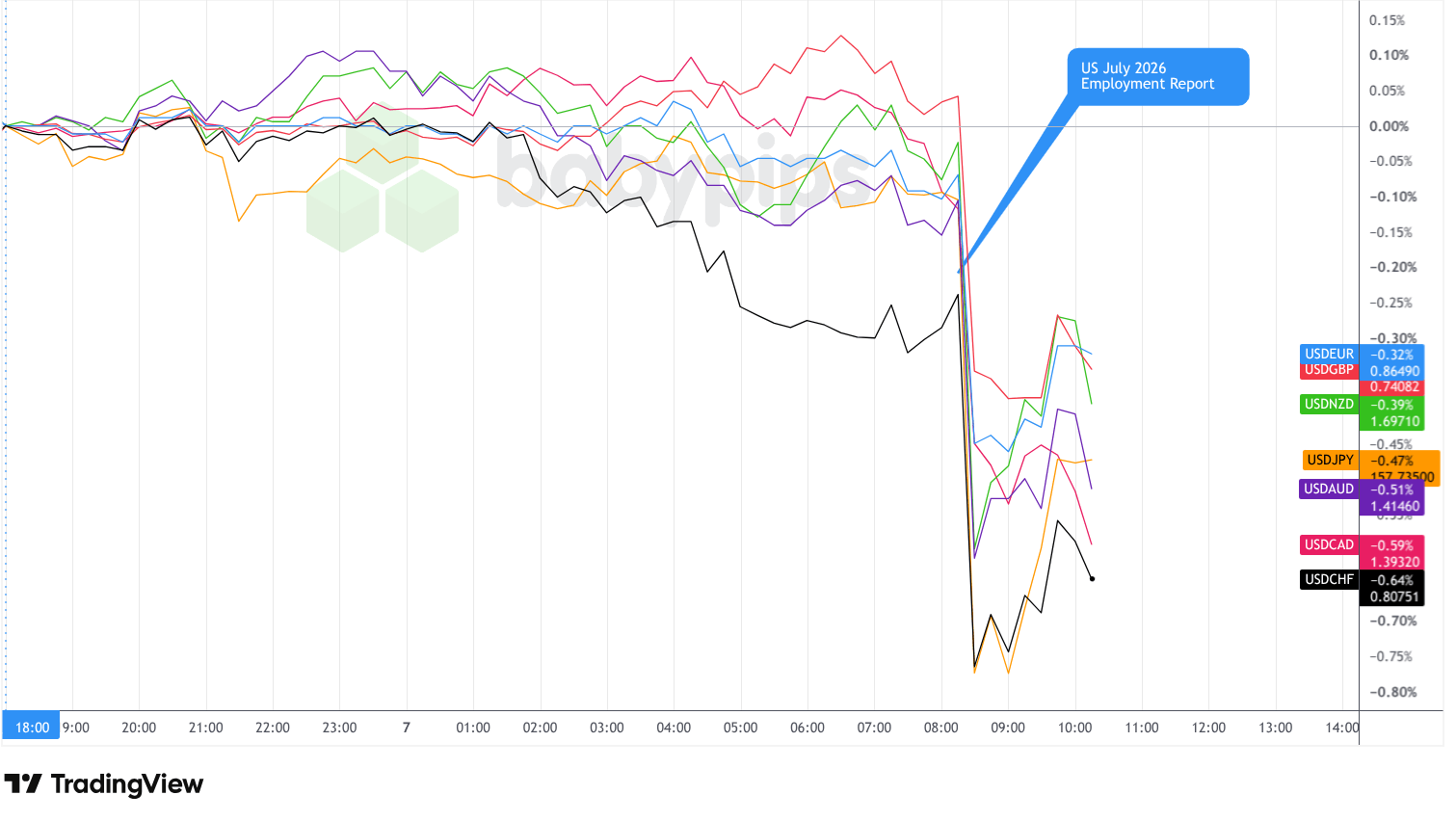
Overlay of USD vs. Major Currencies – Chart Faster with TradingView
The dollar sold off right after the report. The U.S. Dollar Index, which tracks the dollar against a basket of other major currencies, fell 0.5% to 99.43. USD/JPY, the exchange rate between the dollar and the Japanese yen, slipped to 157.20 as traders priced in a less aggressive Fed. Treasury yields fell too: the 2-year yield dropped 8 basis points to 4.16%, and the 10-year yield dropped 6 basis points to 4.61%. A basis point equals one-hundredth of a percentage point.
Stock futures rose, since investors read a softer labor market as a reason for the Fed to stay patient rather than raise rates. For forex traders, weaker jobs data lowers the odds of a Fed hike, and that combination tends to weigh on the dollar.
Frequently Asked Questions About the July 2026 Jobs Report
What does the jobs report measure?
The jobs report, officially called the Employment Situation, comes from two separate BLS surveys. The household survey tracks the unemployment rate and who has a job. The establishment survey counts how many jobs employers added or cut, known as nonfarm payrolls.
Why does this report matter for forex traders?
The jobs report shapes what the Federal Reserve does with interest rates, and interest rates drive currency values. Higher rates tend to attract foreign investment and strengthen the dollar. A weak report like July’s pulls rate expectations lower, which can weaken the dollar instead.
What happened in the July 2026 jobs report?
Employers cut 23,000 jobs, missing forecasts for an 80,000 gain. The unemployment rate fell to 4.1%, but a shrinking labor force helped drive that drop. The BLS also cut its May and June payroll estimates by a combined 103,000 jobs.
What does this mean for the Fed’s September meeting?
Before the report, Fed officials were split over whether to raise rates, with three members already pushing for a hike. The weak jobs data cut the odds of a September hike from 57% to 44%, giving the Fed more room to hold rates steady instead.
What’s the next data to watch?
The BLS will release a preliminary annual benchmark revision on August 28. This update uses state tax records to recheck the past year of jobs data, which could reshape the picture of 2026 hiring so far. The next full jobs report, covering August, arrives September 4, right before the Fed’s next rate decision.