

The UK jobs market took a sharp turn for the worse in the latest data, with payroled employees falling by 100,000 in April — the biggest single-month drop since the start of the COVID-19 pandemic — as the ongoing conflict in the Middle East pushes energy costs higher and chips away at business confidence.
Key points from the latest ONS release:
- Payrolled employees fell 100,000 in April 2026 (provisional), and are down 210,000 year-on-year to 30.2 million
- The unemployment rate held at 5.0% for January to March 2026
- Vacancies dropped to 705,000 for February to April — the lowest level since 2021 — and are down 28,000 on the quarter
- Regular pay growth slowed to 3.4% annually in January to March 2026, the softest pace since 2020; private sector pay rose just 3.0%
- Real regular pay grew only 0.1% on an annual basis — barely keeping pace with inflation
- Youth unemployment climbed to 16.2%, levels not seen since early 2015
- There are now 2.5 unemployed people competing for every open vacancy, up from 2.1 a year ago
- Over 140,000 job cuts have been recorded in the past three months
Link to the ONS Labour Market Overview, UK: May 2026
The headline April payroll figure is hard to ignore, but it comes with a major asterisk. The ONS was quick to flag that the data is likely subject to larger-than-usual revisions — early months in the tax year often carry more uncertainty because some employer submissions may still be incomplete. Research from MUFG points out that prior April and May payroll readings have been revised up dramatically in subsequent months, so the true picture may be a lot less alarming once the dust settles.
That said, the broader trend is hard to dismiss. The three-month average unemployment rate ticked up to 5.0% in January to March 2026, rising 0.5 percentage points from a year ago. So, there’s a clear upward drift in joblessness building across multiple data points — not just one noisy month.
The energy shock from the Iran conflict is being widely cited as a key driver. Retail accounted for a large chunk of the April payroll decline, and economists have pointed to rising input costs forcing businesses to cut headcount. The House of Commons Library notes that as a net energy importer, the UK is particularly exposed to the kind of price shock the Middle East conflict has triggered — squeezing household budgets and weighing on business activity at the same time.
The wage picture adds another layer of concern. According to the ONS Average Weekly Earnings release, while total pay including bonuses rose 4.1% annually, regular pay growth has been cooling steadily. At 3.4%, it’s the lowest since 2020 — and with inflation still elevated thanks to that same energy shock, real wages are barely moving, squeezing household purchasing power heading into the summer.
The UK vacancies data rounds out a gloomy picture. Open positions have fallen to their lowest since 2021, and with 2.5 unemployed workers now chasing each vacancy — compared to fewer than 1 during the post-pandemic hiring boom — the labour market has clearly lost a lot of its tightness.
Analysts at MUFG broadly see the data as consistent with a gradual cooling in UK labor market conditions, even if measurement challenges mean some individual figures need to be taken with caution. The broader direction, they argue, points to further slack building in the months ahead — particularly given that the Iran conflict shows little sign of resolution and domestic political uncertainty is rising.
On that political front, Prime Minister Keir Starmer is under growing pressure following heavy losses for Labour in local elections. His leadership is expected to face a formal challenge in the coming months, adding a layer of domestic political uncertainty on top of the already complex geopolitical backdrop.
Promotion: If your confidence has grown in your market awareness & strategies, and you wanna take action, Maven Trading can help. They provide simulated funding challenges starting as low as $15, allowing you to trade major pairs with professional-sized capital. No time limits mean you can take swing plays on these market themes without the pressure of a ticking clock.
Learn More About Maven Trading Today! And for a limited time: Use code “ETERNAL” for 10% off Challenge fee!
Disclosure: We may earn a commission from our partners if you sign up through our links, at no extra cost to you.
Market Reactions
British Pound vs. Major Currencies: 15-min
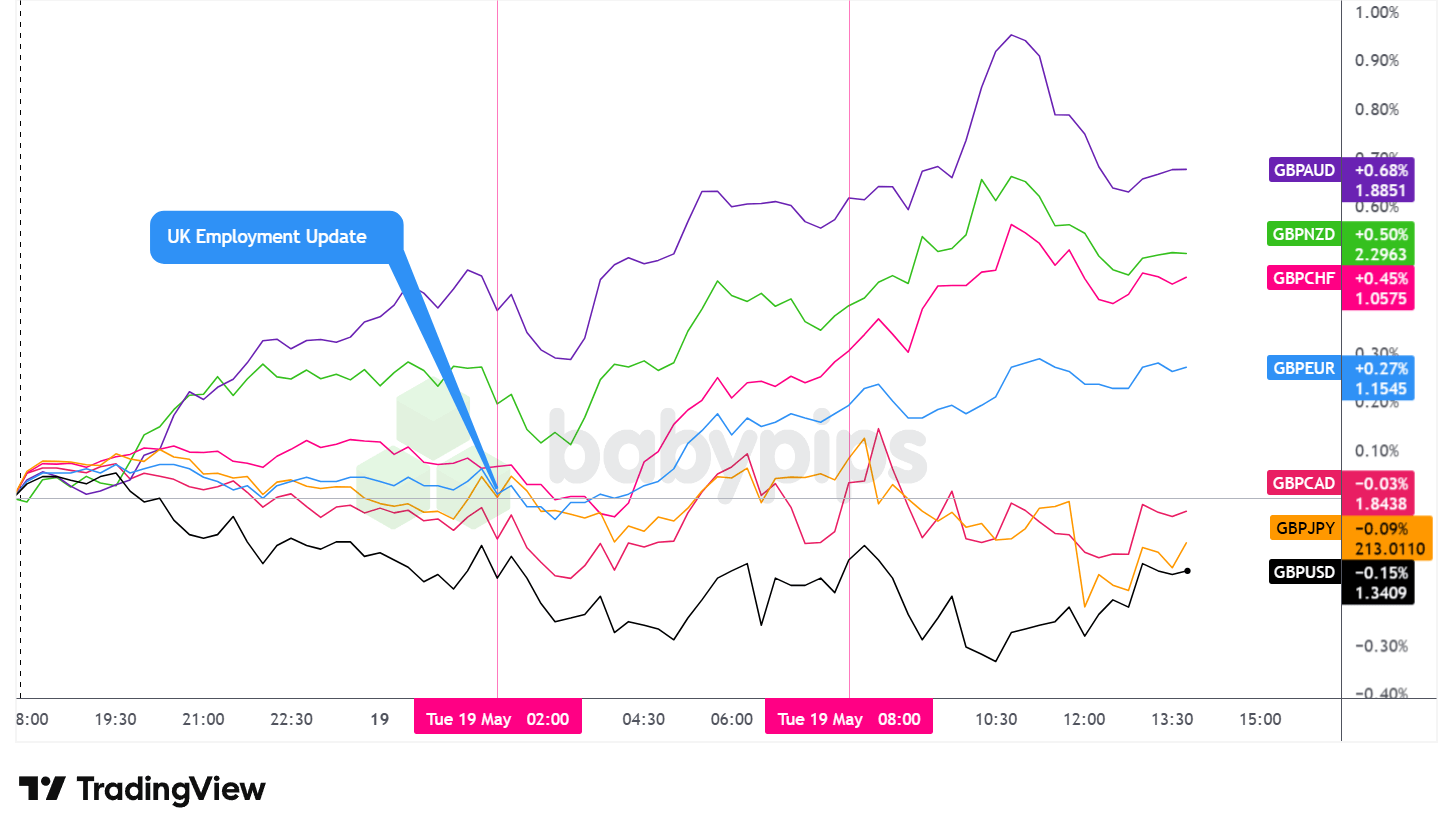
Overlay of GBP vs. Major Currencies Chart Faster with TradingView
The jobs data gave traders a fresh reason to dial back Bank of England rate hike expectations. The BOE is currently holding rates at 3.75%, having resisted pressure to hike in the face of the Iran-war energy shock. With the labor market now weakening and wage growth easing, the usual inflation-fighting logic for raising rates looks shakier. Markets trimmed BOE tightening bets to around 57 basis points of hikes by year-end following the release.
Analysts broadly agree that a weakening labor market reduces the risk of “second-round” inflation effects — where workers demand bigger pay raises to offset higher energy costs, feeding a wage-price spiral. As the House of Commons Library highlights, whether or not those second-round effects materialize will be the key factor shaping the BOE’s next move. Today’s data, on balance, suggests they may not — at least not yet.
The British pound is mixed against the majors since the release. That muted reaction suggests markets had already partially priced in a softening labor market, and that the net dovish signal from the data was offset by lingering inflation concerns tied to the energy shock. The pound continues to navigate a tricky balancing act — weaker growth pulling one way, energy-driven inflation expectations the other.
This article shows how a geopolitical shock (the Iran conflict) creates an energy cost spike that ripples through a country’s labor market, central bank policy, and currency moves. But most traders miss the deeper mechanism at work. Premium members can read our lesson:
📖 Geopolitical Risk, Trade Policy, and Safe Haven Flows
Reading this helps you understand how geopolitical events move currencies, which economies are most exposed to specific shocks, and how to spot the second and third-order effects before the broader market does.
And if you’re not a Premium subscriber yet, consider joining. This is exactly the kind of macro read you’ll encounter as a trader.
With Babypips Premium, you get full access to School of Pipsology lessons that help you understand not just what the chart shows, but the geopolitical and economic forces underneath it that actually move currency prices.