


The U.K. labor market showed further signs of gradual cooling in March 2026, with payrolled employee counts declining for the second consecutive year, wage growth slipping to multi-year lows in real terms, and job vacancies falling to their lowest level since early 2021.
The headline figures were broadly in line with the trend that has been building over the past year. Payrolled employee numbers have now been declining on an annual basis since 2024, and the latest flash estimate for March 2026 suggests that trend is unlikely to reverse imminently.
The ONS continues to flag the March figure as provisional and likely subject to upward or downward revision when additional HMRC PAYE data are received.
Key Takeaways
- Payrolled employees fell by 65,000 (0.2%) year-on-year to 30.3 million in March 2026 (provisional flash estimate), with a further monthly decline of 11,000. The overall near-term trend is described as broadly flat.
- Unemployment rate (aged 16+) was 4.9% for the same period — down 0.2 pps on the quarter but up on the year, and above pre-pandemic levels.
- Claimant Count for March rose on the month but fell on the year, coming in at an estimated 1.694 million (provisional, subject to revision).
- Economic inactivity rate edged up 0.2 pps on the quarter to 21.0%, though it remains below year-ago levels.
- Job vacancies fell by 29,000 (3.9%) on the quarter to 711,000 in January–March 2026 — the lowest reading since February–April 2021.
- Nominal wage growth (average weekly earnings, Dec 2025–Feb 2026): 3.6% for regular pay, 3.8% total — both down on the prior period.
- Real wage growth (CPI-adjusted): 0.4% regular, 0.7% total — barely above inflation. On a CPIH basis, real pay growth was just 0.2% and 0.4% respectively.
The unemployment rate ticking down on the quarter to 4.9% appears to be a mild positive, though it remains above year-ago levels and well above where it was before the pandemic.
The ONS urged caution in interpreting LFS-derived change measures, given continued volatility in survey estimates stemming from ongoing improvements to the data collection methodology.
Link to official ONS U.K. Labor Market Survey (March 2026)
The more significant signal in this release may be the continued deterioration in job vacancies. At 711,000, vacancies are now at their lowest since early 2021 and are down 65,000 over the year, exhibiting a consistent pattern suggesting employers remain reluctant to expand headcount. This has reflected sustained softening that spans well over two years and is consistent with the broader narrative of businesses absorbing elevated employment costs.
Wage growth, meanwhile, continues to decelerate. At 3.6–3.8% in nominal terms, earnings are still growing, but when adjusted for inflation, the picture is far more modest, as real regular pay growth is running at just 0.4%.
Market Reactions
British Pound vs. Major Currencies: 5-min
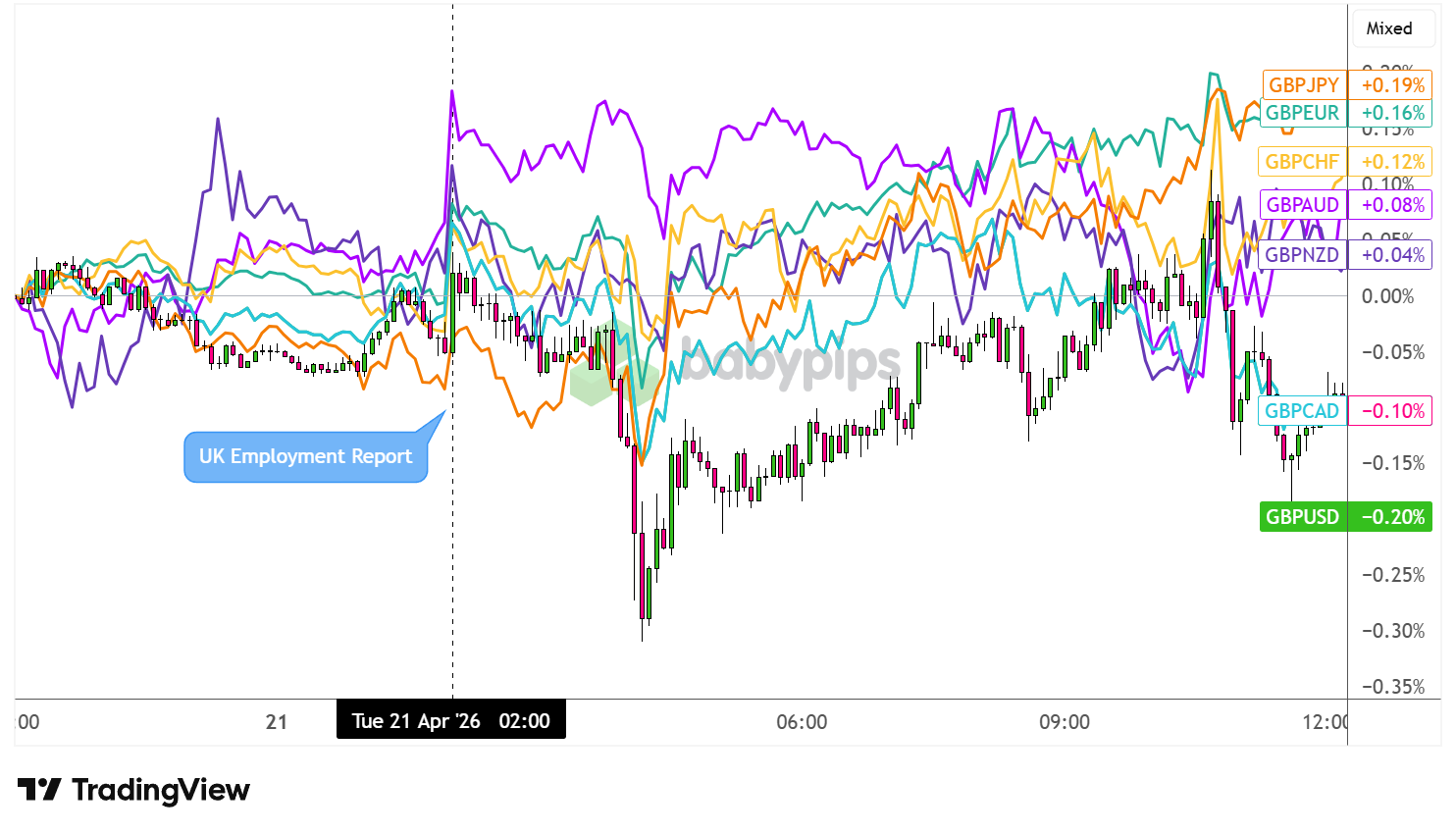
GBP vs. Major Currencies 5-min Forex – Chart Faster with TradingView
However, the U.K. currency quickly faded these gains and found itself on the back foot in the hours that followed, as markets appeared to interpret the underlying labor data as generally downbeat. In particular, falling wages and vacancy levels pointed to more signs of cooling, removing some of the pressure on the BOE to tighten policy.
By the mid-morning London session, most GBP crosses had recovered a portion of the losses. The pound pulled higher against JPY (+0.19%), EUR (+0.16%) and CHF (+0.12%), though it remained in the red against USD (-0.20%) and CAD (-0.10%) while geopolitical uncertainty proved a dominant theme.
Promoted: Softening jobs data and cooling wage growth can send mixed signals that shake traders out of good setups. Staying consistent gets harder when the market story keeps shifting.
Most trading mistakes in these conditions aren’t technical, they’re psychological. In “Trading in the Zone” by Mark Douglas, you’ll learn how to think in probabilities and stick to your plan even when data like today’s U.K. report clouds the picture.
Click on the link to learn more about “Trading in the Zone” by Mark Douglas!
Disclosure: We may earn a commission from our partners if you sign up through our links, at no extra cost to you.